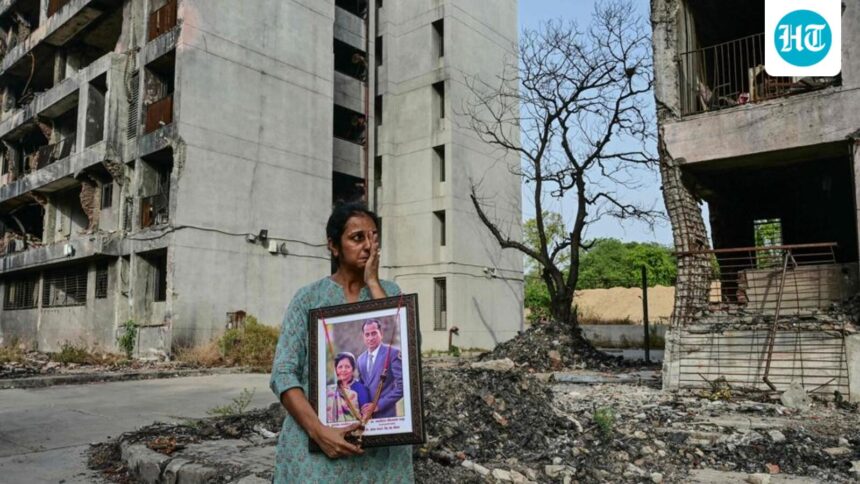
A year after Air India Flight 171 crashed into an Ahmedabad neighborhood, the crash site reflects a slow recovery. Today, the four buildings of Atuliam Lodge remain vacant and dark. Its walls are covered in soot, cracked partitions, broken windows, and exposed concrete. The corridors stand empty and dark. The trees in the complex are still black, and their branches are bare. Grass and weeds dominated the wreckage, and parts of the complex appeared intact as if they had been left in the same state they were in after the accident.

Traces of destruction are still visible. Ashabeen Parmar, a local rag picker, still finds plane fragments on her daily walks. She stands near the most damaged motel building, pulling twisted pieces of aluminum from her bag. Outside the gate, a sign indicates an upcoming prayer meeting on June 12 for Akash Sureshbhai Pattani, a teenager and son of a tea stall owner who was among those killed on the grounds.
On June 12, 2025, just 32 seconds after AI-171 took off from Sardar Vallabhbhai Patel International Airport, it crashed in the area. Of the 260 people who died that afternoon, 19 were on the ground, while one passenger survived the crash.
The immediate horror of the disaster was witnessed by a scientist at the National Institute of Occupational Health (ICMR) (NIOH). After being alerted to the sound of a strong explosion, he rushed up three flights of stairs. From above, he saw the neighboring hostel complex engulfed in flames. Smoke covered the entire area opposite the building, and debris was scattered on the ground.
He went back down and out the gate. He saw a severed head on the ground and its limbs scattered across the campus. Most of those directly affected were killed instantly.
The scientist, who requested to remain anonymous, said: “There was a person on a motorcycle who was involved in the accident. The impact was so severe that he and his bike were burned together, and they were thrown over the wall and fell inside our campus.”
During the incident, one of the wings of the aircraft struck a portion of the ICMR-NIOH campus and damaged the structure, though no one inside the institute was injured.
Institute staff were among the first to join the rescue effort, with about 150 members intervening within minutes. Gloves were distributed to those recovering survivors and bodies from the rubble. Firefighters from the airport were the first to control the fire using carbon dioxide, according to the scientist.
Kishore Thakur, 43, a contractor who lives in Omkarnagar, about 300 meters away, said he reached the site within 20 minutes. He found rescue teams trying to enter the area and directed them through internal access roads. He said he helped rescue three doctors and their families.
“There were cylinders in the hostel. We removed as many of them as we could because they were exploding and aggravating the situation,” Thakur said.
The death toll on the ground could have been much worse had it not been for a clearance campaign in the area several weeks earlier. Both Thakur and Parmar noted that the area was cleared of slum dwellers a month ago, resulting in at least 40 to 50 families being moved away from the impact zone.
Parmar herself was inside the campus minutes before the accident. I moved away from a nearby water kiosk seconds before the plane went down. She said those seconds saved her life.
The incident was followed by weeks of distress for those living nearby.
“We were lucky that no one was injured at the institute though part of the plane hit one of our buildings, which was not seriously damaged. The staff quarters are close to the crash site and residents suffered in the following days. The yagnya was organized for those who died in the accident and for the welfare of the families living in the staff quarters. For a long time, even the sound of planes flying overhead was disturbing people, and it took time for many to return to routine life,” said Modi, Director, ICMR-NIOH.
Air India announced a temporary compensation of $25 lakh to the families of each deceased victim, while the Tata group announced an ex-gratia amount $1 crore to the family of each person who died in the accident. The Gujarat government recently announced plans to demolish the buildings and rebuild the hostel complex at a cost of $103 Crores, with $Rs 53 crore will be contributed by the Tata Group.