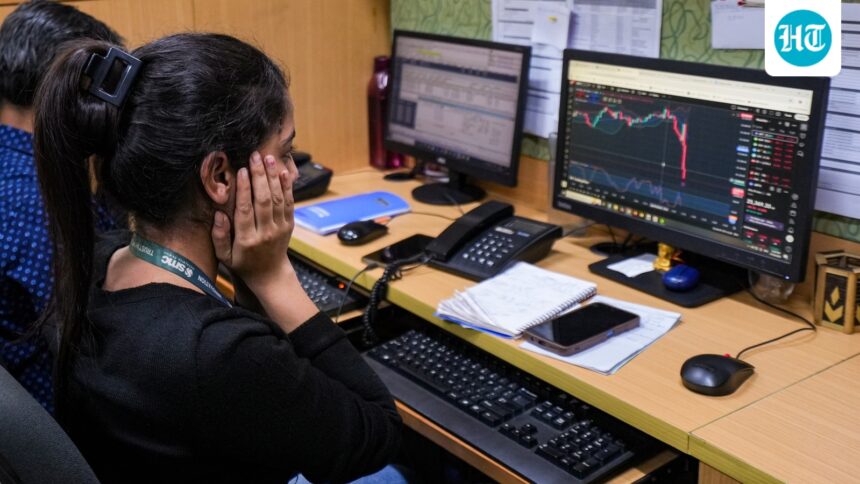
Indian markets ended FY26 on a memorable note, with benchmark indices recording their worst annual performance since the Covid-19 pandemic six years ago. A sharp sell-off in the last trading day capped off the weak end.

The Nifty 50 index fell 5% in FY26, while the Sensex fell 7%, reflecting broad-based weakness across sectors, with the West Asia war, weak rupee and sustained foreign inflows weighing on sentiment.
In contrast, its major Asian peers posted strong gains, with South Korea’s Kospi rising 109%, Taiwan’s TAEX rising 53%, and Japan’s Nikkei 225 advancing 45% in fiscal 2026.
According to Siddharth Bhamre, head of institutional research at Asit C Mehta Investment Intermediate, markets have weathered two major shocks this financial year — tariff and war concerns — yet have held up relatively well, supported by strong liquidity in the first half of the year.
“However, going forward, the ongoing conflict is unlikely to abate quickly, with visible damage to the global economy. Caution has set in, leading to fund outflows and a macroeconomic challenge in India,” Bhamre said. “Rising crude oil prices and supply bottlenecks could push inflation higher, while growth is expected to slow significantly.”
Read also | Rupee crosses $95, bond yield exceeds 7% as Iran war upends India’s financial calculations
On Monday, the last trading day of the year (Tuesday is a market holiday), the Nifty 50 fell 2.14% to 22,331, while the Sensex 30 fell 2.22% to 71,947 – taking the Nifty 50’s losses since the start of the Iran-US war to 11.38%.
The selling was broad-based, with the Nifty Smallcap index falling 2.5% and the Nifty Midcap index falling 2.68%. The BSE market value declined $9.73 trillion. All sectoral indices closed in the red on Monday.
Other Asian markets also fell sharply on the same day, with Japan’s Nikkei 225 down 2.79%, South Korea’s Kospi down 2.97%, and the Hang Seng down 0.87%.
Moreover, foreign institutional investors (FIIs) turned sellers amid the falling rupee, net selling value of stocks. $$1.12 trillion in March, according to the National Securities Depository LLC. In February, purchases by FIIs were net $Rs 17,147 crore.
“Stablecoins are crucial for foreign investors,” said Christy Mathai, fund manager at Quantum Mutual Fund. “If FIIs target returns of X%, a 4-5% currency depreciation significantly reduces returns.”
The rupee, whose value has fallen by 4.23% against the dollar since the start of the war, touched Monday. $94.8. To limit excessive currency volatility, the central bank on March 27 directed all banks to limit their net open positions in the local deliverable market to less than $100 million per business day.
“Uncertainty over crude oil and the currency makes us cautious despite India’s long-term upside potential, and if the situation is prolonged, FY27 earnings could decline further,” Mathai said.
Positioning pressures added to the weakness, with monthly derivatives expirations coinciding with the last trading day of fiscal 2026.
Traders may have reduced their positions due to tax adjustments ahead of the new financial year, said Rajesh Palvia, head of fundamental and technical research at Axis Securities. It is worth noting that the government has increased the STT tax on futures and options by approximately 150%, effective April 1.
Read also | India is forcing banks to back off rupee bets, putting pressure on short sellers
“The upcoming rise in STT, which significantly raises derivatives trading costs, also discourages short-term and low-margin trades, leading to lower position rollovers,” Palvia said.
Technical indicators confirmed the weakness. The Relative Strength Index (RSI) remained below 40, indicating sustained downward momentum, while the advance/decline ratio was just 0.2 – meaning roughly five stocks declined for every one that rose.
The biggest sectoral losers in FY26 were the BSE Realty Index and the BSE IT Index, which fell by 21.1% and 20.9%, respectively. Among the gainers, the Bahrain Stock Exchange Metals Index rose by 20%, followed by the Bahrain Stock Exchange Automotive Index, which rose by 10.6% during the year.
What do the ratings look like?
The Nifty 50 index is trading at 17.3x P/E, 7% below its 10-year average of 18.6x, putting it in historic retracement territory, Elara Capital’s Garima Kapoor said in a March 30 report. “Except for severe disruptions such as Covid-19, this level has typically served as a floor for evaluation,” she added.
Kapoor added that even during the Russia-Ukraine conflict, despite Brent crude holding above $100 per barrel, Nifty multiples have rebounded from the 10-year rolling averages, and thus, “assuming our base case of gradual de-escalation, the current valuation provides a favorable entry point, with limited downside.”