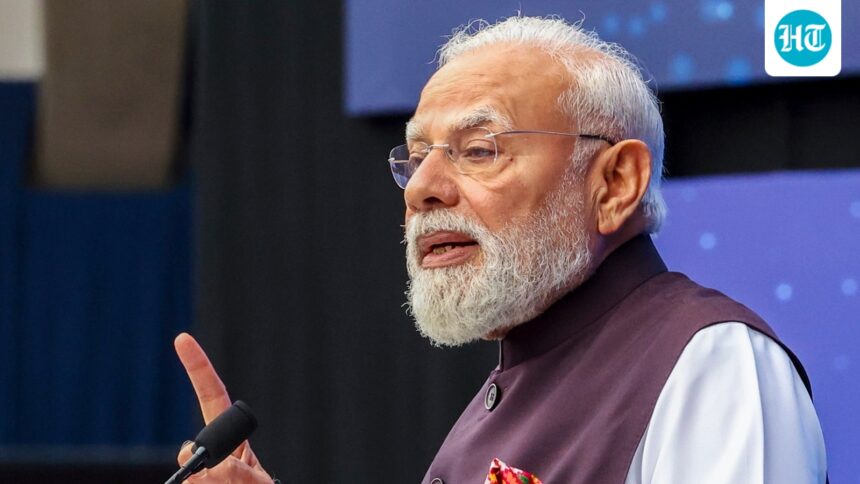
Indian Prime Minister Narendra Modi said on Monday that India hopes the Iran-US peace deal will restore peace in West Asia and ensure freedom of navigation and trade, while welcoming the proposed agreement scheduled to be signed later this week.

Iran and the United States agreed on Sunday to a memorandum of understanding to end more than 100 days of war after negotiations brokered by Pakistan and Qatar. The memorandum of understanding, scheduled to be formally signed in Geneva, Switzerland on June 19, will also end the US blockade of Iranian ports and reopen the Strait of Hormuz.
Modi, who is currently on a visit to Europe, said on social media: “I welcome the understanding reached between the US and Iran on ending the conflict in West Asia, which has caused serious economic disruption across the world and led to loss of lives in many countries.”
He added: “India hopes that the implementation of this understanding will help restore peace and stability in the region and ensure freedom of navigation and trade.” He added: “We look forward to deliberations on the remaining issues to reach a final, sustainable agreement.”
India, the world’s third-largest oil importer and consumer, was severely affected by the war that began on February 28, especially Iran’s closure of the Strait of Hormuz, which is used to transport nearly half of the country’s crude oil needs.
New Delhi has consistently called for a return to dialogue and diplomacy to end hostilities and has supported efforts to ensure the unhindered flow of energy and goods, while adopting a balanced stance in light of its relations with all parties involved in the conflict.
The peace deal between Iran and the United States was first announced on social media by Pakistani Prime Minister Shehbaz Sharif, who has taken a key role in mediating between the two countries in recent months. He added, “The two sides announced an immediate and permanent cessation of military operations on all fronts, including in Lebanon.” “The official signing ceremony will take place on Friday, June 19, in Switzerland.”
Sherif said the mediators will facilitate a “series of meetings” this week to hold “pre-implementation discussions” to lay the groundwork for “technical talks” and the signing ceremony.
Later, Trump wrote on his Social Truth platform: “The agreement with the Islamic Republic of Iran is now complete.” Trump said that the Strait of Hormuz will open on Friday, and that he ordered an end to the US naval blockade of Iranian ports.
Iran’s Supreme National Security Council said in a statement that the war and military operations on all fronts, including Lebanon, “will end immediately and permanently” as of Monday night. Iranian Deputy Foreign Minister Kazem Gharibabadi said that a more extensive agreement, including easing sanctions on Tehran, will be negotiated during the 60-day ceasefire period. The future of Iran’s nuclear program, the most controversial issue, is expected to be addressed in these talks.
Thousands of people have been killed, most of them in Iran and Lebanon, since Israel and the United States attacked Iran on February 28. Iran responded by striking Israel and West Asian countries, such as Kuwait, Oman and the United Arab Emirates, which host US bases, and closed the Strait of Hormuz, sending oil and gas prices soaring.