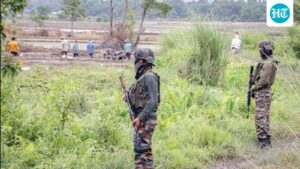
We entered a village in Jalpaiguri located between the Jaldaka River and the Sonakhalu Forest in North Bengal. Before we could speak, a woman asked us: “Are you from I-PAC?”

The question was without hesitation. It was also the most accurate diagnosis of contemporary politics in West Bengal. She didn’t ask what I-PAC was saying, or whether we knew anyone there. I asked are we from her? Confronted with strangers showing up in a remote village to ask political questions, the most plausible explanation was that we belonged to a political consulting firm.
This misidentification tells us something fundamental about how parties interact with voters. This was not possible five years ago. This is now possible because political consulting has acquired an organizational density and on-the-ground presence in West Bengal that has made it indistinguishable from—and in the everyday knowledge of voters, perhaps more important than—the party itself.
What is happening in Bengal contradicts the traditional narrative of the decline of parties in democracies. In his book The Rule of the Vacuum, Peter Mayer described the slow hollowing out of European mass parties as their organizational base eroded. Bengal is not. The local organization of the Trinamool Congress, according to all available evidence, remains strong. Staff are present in the pavilion and the bar (neighborhood). The machine did not disappear, but was functionally repurposed, and a parallel information and mobilization infrastructure was built alongside it.
The starting point for understanding this is the structure of well-being. In his description of Bengal’s ‘party society’, Dwipayan Bhattacharya traces how the Left Front’s organizational form became woven into the fabric of everyday life – a system in which the local party was the means through which claims to the state were made and adjudicated. The TMC inherited this expectation in 2011 and developed it over its first decade. But this detail was beyond a fundamental shift in the form of social care. As Lakshmir Bhandar’s cash transfers, Kanyashree’s, and various direct benefit programs became increasingly global, the local party functionary lost the main source of influence given to him by the older party community: meaningful discretion over who receives what. When the rule is universal, the cadre cannot give differently.
What the cadre retains is the power of inclusion and exclusion from lists, and the power of police participation. In the slums of Titagarh, outside north Kolkata, a resident who works at the local hospital said the local party machine knew which families had not voted for the TMC, and that during a recent intensive special review of electoral rolls, support to those families in navigating documents was withdrawn, while it was given to others across religious lines indiscriminately. The discrimination was not sectarian. He was dependent on the family’s perceived political loyalty, and operated through the gate rather than through the gift. The machine went from distributing to gatekeeping.
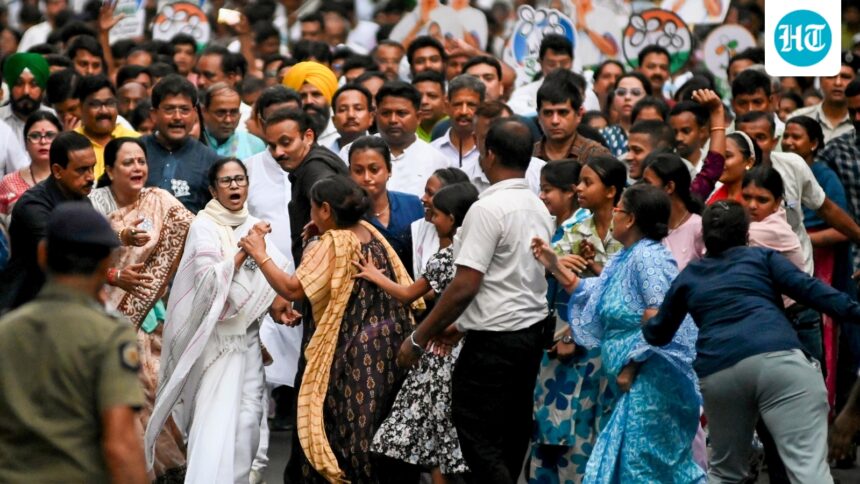
This shift carries a political cost that is now, in 2026, clearly visible. In 2021, across Hooghly, Nadia and North Bengal districts, participating women repeatedly identified themselves with leadership in more personal terms – “We all have Mamata in us,” one woman told us – while, often at the same time, reporting friction with local cadre over money cuts, dada-giri, and differential delivery of benefits. This pattern was a policy in which leadership remained popular precisely while disaffecting the local machine, because machine power was now seen as extractive and punitive rather than provisional.
The leadership’s response to this disease was not internal organizational reform. A parallel structure has been built. Didi ki bolo (Tell Big Sister) directs citizens’ complaints directly to a central office, bypassing the local staff who are the source of many grievances. Sarkar roundabout (Government at your doorstep) The state delivers to the citizen’s doorstep without the need for a local employee to mediate access. Policy consulting was the implementing vehicle for much of this. It would be empirically negligent to attribute these interventions to a single company; What can be said with confidence is that the leadership has become dependent on a parallel infrastructure, separate from the party cadre, to know what is happening on the ground and communicate with voters.
The Bengal case is an important example of a broader phenomenon, whereby leaders, faced with organizational pathologies that they find too costly to address directly, postpone the problem by building parallel structures alongside the party. The cost of postponement lies in the continuation of the underlying problem. The saying of 2021 – “Didi is good, but everyone under her is bad” – returns to the leadership of 2026 as an entrenched anti-incumbency that parallel structures cannot solve, because they were never designed to repair the cadre-citizen relationship.
The other major party faces a related problem of analysis on a different ground. Tariq Thashil’s Elite Parties, Poor Voters documented how the BJP solved its organizational deficit among the rural poor in India’s heartland by relying on service organizations affiliated with the Rashtriya Swayamsevak Sangh, which built a neighborhood party presence without the need for a formal cadre. In Bengal, the social integration of the Sangh was historically weak, and the alternative that had worked in Madhya Pradesh or Uttar Pradesh was not available. What the BJP did in response, by taking control of the central government, was to replace federal institutions with the organizational depth it had not built: the deployment of central armed police, the scheduling decisions made by the Election Commission, the recently completed workflow review and, in the run-up, an expanded interpretation of the governor’s office.
These are not equivalent to private consultations, and the democratic costs are much steeper. But the basic logic is the same. Two leaderships, facing organizational problems that they chose not to solve internally, built parallel structures alongside the party.
The woman in North Bengal was not filing a complaint. She was reading the system she lived in correctly. Her state leadership has built a parallel structure that speaks to her more directly than her local party does. The question this raises is whether parties that postpone their internal problems by building structures on their side are able to do so indefinitely, or whether unaddressed pathology eventually comes back as an electoral cost. West Bengal in 2026 is, in its own way, a test of this question.