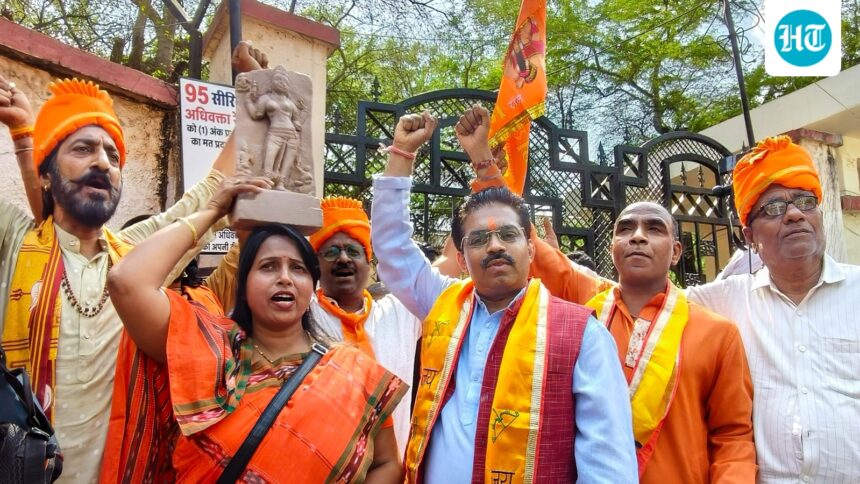
The Madhya Pradesh High Court ruling on the Bhoshala dispute in Dhar disposed of not two but three competing religious claims.

Besides the main dispute between the Hindu and Muslim petitioners, a separate petition filed by a member of the Jain community claimed that the site had always been a Jain temple, and that the deity at the center of the dispute was not the Hindu goddess Saraswati but the Jain goddess Ambika.
The court granted the site to the Hindu site as a temple, and also rejected the Jain petition. In doing so, she made the observation that Jainism is “actually a branch of Hinduism.” The court cited two legal texts to illustrate this point.
Read also | Ayodhya 2.0: Bhojshala Hindu temple, MP HC rules; He cites the principles of the Supreme Council in adjudicating the noon dispute
What Petitioner Jain said
Salik Chand Jain, who sought relief for the community, filed his petition through advocate Dinesh P Rajbhar. It was one of a host of related pleas that the Indore bench of the High Commission was hearing. His case was based on an inscription dating back to 1091 on an idol found in the Bhoshala complex. It is claimed that this idol is now in the British Museum in London. Some initially read the inscription as referring primarily to Vagdevi, another name for Saraswati.
But later academic work, including Sanskrit scholar and Prakrit scholar Harivalabh Bhayani, has said that the main subject of the inscription was Ambika, the Jain goddess, according to the appeal.
The inscription, which was translated and cited by the court in its 242-page judgment, reads: “Vararochi, King Bhoga’s religious superintendent of the Kandranagari and Vidyadari branches of the Jain religion…having first formed the maternal Vajdevi and later the trinity of Jainas, made this beautiful image of Amba.”
On this basis, the petitioner argued that the deity was a Jain, and the site was originally a Jain temple and center of learning; In addition, the architecture of the complex resembles the Jain temples at Mount Abu in Rajasthan.
He also objected to the 2003 ASI order regulating worship at the site. It granted access to both Hindus and Muslims but completely excluded the Jain community which, according to the petition, has a strong historical claim.
However, the petitioner did not seek exclusive ownership of the building. His lawyer explained that the prayer was limited to recognizing Jain heritage at the site; Permission for Jain devotees to worship there; The return of the idol from London.
What did HC say?
A bench of Justices Vijay Kumar Shukla and Alok Awasthi examined the images of the idol and the inscription. In its ruling, it held that the sculptor Vararuchi “made two pratima (idols), one for Vagdevi and the other for Amba. Both figures represent the divinity of Saraswati.”
The court also noted that the figures of Ganesha and Durga seen around the Vagdevi idol were explained through Hindu iconographic traditions, adding that these deities are worshiped together across Hindu traditions.
Regarding Jain idols appearing alongside the main deity, the court said, “The presence of a Jain Tirthankara or ‘sadhak’ or an ascetic seated in ‘padmasana’ in the background of the Hindu statue of Goddess ‘Saraswati’ is quite natural, since Jainism is in fact a branch of Hinduism.”
The court also said: “In India, Jainism and Hinduism are not separate entities. Although the rituals of worship in these two religions may differ, both religions have developed side by side since ancient times, worshiping the same Supreme Being. As a result, idols belonging to the Jain and Hindu traditions are often found within their respective temples.”
The ruling noted that under Section 2(1)(a) of the Hindu Marriage Act, 1955, and Section 2(1) of the Hindu Succession Act, 1956, Jainism and Buddhism are considered part of Hinduism. She considered that the discovery of a Jain Tirthankara idol during excavations at the site was not a “surprise.”
However, it may be noted that the Government of India officially notified Jains as a national religious minority in 2014 under the National Commission for Minorities Act, 1992.
Why was the claim denied?
The court’s grounds for rejecting the Jain rights petition were clear and straightforward: “None of the historical, archaeological and ASI surveys indicated that the disputed area was a Jain temple. Even if the submission…that the idol might be that of Ma Ambika is accepted, his claim that the disputed area is a Jain temple cannot be accepted. Whether the idol is of Saraswati or Ambika would not help much in his claim that the disputed area was a Jain temple.”
The court did not issue any directions regarding Jain access to the site, preservation of Jain relics in the complex, or retrieval of the idol itself from London.
What the referee said is one of the main claims
The ruling essentially allowed petitions filed by the Hindu Front for Justice and others, declaring the religious character of the disputed complex to be Bhojshala and the temple of Goddess Vajdevi (Saraswati).
The 2003 ASI order regulating Hindu worship and allowing Friday prayers was revoked. The petitions filed by Maulana Kamaluddin Charitable Society and Qazi Zakaullah were dismissed along with Jain’s petition.
The court ordered ASI to retain administrative control over the protected monument and asked the state government to consider allocating suitable land in Dhar area for the Muslim community to build a mosque, if a request is made for the same.
The lead counsel who argued for declaring Bhojshala as a Hindu Saraswati temple was advocate Vishnu Shankar Jain, and Union of India and ASI were represented by Sunil Jain, Additional Solicitor General/
Madhya Pradesh said it was dealing with the conflict “not from the point of view of any particular religion, but from the perspective of ensuring peace, order and effective administration.” The ASI findings, historical records and archaeological evidence were placed before the court, all pointing to the pre-existing Saraswati temple, and compiled the Ten Principles of Ayodhya Governance which the court eventually adopted.