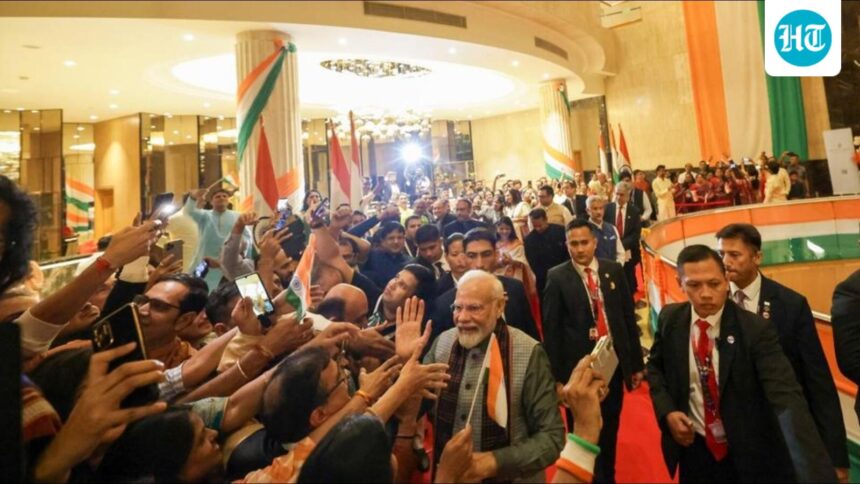
When Prime Minister Narendra Modi arrives in Jakarta in July, most Indians will witness a familiar diplomatic event – another country visit, another set of agreements, another joint statement. Yet what is quietly taking shape in the Indonesian archipelago may represent something far more important to India’s long-term strategic interests: the first large-scale international deployment of India’s digital public infrastructure model in a major emerging economy.

Indonesia deserves much more attention in India than it currently receives. It is the world’s fourth-most populous country, with a population of 280 million, the largest economy in Southeast Asia, and the third-largest democracy on Earth. Its GDP has grown by about 5% annually for two decades, its middle class is expected to reach 140 million people by 2030, and its digital economy is on track to reach $194.5 billion in e-commerce alone by that year. Indonesia is located on the most important maritime trade routes in the world, is a founding member of the Association of Southeast Asian Nations (ASEAN), and enjoys strategic influence across the Indo-Pacific region that India cannot ignore. Yet, for much of modern history, this idea has remained strangely marginal to the public imagination in India.
But this is changing now, and the reason is digital infrastructure.
Today, Indonesia is experiencing a strategic recalibration. As the country seeks to achieve greater economic sovereignty, it is simultaneously working to strengthen ties across multiple centers of global power. China remains central to manufacturing and industrial investment. The United States and Western partners continue to play important roles in market access and geopolitical balance. Europe is becoming increasingly important for technology and important minerals. The Middle East offers sovereign investment partnerships and food security. However, India is emerging as Indonesia’s partner of choice in digital public infrastructure – the foundational technology layer that will determine how 280 million Indonesians access trade, finance and government services in the coming decades.
This is no small thing. This is arguably the most strategically significant bilateral opening that India has seen in the Indo-Pacific region in a generation.
When President Prabowo Subianto visited India in January 2025 as the chief guest at the Republic Day celebrations – marking the 75th anniversary of diplomatic relations – the two governments elevated digital cooperation as a key pillar of their relationship. The joint statement recognized technology, digital transformation and public digital infrastructure as key enablers of future economic growth. This commitment has since moved from declaration to action. In March 2025, a 10-member high-level delegation from the Indonesian National Economic Council traveled to India specifically to study the Digital Public Infrastructure (DPI) policy framework. An official memorandum of understanding on digital cooperation was also signed during the visit and is now being activated.
The most visible outcome of this partnership is a project that Indians should be watching closely: the Indonesia Open Network, or ION. ION, directly inspired by India’s Open Network for Digital Commerce (ONDC) and built on the open Beckn 2.0 protocol, is expected to celebrate its first live transaction during the Modi-Prabhu summit on July 7.
ION is not a market. It is a neutral digital railway – connecting buyers, sellers, logistics service providers, payment systems and financial institutions through a common, interoperable ecosystem, modeled on the same open protocol philosophy that underpins India Stack.
The scale of the problem ION is designed to solve tells you everything about why it matters. Indonesia has more than 65 million micro, small and medium enterprises, which are the backbone of its economy. However, many are still excluded from the full benefits of digital commerce. Platform commissions and fees often range between 25 and 40% of the transaction value, depriving small vendors, farmers and cooperatives of the gains of the digital economy. ION seeks to reduce this to less than 8%.
As T. Koshy, former managing director of Indonesia’s National Development Office and now a consultant for digital commerce initiatives in Indonesia, has argued, “Open networks work because they democratize rather than centralize opportunities.” This principle, pioneered by India, is now being exported on a large scale for the first time to the country with the largest economy in Southeast Asia. Sandeep Chakravorty, India’s ambassador to Jakarta, recently noted that “open digital networks could give Indonesia the structural leverage it needs to achieve its 8% growth ambition – by expanding markets for millions of small businesses that remain productive but are geographically and digitally constrained.”
The second initiative with huge implications for Indian businesses and travelers is the proposed integration of the Unified Payments Interface (UPI) with Indonesia’s QR Code Payment System (QRIS). For Indians, the Quality Rating System (QRIS) is worth understanding. It is Indonesia’s national interoperable QR payment standard – which was launched in 2019 and is now among the most successful digital payment systems in emerging Asia. By the end of 2025, QRIS had reached 59 million users and 42 million merchants, and processed 13.66 billion transactions over the course of the year – more than double its original target. The QRIS Cross-Border system is already operational in Thailand, Malaysia, Singapore and Japan. Bank Indonesia is actively exploring formal integration with UPI.
For Indian companies with business or investment experience in Indonesia, and for the estimated 1.7 million Indian tourists who visit Bali and other Indonesian destinations every year, the direct UPI-QRIS corridor will be transformative. Besides convenience, it would create the basis for a bilateral digital trade corridor of the kind that has no real precedent in India’s regional relations. As Dr. Bayu Prawira Hee, a leading Indonesian digital transformation expert, recently noted, “Interoperability is no longer a technical issue; it is an issue of economic leverage.”
The third area of cooperation may be of greater importance in the long term. Protean e-Gov Technologies in India – one of the architects behind India’s foundational DPI layers, which include digital identity, eKYC, e-signatures, tax modernization, pensions and open digital commerce – is exploring opportunities to support Indonesia’s DPI ambitions at the infrastructure layer. Indonesia’s National Economic Council, under the Nusantara Digital Initiative, has set out to build a unified, interoperable and scalable national digital infrastructure. The similarities to India’s digital journey a decade ago are striking – and it creates a real opportunity for Indian tech companies, not just as vendors, but as architects of a sovereign digital nation.
Indonesia’s Ministry of Communications and Digital Affairs has clearly expressed its ambition to make Indonesia a producer and exporter of digital solutions across ASEAN, rather than just a consumer.
“Indonesia’s long-term competitiveness depends on developing sovereign digital capabilities rather than importing platforms wholesale,” said Ilham Habibie, CEO of the National ICT Council and President of the Indonesian Institute of Engineers. This is ambitious India understands it instinctively – an ambition that Indian expertise, built on a decade of hard-earned experience with Aadhaar, UPI, ONDC and DigiLocker, is uniquely positioned to help.
The fourth initiative addresses the capital market modernization agenda in Indonesia. Discussions are currently underway with the participation of Indian technology companies and institutions associated with the Bombay Stock Exchange ecosystem to explore AI-powered market surveillance, integrity solutions, and digital investment platforms for Indonesian stock markets. India faced very similar governance and transparency challenges in its capital markets three decades ago, and responded by rebuilding them through technology and automation. This experience has direct commercial importance in Jakarta today.
For Indian readers, the bigger picture is this: India has spent a decade and billions of dollars building the digital public infrastructure that the world is now beginning to recognize as a real alternative to the closed platform models exported by the US and China. The Modi-Prabowo summit in July 2026 represents the most important test yet of the extent to which this model can be transferred to a large, complex, and strategically important partner economy.
Indonesia is not a passive recipient of this story. It is a sovereign democracy of 280 million people, with its own digital ambitions, its own institutions, and its own geopolitical choices. The fact that it has chosen to orient its core digital infrastructure toward the Indian model – rather than adopting a range of Chinese or Western platforms – constitutes a strategic signal that deserves far greater recognition in New Delhi than it has received.
If the twentieth century connected countries through shipping lanes and trade routes, the twenty-first century will increasingly connect them through digital railways. For India, the opportunity in Indonesia is not just diplomatic. It is an opportunity to demonstrate that open, inclusive and sovereign digital public infrastructure is not just a development tool but an exportable model – one capable of reshaping the economic structure of the Indo-Pacific region from the ground up.
The bridge being built between Jakarta and New Delhi may not make headlines tomorrow. But its foundations, quietly laid in open protocols, payment integrations, and shared digital infrastructure, could prove to be among the most lasting strategic investments made by either country this decade.
(Sachin V. Gopalan is the founder of the Indonesian Economic Forum. Opinions expressed are personal)