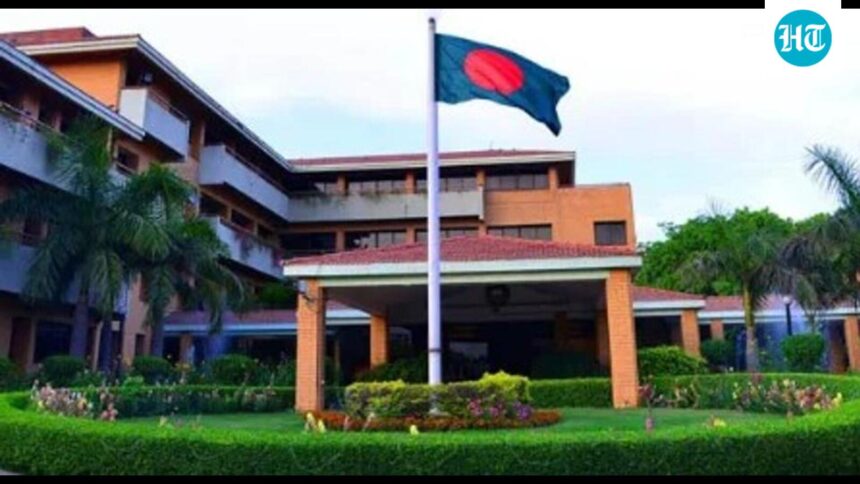
The Bangladesh government’s decision to appoint two journalists who have been highly critical of India as official spokespersons at its missions in New Delhi and Kolkata has raised eyebrows in diplomatic circles, especially as the move comes at a time when the two countries are engaged in a delicate process of rebuilding their strained relations.
Saeedur Rahman, the political editor of the Bengali daily Ittefaq who was appointed as spokesperson for the Bangladesh High Commission in New Delhi, and Om Maruva, a special correspondent for television network News24 who was appointed as spokesperson for the Deputy High Commission in Kolkata, made derogatory posts on social media about India and its government, people familiar with the matter said.
By Tuesday, the two journalists had deleted several social media posts after the official announcement of Rahman’s appointment on a one-year contract by the Bangladesh Ministry of Public Administration.
One person said: “The choices made by the Bangladeshi side are strange, especially since the two sides are now focusing on rebuilding their relations after the great tensions witnessed in the past two years.”
Another person said: “Maybe the new government in Dhaka thinks the two candidates it has chosen are more suitable for its approach.”
In a Bengali-language Facebook post in December 2024 in response to a letter from the Indian Prime Minister congratulating Bangladesh on Vijay Diwas, Rahman asserted that India had no role in Bangladesh’s liberation war, and that complete freedom for Bangladesh came with the end of India’s “slavery” in August 2024 — a reference to the student-led protests that toppled the government of former Prime Minister Sheikh Hasina.
In another social media post in February 2025, Rahman linked India to the February 2009 mutiny by members of the Bangladesh Rifles, a paramilitary force now known as the Bangladesh Border Guard. In other social media posts, Rahman claimed that India was behind the excesses committed by the Hasina government and even made a baseless claim that India had a hand in the assassination of BNP founder Ziaur Rahman.
Marova’s social media posts relate to support for forces in Bangladesh that New Delhi considers extremist, and promote narratives deemed hostile to India’s strategic interests, including controversial claims about the northeastern states bordering Bangladesh.
Unlike Indian missions where the position of spokesperson is usually held by an Indian Foreign Service officer, Bangladesh has long had a policy of political appointments to the position. Over the past decade, this position in New Delhi has traditionally been held by journalists.
The Bangladesh High Commission’s last spokesman, Faisal Mahmood, had drawn the ire of the Ministry of External Affairs for his actions, including commenting on India’s internal politics on Bangladeshi television channels while serving in the position. The Bangladesh government canceled Mahmud’s contractual appointment in February.