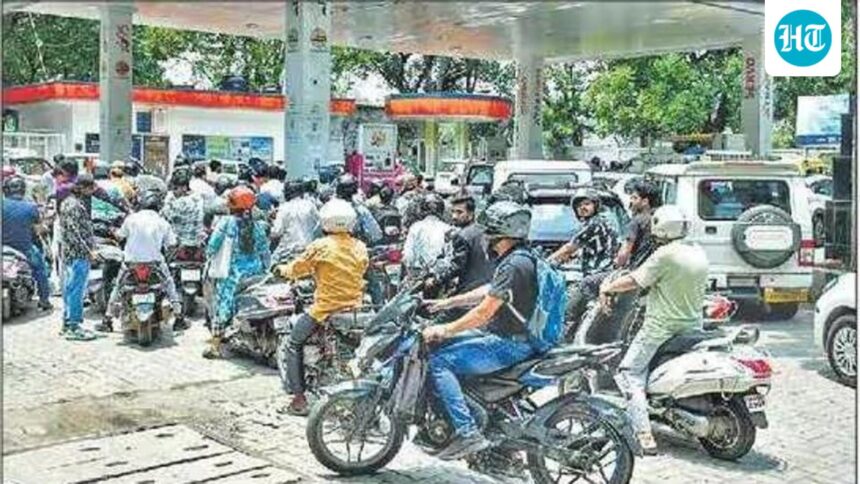
The government has banned petrol pumps from selling motor fuel to bulk users and capped diesel sales to 200 liters per vehicle per day to check state-run oil companies’ revenue losses even as the global price of crude oil fell below $86 a barrel on Friday, amid hopes for a peace deal between the US and Iran.

Triggering the Essential Commodities Act (ECA) on June 11, a government order barred industrial and commercial customers from purchasing petrol or diesel from retail outlets (ROs) and directed them to fulfill their fuel requirements from their consumer pumps. Bulk users include state government transport companies, IT parks, shopping malls, industrial units and defense units.
The sale of diesel is particularly regulated. “Retail outlet dealers should distribute HSD [high speed diesel or diesel] “Only in a vehicle tank, or PESO approved containers, not exceeding 200 liters per day to the customer/vehicle and this HSD cannot be resold,” the notification said.
The order is issued and takes effect immediately for a maximum period of three months.
Officials and executives of state-run oil marketing companies, on condition of anonymity, said the move was aimed at ensuring the availability of petrol and diesel to genuine customers and verifying diversion of motor fuel due to the huge price difference between the pump price and the wholesale price. Diesel price $95.20 liters delhi pumps price $134.50 liters in bulk.
While gasoline sales in bulk are limited, they are about to be $3-6 per liter is more expensive at pumps operated by private companies. As on June 8, when the international benchmark Brent crude oil price was at $97.25 a barrel, state-run international oil companies were losing ground. $6 per liter revenue on gasoline and $30 on diesel.
However, news of the potential truce sent Brent crude falling to $85.89 per barrel during intraday trading, down more than 28% from a peak of around $120 per barrel on March 9.
This is the latest in a series of measures taken by the government to ensure regular supply of fuel – petrol, diesel and cooking gas to citizens despite massive disruptions in the supply chain since the outbreak of war in West Asia on February 28. Some of the measures included priority in supplying liquefied petroleum gas to more than 330 million families by legalizing sales to commercial entities and exempting from customs duties on ethanol at a rate of up to 30% when mixed with gasoline.
India, which imports more than 88% of the crude oil it processes and pays in dollars, has also intensified exploration and production work in local sedimentary basins.
After Home Minister Amit Shah’s intervention, the decades-long interstate impasse between Nagaland and Assam over oil and gas exploration areas was resolved.
In Shah’s presence, a tripartite memorandum of understanding was signed involving the central government, the states of Assam and Nagaland to facilitate mineral oil operations.
A government statement said, “The two countries have decided that they will not allow any obstacle to oil exploration in India, but will move forward on the path of mutual cooperation, as these resources constitute a national wealth.”