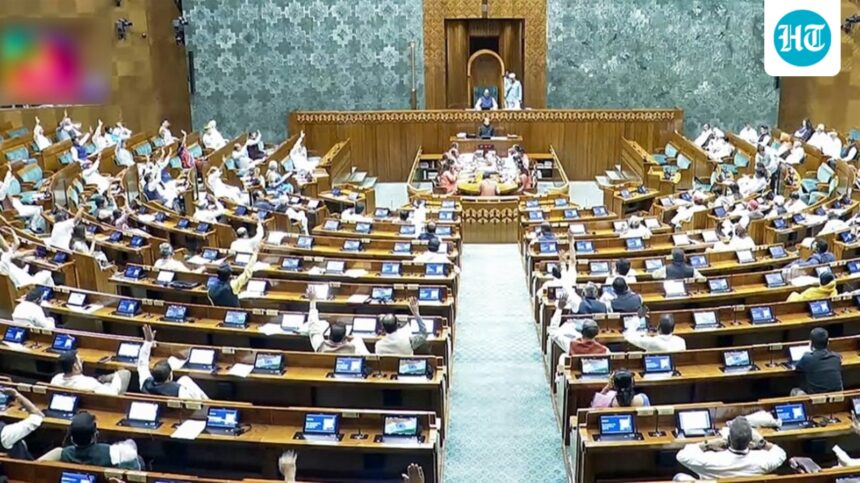
The BJP-led Central government has proposed increasing the number of Lok Sabha seats up to 850 as part of efforts to implement reservation for women in the House from 2029 elections. According to the draft law seen by Hizb ut-Tahrir, 815 seats have been proposed for states and 35 seats for union territories.

The government proposes to increase the number of Lok Sabha seats from 543 to 850 by revising Article 81. It also says the population to which seats will be allocated will depend on the latest census data, as decided by Parliament.
The government is looking to move the Constitution Amendment Bill to implement 33% reservation for women in Lok Sabha from 2029 in a special session of Parliament on April 16-18.
This special portion of the Budget session was held to amend the provisions of the Nari Shakti Vandhan Adhinyam Act, 2023, and the proposed delimitation bill. While the Nari Shakti Vandhan Adhinyam Act was passed in 2023, the reservation was scheduled to come into force only after the ongoing delimitation and census exercise, but now it can be linked to a population census from the past, which is 2011 in this case.
Prime Minister Modi calls on parties to support the amendment
Prime Minister Narendra Modi had earlier called on all political parties to support “collective action” to ensure the reservation takes effect by 2029. “From April 16, a historic debate related to Nari Shakti Vandhan Adhiniyam is scheduled to take place in Parliament,” Modi wrote.
During an event in Dehradun, the Prime Minister said that after four decades of anticipation, Parliament has passed the Nari Shakti Vandhan Adhinyam Bill to ensure 33 per cent reservation for women in the Lok Sabha and state assemblies.
Read also: Pressure to introduce women’s quota in line with opposition demands: PM Modi
“Let all political parties come together and advance this work regarding the rights of the sisters and daughters of the country with unanimous consensus,” the Prime Minister said.
The special session comes at a time when Lok Sabha elections are scheduled to be held in 2029, followed by the ongoing state Assembly elections. Speaking about this, the Prime Minister said that it is Nari Shakti’s “wish” that it be implemented before 2029.
Also read: Congress is pushing for reservation for women in the current Lok Sabha seats
The opposition expresses its concern
Meanwhile, opposition parties have expressed concerns over the proposed delimitation bill, claiming that it will limit the representation of southern states in the Lok Sabha.
Opposition parties also objected to the government’s “rushing” the draft law before conducting the general census.
Alleging that the Center is “demolishing” the constitutional amendment, Tamil Nadu Chief Minister M K Stalin said the amendment is being passed without proper consultation with the states. He said Tamil Nadu would unleash widespread unrest if the state’s interests were damaged or if southern states were disproportionately affected.
Speaking about the bill, Congress leader Sonia Gandhi claimed that the real issue is not women’s reservations at all, but the demarcation practice that is combined with it.
“The real issue is demarcation, which, based on informally available information, is extremely dangerous and an assault on the Constitution itself,” she wrote in an article for The Hindu.
She said demarcation should only be done after a fresh census, as has always been done, and warned that it could hurt smaller, southern states like Tamil Nadu and Kerala.
Sonia Gandhi also questioned the timing of the government’s change of position from 2023, suggesting there is a “political narrative” behind it.