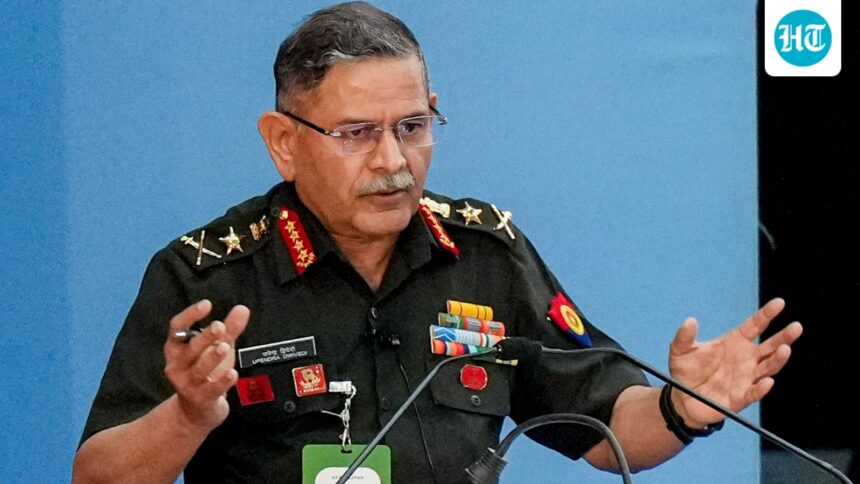
India’s Operation Sindoor was planned and executed not only meticulously but also with carefully thought-out timing, Indian Army Chief Upendra Dwivedi said, revealing that the armed forces deliberately avoided striking terror hubs during prayer hours.

Explaining operational flexibility, he said: “When we were preparing to hit these targets, the timing could have been two o’clock, four o’clock, or any o’clock.” But he added that the forces deliberately retreated at certain times.
“We made sure that we would not act at a time when people on the other side might be praying in terrorist camps,” he said.
Dwivedi summed up this approach by saying: “Sabka malik ek hai (There is one God for all). That is why we chose the time when we knew that such prayers would not take place.”
The army chief was referring to the military operation that began in May last year after the April 22 terrorist attack in Pahalgam district of Jammu and Kashmir that killed 26 people, most of them tourists. The attack saw Pakistan-backed terrorists storm a popular tourist valley, leading to a rapid Indian military response that targeted terror launch pads across the Pakistani border and the Pakistan-occupied Kashmir areas.
Pakistan responded with a sharp escalation in the days following Operation Sindoor, launching drones and carrying out bombing operations. Within about a week, Islamabad sent swarms of drones towards India, most of which were successfully intercepted in the air, although some caused damage in areas along the border.
As losses mounted in Islamabad, Pakistan’s Director General of Military Operations reached out to his Indian counterpart and the two sides agreed to effectively cease all military actions – on land, air and sea – on May 10, 2025.
A “specific case study” in modern warfare
On Thursday, Dwivedi described the operation as a turning point in India’s military development.
He was speaking at the ‘Ran Samvad’ forum in Bengaluru, when he said: “Operation Sindoor has been India’s most powerful tool to move towards domain consolidation. But we need to achieve domain integration and fusion,” news agency PTI reported.
The Army Chief also noted the growing importance of non-kinetic operations, adding that a significant portion of the efforts went beyond the battlefield.
He said: “15% of our efforts were in managing the disinformation campaign,” highlighting the parallel information war that accompanied the military action.
He added that after the operation, the army moved to strengthen its capabilities in this field, including establishing an information warfare organization and a psychological defense department.
However, Dwivedi cautioned that challenges remain, particularly in synchronizing actions across strategic, operational and tactical levels.
“These are usually below the conventional military threshold, with the aim of exploiting an opponent’s weakness,” he noted, warning that such gray zone tactics are becoming increasingly important in modern conflicts.