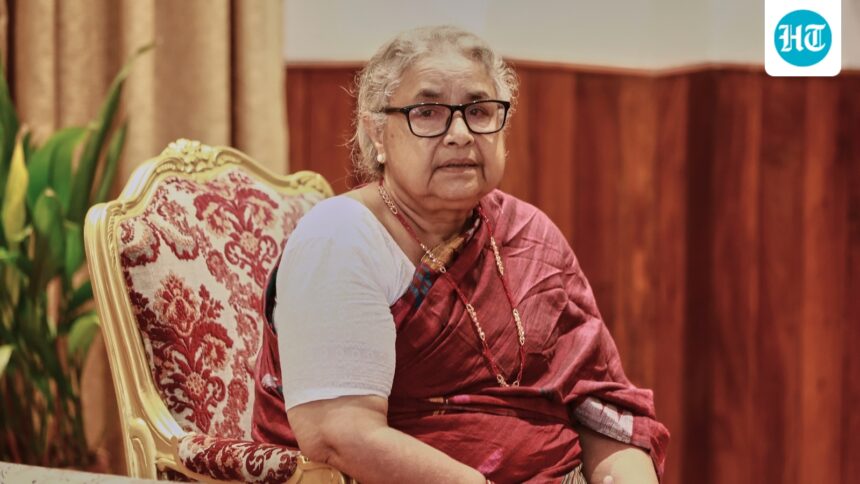
Sushila Karki, former Chief Justice of the Supreme Court, rose to a leadership position at the age of 73, as an anti-corruption figure. “Chaos does not bring happiness,” say Generation Z and others.

These images were seared in the world’s memory in just 72 hours, amid fear and dread over what happened in Nepal in September 2025. The parliament building in Kathmandu was set on fire. The Prime Minister’s residence was looted and set on fire. Military helicopters were seen evacuating ministers from besieged homes.

All of this was immediately sparked by the ban on Instagram; Although years of popular discontent with entrenched elites served as fuel. Most of the protesters were from “Generation Z,” the popular culture name for those barely 30 or younger, born roughly between 1997 and 2012.
And at the end of it all, a 73-year-old former judge – who later fondly recalled her student days in peace beside the Ganges – was chosen to lead the nation.
Sushila Karki was sworn in as the 42nd Prime Minister of Nepal on September 12, 2025, becoming the first woman in the history of the Himalayan Republic to hold the position. A former Chief Justice of Nepal, she became Nepal’s leader as a direct result of the most violent political unrest the country has seen in a generation.
Its rise was driven by discord and it decided on Discord, the latter being the name of a gaming communications platform.
Read also | Social media is at the heart of the Gen-Z revolution that toppled Nepal’s government
The ban that lit the fuse
This spark may have been gathering for years, thanks to Nepal’s chronic political instability: 14 governments in 17 years under eight different prime ministers since the monarchy was abolished in 2008. And corruption was endemic. The youth unemployment rate reached about 20%, and the government estimates that more than 2,000 Nepali youth leave the country every day in search of work abroad.
Then, on September 4, 2025, Prime Minister KP Sharma Oli’s government suspended 26 social media platforms including Instagram, Facebook, YouTube, WhatsApp and X, for failing to register with Nepalese authorities under a controversial new digital law.

By the morning of September 8, thousands of young protesters, many still wearing school uniforms, gathered at Mitighar Mandala in central Kathmandu and marched toward Parliament. Their complaints were broader than just one law or Instagram as a social lifeline.
They raised slogans against corruption, nepotism and the so-called “Nibo kids”, the children of ruling class politicians who flaunt lavish lifestyles on social media even as the platforms have been blocked from ordinary citizens.
Analysts said the Oli regime banned social media to stop all group talk about nepotism, among other reasons. The ban brought the groups and the conversation to the streets instead.
The government responded with security forces opening fire on the crowd, killing 17 protesters in Kathmandu alone. Two others were killed in police actions outside the capital. Hundreds were injured. Doctors at the Kathmandu morgue, which received 47 bodies over two days, determined that most of them died from high-velocity gunshot wounds to the head, neck, chest or abdomen.
The killings were documented in real time on social networks after the ban was late lifted. By then, it had turned into a massive fire.
The next day, Kathmandu burned, with the Parliament building, the Supreme Court complex, the prime minister’s and president’s residences, police stations, and the headquarters of KP Oli’s Communist Party being targeted.
By the time the army imposed a nationwide curfew on September 10, more than 70 people had died and more than 2,000 were injured. A government commission later estimated the damage to Nepal’s $42 billion economy at more than $586 million.
Before this, on September 9, with the persuasion of Nepal Army Commander General Ashok Raj Sigdel, KP Oli submitted his resignation as Prime Minister to President Ramchandra Poudel. “Given the exceptional situation in the country, I submitted my resignation to facilitate the solution of the problem,” he wrote.

Strife, the army, and the septuagenarian as a leader of Generation Z
This was not the end of Nepal’s most violent and difficult reckoning since the Maoist civil war, from which Oli and others such as rebel leader Prachanda emerged as mainstream politicians.
The organization at the heart of the protests, Hami Nepal, held a virtual meeting on the messaging app Discord — a platform originally designed for gamers — where an estimated 10,000 Nepalis, including members of the diaspora spread across the globe, discussed and voted on who should lead their country.
Sushila Karki’s name emerged from a shortlist of five candidates. General Sigdel served as a crucial bridge between the Generation Z leadership, the Office of the President, and the political parties, resolving sharp disagreements over the constitutional mechanism through which Karki could be appointed.
On September 12, President Poudel dissolved the 275-seat parliament on Karki’s recommendation, and administered the oath of office at a ceremony at the presidential residence, Sheetal Niwas, attended by youth representatives, foreign diplomats and UN officials.
The next election was later announced as 21 March 2026. Procedurally, this was two years earlier than would have been the election date if Oli’s government had finished its term.
Read also | Sushila Karki’s journey from the first Chief Justice of Nepal to the first Prime Minister of Nepal
The irony of Sushila Karki’s leadership is not lost on commentators.
The movement, which has complained loudly about the generation gap between itself and Nepal’s elderly rulers, has chosen a 73-year-old man to lead its revolution. But Anish Ghimire, a journalist who was 24 at the time, offered an explanation to Al Jazeera: “People wanted someone they could trust, someone they could look up to. I think the bigger picture is that Gen Z protesters rallied behind the septuagenarian Sushila Karki, because, even in her earlier statements to the press, her image as the first female chief justice of Nepal’s Supreme Court symbolized integrity and resistance to corruption.”
A judge who will not be bought
Perhaps he was referring to Karki’s autobiography. She was born on June 7, 1952 in Biratnagar, eastern Nepal, and was the eldest of seven children. She earned a master’s degree in political science from Banaras Hindu University in Varanasi, India, in 1975, before returning to Nepal to study law at Tribhuvan University and then starting practice in Biratnagar in 1979.
She joined the People’s Movement Against Absolute Monarchy in Nepal in 1990 and was briefly imprisoned in Biratnagar Jail for it. That experience later inspired her 2019 novel Kara (Prison).
She has risen through the judiciary over decades, and in July 2016 made history as the first woman to be appointed Chief Justice of the Supreme Court of Nepal.
Her tenure was short and turbulent. When the Supreme Court overturned the government’s appointment of the preferred police chief and chose the highest-ranking officer instead, Parliament responded with an impeachment motion that was widely described as “politically motivated.” The UN High Commissioner for Human Rights said at the time that the attempt to remove her raised “serious concerns about the government’s commitment to transitional justice and the rule of law.”
The proposal was eventually withdrawn under public pressure. Karkey retired in June 2017. It was precisely this history and reputation that made her an unlikely champion of the Generation Z movement.
In her first public statements after being sworn in, Karki said: “I did not reach this position because I sought it, but because there were voices in the streets demanding that Susheela Karki be given responsibility.”
Briefing diplomats in October 2025, Karki said in one of her most specific statements about her role: “This apolitical transitional government has one non-negotiable mandate: to hold free, fair and impartial general elections for the House of Representatives on March 5, 2026. We are committed to a maximum term of six months, after which we will hand over power peacefully to a democratically elected government. We are not here to pursue a political agenda, but to pave the way for a law.” New and legitimate.”
India Connection
Karki’s appointment was met with immediate welcome in India, Nepal’s closest cultural neighbour, which has faced some hostility from Kathmandu and sections of the Nepalese population over the past few years.
Prime Minister Narendra Modi, who represents Varanasi in Parliament, congratulated Karki and called her appointment a “shining example of women’s empowerment.”
In an interview before taking oath, Karki spoke in English and Hindi about her love for India. “Indians treat me like a sister. I greatly admire Indian leaders,” she said, addressing Modi directly, “Main Modi ji ko namaskaar karti hoon.” (“My regards to Mr. Modi”).
I remembered the Ganges fondly. Her hostel at BHU was located on the riverbank, and she and her peers would sleep on the roof terrace on hot summer nights. “I still remember my teachers and friends,” she said.
On September 18, in an official phone conversation between the two prime ministers, Karki reiterated that elections remain her government’s top priority, and that the historic ties between Nepal and India “will continue to be strengthened through the multifaceted people-to-people ties.”
In the following months, India experienced a different kind of engagement with Nepal, one related to the specter of a Generation Z revolution. Police and government agencies described political demonstrations in Ladakh, Assam and Delhi as “attempts to organize a Nepal-like protest.” Activist Sonam Wangchuk from Ladakh remains in prison.
Transformation under Karki, Bangladesh comparison
Karki quickly declared those who died in the protests “martyrs”; She visited injured demonstrators in hospitals; Compensation announced.
Its government included reformist figures. It also established a judicial commission of inquiry to investigate killings and destruction of public property, and established a Reconstruction Fund to rebuild government infrastructure.

With elections now being held, the stark reality is back in the spotlight. Nepal has not completed its full five-year rule since the abolition of the monarchy in 2008. Several older players like Oli are still in the mix. Young leaders like Kathmandu Mayor Balin Shah are seen as the future. Therefore, the transition process remains a work in progress.
This is very different from Bangladesh, another South Asian country that witnessed the Generation Z revolution a year earlier. There, ousted Prime Minister Sheikh Hasina was sentenced to death while exiled to New Delhi, and her party remained banned in the just-held elections. Tariq Rahman, the son of her rival Khaleda Zia, is now Bangladesh’s prime minister, and interim leader Muhammad Yunus considers his job done.
Nepal under Karki chose a more moderate path than bans and death rows. Therefore, the election results could test this approach as well.
“Chaos does not bring happiness”
Karki had addressed the doubts at an all-party meeting, saying: “Let us not think about whether the elections will be held or not; let us think about how to make them successful. If all 126 parties are united in their determination, no one will be able to disrupt the elections.”
As she completed her 100th day in office, she spoke about the long-term future. She said: “Chaos does not bring happiness. Only peace and stability open the door to prosperity. The change we seek is not an achievement that can be achieved in one day, but rather a long, tireless journey.”

Arish Chhabra is an associate editor on the Hindustan Times online team, where he writes news reports and explanatory features, as well as overseeing the site’s coverage. His career spans nearly two decades across India’s most respected newsrooms in print, digital and broadcast. He has reported, written, and edited across formats—from breaking news and live election coverage, to analytical long-reads and cultural commentary—building a body of work that reflects editorial rigor and a deep curiosity about the community for which he writes. Areesh studied English Literature, Sociology and History along with Journalism at Punjab University in Chandigarh, and began his career in that city, eventually moving to Delhi. He is also the author of Little Big City: What Life is Like from Chandigarh, a collection of critical essays originally published as a weekly column in the Hindustan Times, which examines the culture and politics of a city that is much more than just its famous architecture – and in doing so, holds up a mirror to modern India. During his stints at BBC, The Indian Express, NDTV and Jagran New Media, he has worked across formats and languages; Mainly English, as well as Hindi and Punjabi. He was part of the crack team for the BBC Explainer project which was replicated around the world by the broadcaster. At Jagran, he developed editorial guides and trained journalists on integrity and quality content. He has also worked at the intersection of journalism and education. At the Indian School of Business (ISB) in Hyderabad, he developed a website to streamline academic research in management. At Bennett University’s Times School of Media in Noida, he taught students the craft of digital journalism: from newsgathering and writing to social media strategy and video storytelling. Having moved from small town to larger town to megalopolis for education and work, his intellectual passions lie at the intersection of society, politics, and popular culture—a perspective that guides his writing and worldview. When he’s not working, he’s constantly reading long-form journalism or watching cerebral content, sometimes both at the same time.Read more