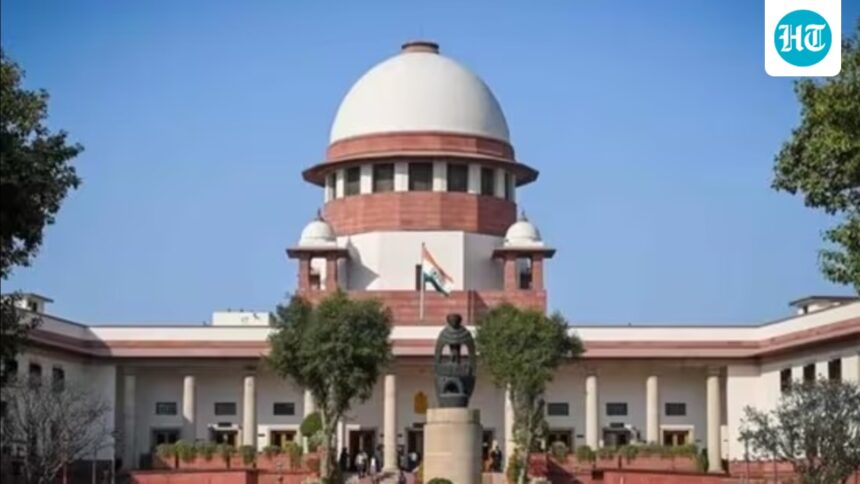
The Supreme Court on Wednesday directed the Central Bureau of Investigation (CBI) to investigate the 2023 Manipur violence cases to help build trust between victims and their families by ensuring speedy trial, as it observed a fresh spate of violence in the state and several cases investigated by the CBI and Special Investigation Team (SIT) where trial has not yet begun.

A bench headed by Chief Justice of India Surya Kant said: “You are the prosecutor. You have to ensure confidence building measures with the victims and their families. Unless there is a speedy trial, confidence cannot be restored.”
The court was hearing two appeals submitted by the Central Bank of Iraq demanding the cancellation of bail for two people involved in one of the heinous cases arising from the sectarian violence that rocked the state from May 2023 to February 2024.
“The women there are traumatized. You have to give confidence to the victims… and it does not serve to prevaricate on interim bail orders. Our main concern is to bring the truth home through the judicial process of guilt or innocence,” the bench, also comprising Justices Joymalia Bagchi and Vipul M Pancholi, said.
The court pointed out another procedure under which the investigation and prosecution of violence cases in Manipur is monitored periodically. In August 2023, the court ordered the CBI to take over more than 30 heinous cases in which the trial was shifted to Assam to instil confidence in the victims and witnesses. The court appointed former Director General of Police (DGP) of Maharashtra Dattatraya Badsalgekar to monitor the investigation and trials, and constituted a three-judge panel headed by Justice Geeta Mittal, former Chief Justice of the Jammu and Kashmir High Court, to hear cases of rehabilitation and resettlement of victims.
Since this matter was also listed before the same court, the court said: “There is an alarming report filed by the former Director General of Police indicating that law and order is completely unstable as fresh incidents of violence took place on April 7 and 18. Due to the marches, sit-ins and protests, the state police have been stretched to the limit.”
Additional Solicitor General (ASG) DP SIngh representing CBI told the court that 21 cases are currently under trial and with the cooperation of witnesses, victims and accused, the agency expects to complete the trial within 6 to 7 months. He urged the court to consider cancellation of bail to enable witness statements to be recorded without any fear.
“Bail was granted due to the CBI’s mistake. The trial is now in Assam. You have to give that confidence to the victims. The Supreme Court has looked into the freedom of these people. Unless there is an egregious case against them, there is no reason to cancel the bail,” the bench said.
The court directed the states of Manipur and Assam to ensure effective implementation of witness protection and victim protection schemes, and directed all stakeholders, including State Legal Service authorities of Manipur and Assam, to provide all legal support to the victims and witnesses in deposition during the trial.
The victims were also represented in court by Mehmet Nizam Pasha, who said that the victims were also planning to file an appeal against the bail granted to the accused. He said that in May 2025, the Gauhati High Court noticed that the accused were accused of committing a heinous rape and murder, and four months later, they were released on bail.
“Our main concern is to see that the trial of these cases proceeds smoothly. To that limited extent, we are examining the matter here,” the bench said. The status report submitted by the Manipur Special Investigation Team before the court said that out of 297 cases, chargesheets were filed against 414 accused. However, the trial has only begun in 10 cases.
“The ongoing trials must be expedited. We urge the CBI and all stakeholders, including legal service authorities, to provide legal assistance who can interact with the victims, their families and witnesses,” the bench said.
The court ordered the investigating agencies to submit fresh case reports when the matter is next heard by the court.