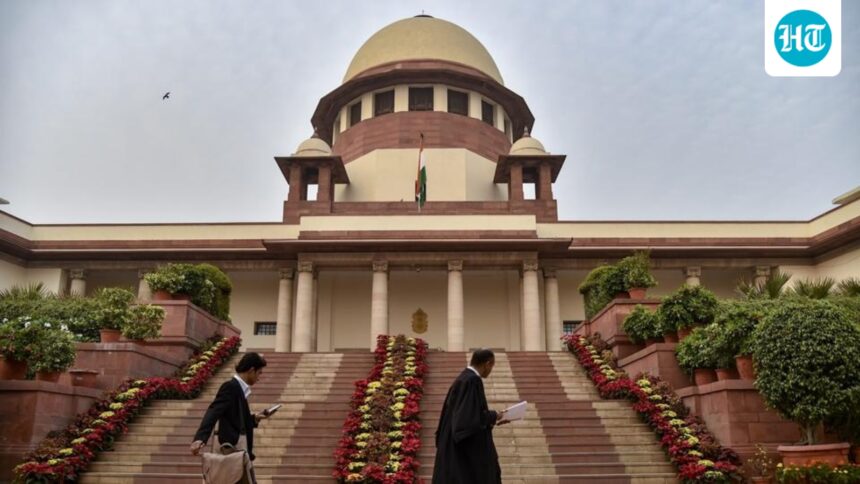
The Supreme Court on Wednesday emphasized the delicate balance between judicial restraint and constitutional duty in religious matters, noting that while courts cannot “empty religion” in the name of social reforms, there may be cases where “constitutional dharma” requires intervention.

The remarks came during the fourth day of hearings before a nine-judge bench led by Chief Justice of India Surya Kant in the Sabarimala case, in which the court grappled with the limits of judicial review of religious practices and sectarian rights. The bench also includes Justices B V Nagarathna, M M Sundresh, Ahsanuddin Amanullah, Arvind Kumar, A G Masih, R Mahadevan, Prasanna P Varali and Joymalia Bagchi.
“Welfare reform is enshrined in the Constitution,” the ICJ observed, though Justice B. V. Nagaratna warned that “we cannot discharge debt in the name of welfare reform.” At the same time, the thrust of the bench’s inquiries indicated that constitutional separation cannot remain completely suspended when it comes to fundamental rights.
This conversation unfolded when senior advocate Abhishek Manu Singhvi, who was representing the Travancore Devaswom Board, which runs the Sabarimala temple in Kerala, sought to draw strict boundaries around judicial scrutiny of religious practices. Singhvi argued that courts should adopt a “subjective” approach rooted in the beliefs of the religious community itself, rather than applying external or objective standards of rationality.
“Courts cannot and should not rewrite or justify the practices and principles of religion,” he said, warning of what he described as the dangers of imposing judicial notions of morality on faith. According to him, once it is established that a practice is part of a genuine collective religious belief, it should only be interfered with for limited reasons expressly recognized under the Constitution – public order, health and morality.
A key element of Singhvi’s memoirs was criticism of the “essential religious practices” doctrine, which he described as a problematic judicial innovation. He urged the bench to ignore the test, arguing that it forces courts to enter the theological realm by determining what is “essential” to religion. Instead, he suggested a threshold investigation limited to whether a practice is religious at all, to be assessed from the point of view of its adherents.
However, the Council tested these proposals through a series of assumptions and conceptual questions. Justice Nagaratna asked whether anything outside the scope of Article 25(2)(b), which allows the state to open Hindu religious institutions of a public nature, should be automatically protected, while Justice Bagchi looked at how courts deal with activities that cut across religious and secular spheres.
Singhvi admitted that such “interconnected” issues constitute a “headache” for the law, admitting that there can be no universal formula and that courts may have to decide on a case-by-case basis. He explained the difference by pointing out that while performing prayer is undoubtedly religious, activities such as financial management or procurement associated with rituals may fall within the scope of regulation.
A large part of the session was devoted to the interaction between Articles 25 and 26 of the Constitution. While Article 25(2)(b) allows the state to ensure access to public temples, once entry is secured, communal independence under Article 26 must prevail in matters of internal administration and methods of worship, Singhvi said.
However, the bench appeared concerned about the broader implications of such a position. Justice Sandrich noted that religious denominations derive their existence from the collective beliefs of individuals, raising the question of how to isolate their rights from the constitutional framework that governs those same individuals.
Meanwhile, Justice Amanullah spoke to Singhvi about the evolving nature of constitutional concepts, especially “constitutional morality”. Singhvi strongly opposed its use as an independent basis for testing religious practices, calling it a “wild horse” that introduces subjective and potentially difficult to control criteria into judicial adjudication.
Echoing this concern, the IJC noted that “the danger to constitutional morality in this context would be the unmanageable standards by which it is judged.” Justice Kant added: “The court’s most difficult task may be how to issue a declaration that the beliefs of millions of people are false or false.”
Singhvi also sought to ground his proposals in the idea of fraternity, describing it as an underappreciated constitutional value that should guide the interpretation of religious freedoms. He said that a harmonious reading of Articles 25 and 26 must ensure that individual and collective rights coexist without reducing each other “to the vanishing point.”
In a sobering focus of the Sabarimala dispute, Singhvi defended the exclusion of women between the ages of 10 and 50 from the Sabarimala temple, arguing that the practice was intrinsically linked to the unique personality of the deity, Lord Ayyappa, who was worshiped there as a “naisthika brahmachari” (eternal celibate).
He asserted that the restriction is not a blanket exclusion on the basis of gender but a classification linked to the identity of the temple and thus able to withstand scrutiny under Articles 14 and 15. He noted that women outside this age group are allowed to enter, and devotees have access to many other Ayyappa temples across the country.
The session will continue on Thursday. The nine-judge panel was tasked with answering seven fundamental questions arising from the 2019 reference, including the contours of basic religious practices, the balance between individual rights and sectarian autonomy, and the limits of judicial review in religious matters.