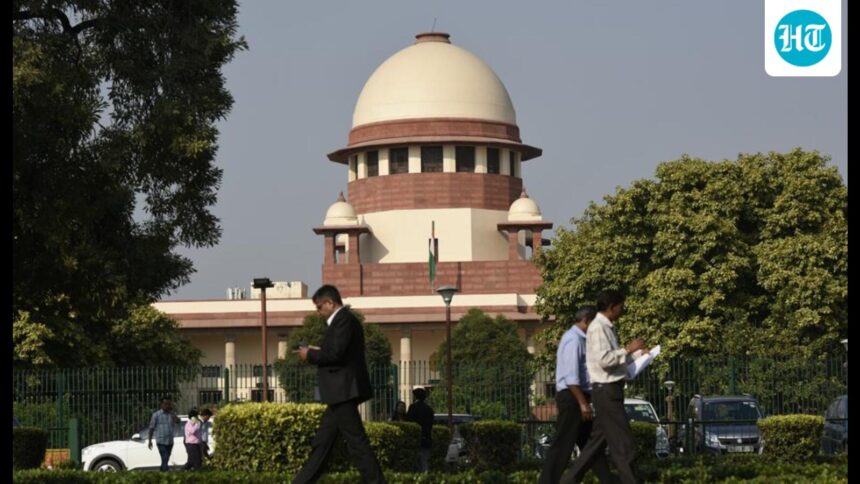
The Supreme Court on Thursday clarified that although participation in elections is vital for democracy, citizens cannot be forced to vote, stressing that awareness, not coercion, is the appropriate means to promote electoral participation.

A bench headed by Chief Justice of India, Surya Kant, and including Justices Joymalia Bagchi and Vipul M Pancholi, said any move to impose penal or other consequences for non-voting falls squarely within the “policy sphere” of the legislature and cannot be judicially mandated.
“The issues raised fall within the realm of policy,” the bench said in a brief order, after disposing of the petition filed under Article 32 of the Constitution, which seeks to impose criminal and other restrictions against individuals who abstain from voting. The court granted freedom to the petitioner, Ajay Goel, to contact the relevant authorities.
During the hearing, the panel pushed back strongly against suggestions that nonvoters should face punitive consequences or be denied government benefits. “Should we arrest them?” asked the CJI, adding that India’s democratic framework is built on trust in citizens. Judge Kant added: “Everyone is expected to go. If they don’t go, they won’t go. So all we need is awareness. But we can’t force them.”
The court also pointed out practical realities that may prevent citizens from voting. “If a poor person says I will earn my salary, how will I vote? What should we say?” The CJI commented, highlighting that economic motivations and personal circumstances can influence participation.
In a lighthearted moment that underscored the jury’s view, the ICC pointed to Justice Bagchi, noting that his home state of West Bengal was due to go to the polls on April 29. “If we accept this, my brother Justice Bagchi should leave court work and go to West Bengal to vote, even though it is a working day,” he said.
Justice Bagchi responded that “judicial work is also important…it is as good as basic service.”
Under the constitutional system, the right to vote is not a fundamental right but a statutory right, derived from the Representation of the People Act 1951. While Article 326 of the Constitution guarantees adult suffrage, voting mechanisms, including eligibility and procedures, are subject to legislation.
The Supreme Court has consistently held that voting is a legal right with a constitutional basis, not an enforceable duty. At the same time, the Court expanded the quality of this right.
In the N.B. Ponnuswamy case (1952), the Supreme Court held that the right to vote was legal. The Jyoti Basu judgment (1982) held that voting is neither a public law nor a fundamental right; It exists only by law. Similarly, in Kuldeep Nayar v. Union of India (2006), the Court made it clear that the right to vote is legal, even when it plays a crucial role in the democratic framework. In its landmark 2013 ruling in People’s Union for Civil Liberties v. Union of India, it recognized the right of voters to reject candidates through the “none of the above” option, holding that free and fair elections require not only participation, but meaningful choice.
While the Constitution under Article 51A sets out the fundamental duties of citizens, including upholding democratic values, it does not explicitly provide for voting as a legally enforceable obligation.
Countries around the world, mostly in Latin America, have experimented with compulsory voting, often backed by penalties for abstention. In India, attempts to introduce such measures have largely remained within the scope of legislative debate, with no national framework requiring a vote.