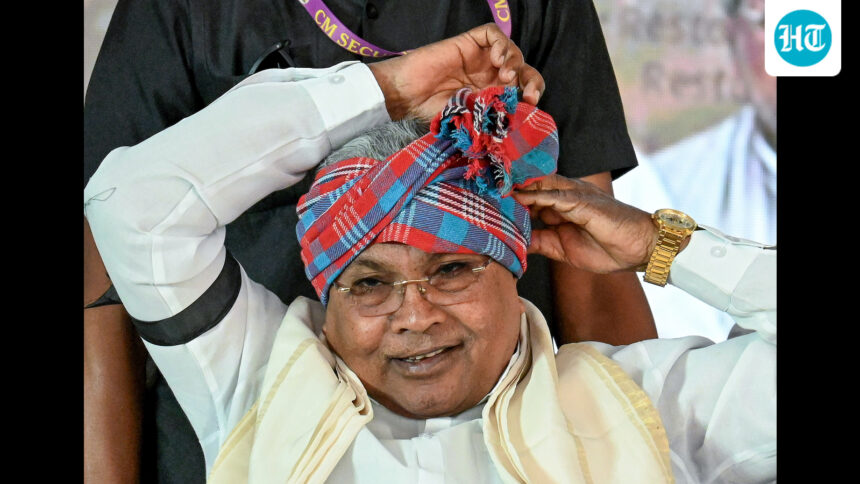
Karnataka has officially backed Tamil Nadu’s push for a new national conversation on the balance of power between the Union and the states, with Chief Minister Siddaramaiah urging the Center to create an organized platform for deliberation on federal issues.

In a letter dated March 2 to Tamil Nadu Chief Minister M K Stalin, Siddaramaiah expressed support for re-examination of Center-state relations and welcomed the report prepared by a high-level committee constituted by the Tamil Nadu government. The correspondence was in response to Stalin’s letter of 20 February in which he transmitted the first part of the commission’s findings, which covered ten major topics ranging from language policy to governance, education, health, demarcation, elections, and GST, among others.
Speaking to X, Siddaramaiah said Karnataka would stand with efforts to initiate a dialogue at the national level.
“Federalism is not a political demand. It is part of the Constitution,” he said, arguing that states need sufficient authority and financial resources to fulfill the responsibilities assigned to them.
Over time, the constitutional balance has been shifted by increasing centralization in the fiscal and legislative spheres, Siddaramaiah said in his letter. He cited expanded interpretations of the concurrent list, conditional fiscal transfers, centrally designed plans with reduced state flexibility and delays in governors granting approval to state legislation as developments that have changed the federal balance.
Siddaramaiah said in the letter that Karnataka shares many of the concerns mentioned in the committee’s report.
“Over the past decades, the phenomenon of increasing centralization has altered the federal balance through expanded interpretations of the concurrent list, conditional fiscal transfers, centrally designed schemes with reduced state flexibility, and procedural bottlenecks in governor approval,” he wrote, adding that what was conceived as cooperative federalism increasingly resembled “coercive federalism.”
He stressed that the financial arrangements under Articles 268 to 281 of the Constitution, the role of the Finance Commission under Article 280 and the GST framework under Article 279A, should not weaken the fiscal sovereignty of the states. Referring to the principle of subsidiarity, he said that management must act at the most urgent level consistent with efficiency.
“These are not sectoral claims; they are constitutional claims. They arise from a principled commitment to pluralism, diversity and democratic accountability,” the letter said, referring to issues such as language policy, education, public health, fiscal delegation and legislative independence.
Siddaramaiah added that federal renewal should include all states, regardless of their political affiliation.
“The goal, as your letter rightly emphasizes, is not to weaken the Union, but to resize it, to ensure that national energy is focused on genuine national priorities, while states are trusted in the areas constitutionally entrusted to them,” he wrote.
He suggested that the Union government facilitate the dialogue through mechanisms such as revitalization of the Inter-State Council under Article 263, a special meeting of chief ministers or a structured constitutional review process.
“Whether it is through an inter-state council activated under Article 263, a special meeting of prime ministers, or a structured dialogue to review the Constitution, the Union must facilitate a forum where states can make their recommendations formally, transparently and deliberatively,” he said, noting that the absence of such participation has fueled perceptions that cooperative federalism has receded in practice.
Meanwhile, in his response to Siddaramaiah, Stalin, in a social media post, said he highly appreciated Siddaramaiah’s “thoughtful endorsement” of the Tamil Nadu initiative and his acknowledgment that federal renewal must be a collective effort.
“As you have rightly observed, unity in a diverse republic like India is maintained not by uniformity, but by constitutional trust,” Stalin said.
The first part of the report of the High-Level Committee on Union-State Relations – in Tamil and English – was submitted to the Tamil Nadu Legislative Assembly on 16 February 2026.
The committee met in New Delhi on 22 February 2026 to discuss the second part of its report.
(With agency inputs)