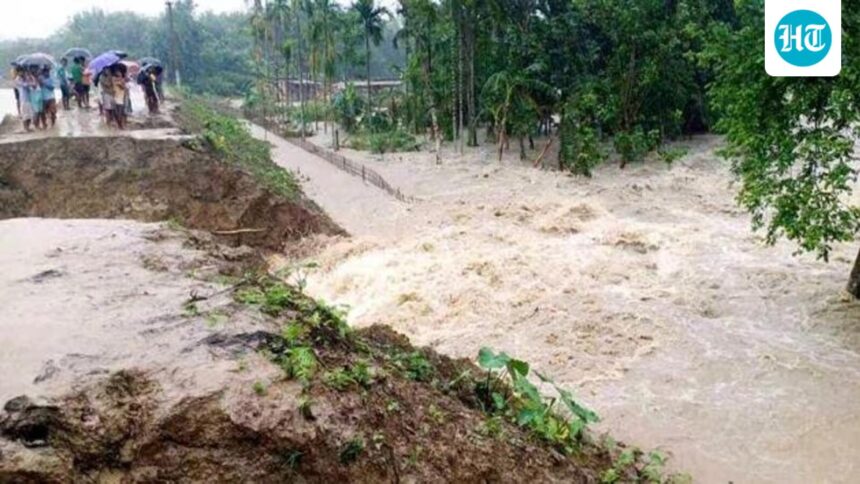
A lower-than-normal monsoon forecast across parts of the Hindu Kush Himalaya (HKH) is unlikely to reduce disaster risks, as scientists warn that short periods of heavy rainfall, extreme heat and increased water pressure could affect people in large parts of the region.

The Hindu Kush Himalaya (HKH) 2026 monsoon forecast, released on Thursday, forecast below-normal rainfall in several countries, including Bhutan, India, Nepal and Pakistan, along with higher-than-normal temperatures in most parts of the region.
“The forecast gives disaster management authorities a critical opportunity to prepare,” said Navneet Yadav, head of the disaster risk reduction and climate resilience team at Palladium India.
Experts warned that the risk of floods, landslides and other hazards remains high. “Even in weaker monsoons, short periods of heavy rainfall remain a major concern. Communities and authorities need to closely follow short-term forecasts and warnings,” said Manish Shrestha, a hydrologist at the International Center for Integrated Mountain Development (ICIMOD).
The combination of erratic rainfall and high temperatures is expected to increase the risks of drought and floods during the same season. The analysis said that long periods of drought may be followed by sudden heavy rains, creating conditions for flash floods and landslides, especially in mountainous areas.
Warmer conditions are also likely to intensify heat stress and reduce water availability. Reduced snowfall persistence early in the season weakens the region’s natural water barrier, making river and groundwater recharge systems more sensitive to rainfall variability.
“Reduced snow persistence means the region is entering monsoon with a lower seasonal water barrier,” said Sarthak Shrestha, co-author of the forecast.
The forecast highlights increasing pressures on food production, water resources and energy systems, as well as increasing vulnerability in both rural and urban areas.
With increasing climate volatility, experts warn that preparing for one type of risk is no longer enough.
HT reported on Thursday that El Niño — a pattern of warming in the Pacific Ocean that weakens India’s monsoons and leads to harsh summers — is happening now, according to the Japan Meteorological Agency, an announcement that alerts India’s weather organization as the rainy season struggles to establish itself.
The Japan Meteorological Agency said that distinct El Niño conditions have been observed in both the ocean and atmosphere of the tropical Pacific Ocean, and that an event is currently underway. The India Meteorological Department has not yet made the same announcement, but the threshold is close. “We will issue a statement soon, based on the models we are reviewing, on the onset of El Niño conditions,” said M Mohapatra, Director-General of the International Institute for Management Development.
The southwest monsoon has advanced further in other parts of Karnataka, Telangana, Andhra Pradesh, remaining parts of Tamil Nadu, some other parts of West Bengal and parts of Bihar, the IMD said on Thursday. Under the influence of the Western Disturbances, a wet wave is likely over northwest India until June 13, with thunderstorms with gusty winds (50-60 kmph) and hailstorms likely on June 11 and 12.
Conditions are favorable for further advance of the southwest monsoon into some other parts of the central Arabian Sea, Maharashtra, remaining parts of Karnataka, Telangana, Andhra Pradesh, central west and northwest Bay of Bengal, some other parts of West Bengal, Bihar, parts of Chhattisgarh, Odisha, Jharkhand and Uttar Pradesh during the next two-three days.
There is a 26% decrease in rainfall across the country between June 1 and June 10, with a 39% decrease in eastern and northeastern India, a 10% decrease in northwestern India, a 45% decrease in central India, and a 3% increase in southern peninsular India.