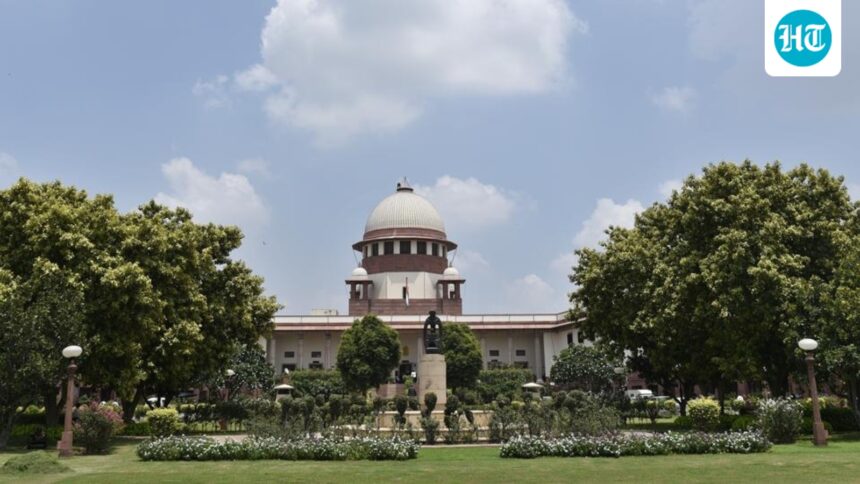
The Supreme Court on Friday dismissed a writ petition seeking directions to prevent political leaders from changing parties, stating that the petition was based on “vague, wild and informal allegations” without any supporting material on record.

The appeal comes amid speculation of internal divisions and unrest in the main opposition parties – Trinamool Congress (TMC), Shiv Sena-UBT and Samajwadi Party (SP).
During the hearing, lawyer C R Jaya Sokin alleged that party leaders were induced to change their positions through corruption or coercion, according to Barr and Bench.
“In this country, party leaders either indulge in corruption by offering bribes, or threaten to harm family members if they do not join the party,” Barr & Bench quoted Sokin as saying in its report.
Also read: ‘I’ve got an offer’: Trinamool MP Saugata Roy on rebels planning to switch to BJP-led NDA; He is seeking India bloc support for Mamata
The Commission wondered about the general nature of the allegations, and asked which ruling party was being referred to.
The Chief Justice commented, “Which party is in power? In your state, parties keep changing.”
“She asked for a minute, we gave her 7”
Sokin responded that in some states, legislators were resigning from their parties and joining competing political formations soon after the Speaker of the House accepted their resignations.
“In one state in eastern India and another in central India, party leaders are joining other parties. The Speaker must investigate the resigned leaders. Speakers contact the media, accept the message and within minutes join another party. This is destroying democracy,” he said.
However, the court found no basis for this petition and refused to consider it.
“You asked for one minute, and we gave you seven minutes,” the chief justice noted before dismissing the petition.
The council rejected the order, saying the petition was based on “vague, wild and informal allegations” and lacked any reliable material on record.
“We see no basis for intervention,” the court said.
Trinamool Congress, Sena-UBT crisis
While advocate Sokin did not name any country or political party during the hearing, his arguments referred to the insurgency crisis that has primarily bedeviled the TMC and the Shiv Sena-UBT. Rumors of a split in the Samajwadi Party led by former Uttar Pradesh Chief Minister Akhilesh Yadav also emerged recently.
The Trinamool Congress (TMC) is facing a revolt with its MLAs breaking rank to recognize themselves as the main opposition in the West Bengal Assembly first and then at least 20 MPs announcing their merger with the Nationalist Citizens Party of India (NCPI). Terming it an “illegal secession”, the Congress claimed that the move was aimed at helping the NDA improve its numbers in the Lok Sabha.
A BJP MP involved in the discussions told the Hindustan Times that NCPI was chosen to maintain the insurgents’ connection to West Bengal while expanding its symbolic reach to the northeast.
If the merger is approved, the TMC’s strength in the Lok Sabha will fall from about 28 to eight members, while the number of NDA members will rise from 294 to 314. Even then, the ruling alliance will remain 46 seats short of the two-thirds majority mark.
The crisis within the TMC emerged after the party suffered a major defeat in the West Bengal Assembly elections, ending its 15-year rule in the state. The BJP achieved a decisive victory, with Suvendu Adhikari becoming Prime Minister.
The move by the MPs came days after 58 out of 80 TMC MLAs supported rebel leader Ritabrata Banerjee as Leader of the Opposition in the Assembly.
These developments come at a time when the National Democratic Alliance government is seeking to secure support for the proposed border demarcation bill. The alliance currently lacks 46 members to reach the two-thirds majority in the Lok Sabha required for the measure.
The Trinamool Congress (TMC) played a major role in defeating the Constitutional Amendment Bill on delimitation earlier this year.
In Maharashtra, signs of an alleged attempt – billed as ‘Operation Tiger’ – by the BJP-Shiv Sena to poach elected leaders emerged four days ago, when some Shiv Sena (UBT) MPs failed to turn up in person for a meeting called by faction chief Uddhav Thackeray at his residence in Mumbai. Then, on Tuesday, the rebel MPs cut off communications with party leaders. Matters reached a critical stage when the six dissident MPs defied the party whip and called a meeting of the Sena’s parliamentary party (UBT) in Delhi on Thursday.
Reportedly, the six MPs are: Sanjay Jadhav (Parbhani), Bhausaheb Wakshuri (Shirdi), Sanjay Deshmukh (Yavatmal-Washim), Nagesh Patil Ashtekar (Hingoli), Sanjay Dina Patel (North East Mumbai), and Umraji Nimbalkar (Dharashiv).