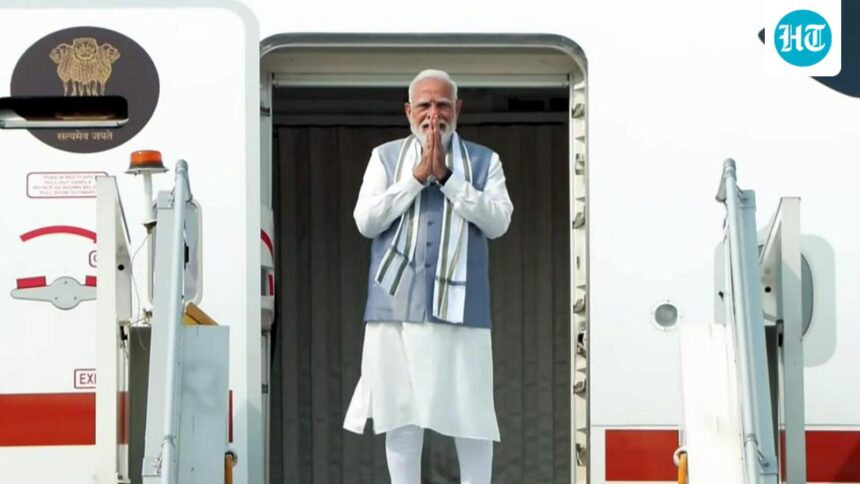
Prime Minister Narendra Modi’s visit to Seychelles from June 27-29, the first by an Indian Prime Minister in 11 years, is more than just a celebratory anniversary celebration. It reflects the growing strategic importance of the Western Indian Ocean and the recognition that India’s partnership with a major ocean nation in its immediate neighborhood serves the maritime security interests of both India and Seychelles.

The visit marks two significant events: the 50th anniversary of Seychelles’ independence and diplomatic relations between India and Seychelles. Prime Minister Modi will attend Seychelles’ National Day celebrations and address a special session of the National Assembly. The official visit of President Patrick Herminie to India in February 2026, quickly followed by this return visit, indicates strong political momentum.
The relationship is one I’ve known practically since birth. I was posted to the Indian High Commission in Kenya in 1979 to learn Swahili, and was additionally charged with managing our relations with Seychelles, which gained independence in 1976. This led to many visits to friendly Seychelles, a beautiful, informal and welcoming country. I was reminded when I first arrived that Seychelles was a no-holds-barred zone. Check-in flight listings were published in the local newspaper, and I quickly learned that the first priority after checking into the hotel was not to unpack; I was strolling down Main Street in Victoria, greeting as many friends as I could, or getting my ears adjusted for the next day! The official talks were warm and real good-neighborliness. Exchanges with the Seychellois leadership reinforced the necessity of quickly opening a Resident Indian Mission in Victoria, which soon followed. Security and maritime cooperation were important factors in the opening of our High Commission in Victoria in 1979.
Decades of steady cooperation followed. Since then, Indian lines of credit have financed transportation, judicial and digital infrastructure, renewable energy and community projects. Capacity building under the Indian Technical and Economic Cooperation Program and others has reached more than one percent of the Seychelles population, one of the highest per capita rates anywhere.
During President Herminie’s visit in February, India announced a special economic package worth US$175 million for Seychelles. The two sides also adopted the Joint Vision SESEL, a roadmap for sustainability, economic growth and security through enhanced linkages, which includes renewable energy, blue economy, digital governance, healthcare and maritime surveillance. The projects that will be inaugurated electronically during this visit will begin to translate SESEL from an ambitious framework into practical results.
Seychelles has been a pioneer in innovative approaches to ocean management. An archipelago of 115 islands and an exclusive economic zone of 1.3 million square kilometres, it has championed the identity of “big ocean states” as stewards of vast marine spaces, biodiversity reserves and climate management. In 2018, Seychelles became the first country to issue sovereign blue bonds, raising funds for sustainable marine and fisheries projects. Debt-for-nature swaps have converted a portion of their sovereign debt into financing for ocean conservation. In contrast, Seychelles has protected nearly a third of its exclusive economic zone from industrial activities, including oil exploration and unregulated fishing. Seychelles is an ideal partner for India, whose maritime strategy increasingly links security and sustainable ocean management.
Maritime security anchors our expanding relationship and gives it long-term strategic logic. Seychelles lies on vital sea lanes of communication near the Mozambique Canal, through which a large share of global trade and energy shipments pass. With limited surveillance capabilities, Seychelles has relied on India as its primary partner in combating piracy, drug trafficking, poaching, and other transnational threats.
The focus of Prime Minister Modi’s visit will be the handover of a fast patrol vessel to the Seychelles Coast Guard. India had earlier provided two Dornier maritime patrol aircraft, patrol boats and embedded defense personnel working alongside the Seychellois forces. This reflects a steady build-up of an integrated naval presence, with Indian and Seychellois assets working in coordination.
In the context of defence, the 11th edition of Exercise LAMITYE, held in March 2026, was for the first time raised to the tri-service level. Seychelles participates in our multilateral exercises Milan and Pragati, and has expressed its intention to join the Colombo Security Meeting as a full member. Maritime cooperation, which began with the transfer of donor and recipient capabilities in the 1980s, has matured into joint operational responsibility for security in the Western Indian Ocean.
This is what Vision MAHASAGAR is designed to promote. It puts countries like Seychelles at the center of our maritime strategic thinking. The Indian Ocean is no longer just one maritime theater among many. It is an area where India must increasingly contribute to stability and security. Large ocean states with large sea areas and limited surveillance capacity are natural partners in this effort.
Meanwhile, piracy in the western Indian Ocean has resurfaced in recent years. Drug smuggling operations have expanded through the East African corridor, with the Seychelles exclusive economic zone being used for transit. Illegal, unreported and unregulated fishing by remote fleets depletes essential stocks of small island economies. Climate change is changing weather patterns and increasing the frequency of hurricanes and extreme events that are straining the Coast Guard’s capabilities. India and Seychelles have been building these capabilities over decades. Our partnership has evolved steadily and has not been improvised in response to crises.
The relationship is also based on deep human connections. Five Indians were among the islands’ first recorded residents in 1770. About 6,000 people of Gujarati and Tamil origin and 9,000 Indian nationals live in Seychelles, out of a total population of 133,000. Prime Minister Modi’s diaspora meeting on June 28 and his visit to Navasakti Vinayagar Mandir on June 29 reflect a deeper relationship of government-to-government cooperation.
As geopolitical competition across the Indian Ocean intensifies, India’s influence will depend not on episodic diplomacy, but on sustained partnership. Seychelles demonstrates the value of this approach. Five decades of development cooperation have matured the relationship into one of India’s closest trust-based partnerships.
(Ajay Malhotra, Distinguished Fellow, TERI. Former Indian Ambassador to Russia, Kuwait, UN/New York, Romania, Albania and Moldova)