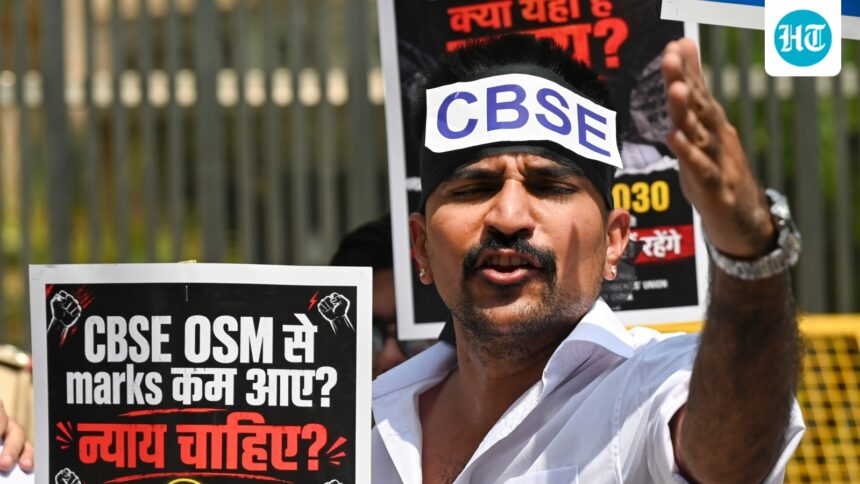
Scanned copies of CBSE answer scripts will be available to students through DigiLocker from next year, officials said on Friday, while defending the board’s rollout of on-screen marking (OSM) and its decision to award the contract to Telangana-based Coempt Edu Teck.

Officials also defended the selection of Quimpet amid allegations raised by opposition leaders, including Congress MP Rahul Gandhi, regarding the company’s past work in Telangana, HT reported earlier.
The report quoted an official as saying that the courts looked into the legal challenges related to the operation of the company’s post-examination department in the state, and “nothing unusual” was found.
The Central Board of Secondary Education (CBSE) awarded its OSM contract to Coempt on December 5, 2025 — just 66 days before the full implementation of the system was announced on February 9 — after the company emerged as the lowest financial bidder in the quality-cost-based tendering process, officials said.
The timeline, which was confirmed to HT, has drawn attention amid growing scrutiny over the speed at which the new assessment system has been implemented.
How CBSE chose Coempt to do OSM
As HT reported on Friday, CBSE was unable to secure a qualified vendor in two previous rounds of bidding before several technical requirements were amended in its request for proposal (RFP) in August 2025.
Under the Quality-Cost-Based Selection (QCBS) framework, which allocated 70% weight to technical criteria and 30% to financial bids, Coempt transferred approx. $25.75 per answer text, including taxes. Tata Consultancy Services (TCS), the only other bidder to technically qualify, submitted a bid of approx $65 per copy after taxes for certain categories.
“TCS rates were much higher at approx $“$65 per copy after taxes for certain categories,” said an official who requested anonymity.
The two companies achieved Level 5 Certification for Capability Maturity Model Integration (CMMI) — the highest level of maturity — when the contract was awarded, officials said.
Officials also admitted that about 20 cases of answer sheet mismatches had been reported, but said such errors could occur even under manual assessment systems, especially given the size of the exercise involving nearly 9.8 million answer books.
“For a child whose answer sheet is mixed up, there is no adequate explanation,” one official said. “But if speed alone determines errors, more such problems could occur.”
The board is investigating the reasons for the mismatch and is exploring measures to make the system “completely error-free,” the official added.
On the issue of penalties for reported non-conformities and technical errors, officials said that the contractual provisions will be activated once the verification process is completed.
According to officials, the penalties stipulated in the contract include: $4000 for each incorrectly scanned or mismatched answer book, $8000 for partially scanned copies and $15,000 for completely unscanned answer books.