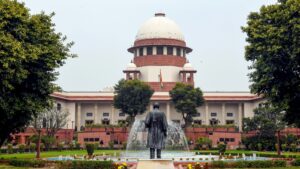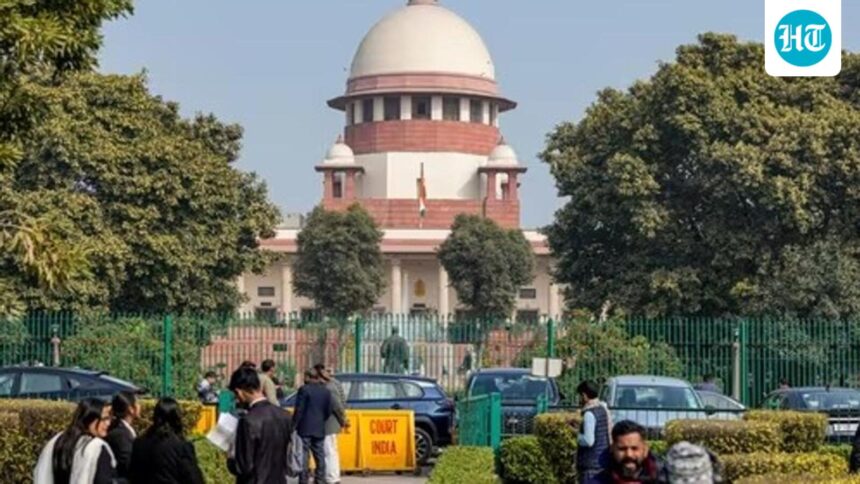
The Supreme Court on Monday sought responses from the Election Commission of India (ECI) and Bihar Panchayati Raj Minister Deepak Prakash on a petition questioning his continuation in office despite not being an elected member of either house of the state legislature.

A bench comprising Chief Justice of India (CJI) Surya Kant and Justice Mohana issued notice to the Election Commission of India, Prakash, the Bihar government and the Cabinet Secretary on a petition filed by a resident of Bihar, Rakesh Kumar Singh, challenging the reappointment and continuation of the minister under Article 164(4) of the Constitution.
The case is likely to be heard on July 15.
The petition, filed under Section 32 through registered advocate Sanya Kaushal and filed by advocate Sudip Chandra, seeks an injunction questioning the authority under which Prakash continues to hold a ministerial post. He is challenging his reappointment on May 7, 2026, as being in contravention of Article 164(4) of the Constitution.
Section 164(4) allows any person who is not a member of the state legislature to appoint a minister, but only for a period of six consecutive months. If a person fails to be elected to either House of the Legislature during that period, he or she ceases to be a Minister. The Supreme Court has previously held that the clause cannot be used as a means to repeatedly appoint a non-legislator without an electoral mandate.
Read also: Presumption of innocence ends with a guilty verdict: Supreme Court
Singh’s petition contends that the six-month constitutional window available to a non-legislator minister cannot be repeatedly invoked through resignation and reappointment to enable a person to continue in office without being elected.
According to the petition, such a practice would amount to circumventing constitutional guarantees and undermining the principle of representative democracy.
The petitioner seeks declarations that Prakash’s reappointment and continuation in office are unconstitutional, illegal and invalid, along with directions restraining him from exercising powers attaching to ministerial office.
Singh alleged “deliberate circumvention and structural subversion” of the constitutional scheme embodied in Article 164 through what he described as artificial fragmentation and re-exploitation of the limited grace period available to a non-lawmaker minister.
Prakash was initially appointed and sworn in as Panchayati Raj Minister of Bihar on 20 November 2025, under the Cabinet headed by Nitish Kumar, despite not being a member of the Bihar Legislative Assembly or Legislative Council.
The petition said that a gap of about 22 days arose between April 15, 2026 and May 6, 2026, during which Prakash did not hold any ministerial post after the formation of a new government headed by Samrat Chaudhary. During that period, the Panchayati Raj portfolio remained in the hands of the Prime Minister, she says.
However, after the expansion of the Cabinet on 7 May 2026, Prakash was reappointed as Panchayati Raj Minister despite continuing to remain an unelected legislator.
According to the admission, Prakash had already used approximately four months and 26 days of the six-month period stipulated under Section 164(4) from the date of his original appointment, leaving only a little over a month before the constitutional deadline expires.
The petitioner argues that by resignation and subsequent reappointment under a reconstituted Government during the term of the Legislative Assembly itself, the constitutional limitation cannot be reset or extended. The petition claims that this practice amounts to a “colourful exercise of constitutional power” aimed at achieving what cannot be directly achieved under the Constitution.
Accordingly, the petition seeks an injunction requiring Prakash to disclose the constitutional authority under which he continues to hold office and seeks a declaration that his reappointment is unconstitutional, void and inconsistent with Article 164(4).