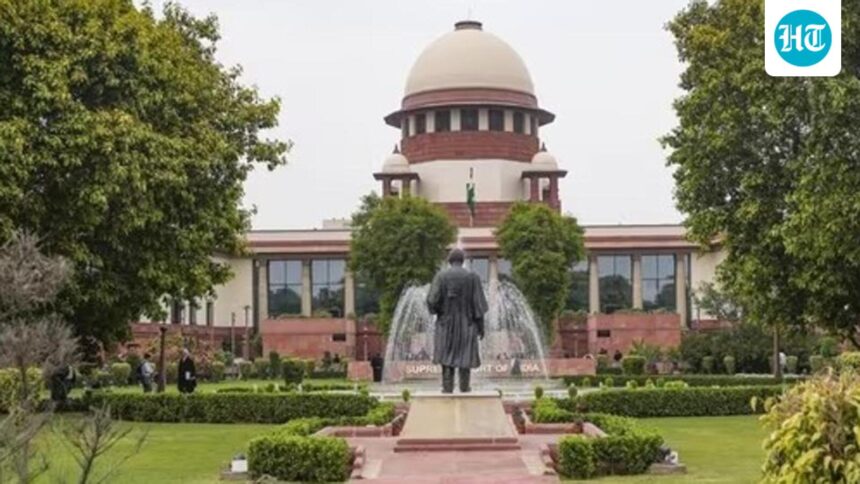
The Supreme Court on Wednesday questioned the federal government, the Central Board of Secondary Education (CBSE) and the National Council of Educational Research and Training (NCERT) on whether there are enough teachers, textbooks and logistical infrastructure to implement the new three-language policy, as it agreed to examine a batch of petitions challenging the policy.

A bench comprising Chief Justice of India Surya Kant, Justices Joymalia Bagchi and Vipul M Pancholi issued notices to the Centre, CBSE and NCERT, seeking their responses to the challenge against the policy filed through a CBSE circular dated May 15, 2026.
The Court noted that in addition to the constitutional issues raised, it was concerned about the practical feasibility of implementing the policy from the next academic session.
“Do schools have enough books…teachers?” This question was repeated during the hearing, noting that there appeared to be “issues of difficulty, inconvenience and logistical support” that required immediate attention.
The matter will now be heard in the second week of July after the court ordered the defendants to file their responses within four weeks.
Read also: The Supreme Court set aside the MHA’s order denying VRS to an IPS officer over CAA’s protests
Speaking to Additional Solicitor General Aishwarya Bhatti, the bench said it wanted a detailed report on logistical preparedness to implement the policy. “It is a matter of unreasonableness when teachers are not present in schools…books are not there,” the bench observed.
Senior advocate Mukul Rohatgi, appearing for the petitioners, said the circular effectively forces students across the country to comply with the revised framework from July 1 itself, even though schools lack the infrastructure to support the transition.
“The mandate in all of India is… Suppose someone in Chennai is studying Tamil, English, French. Now they have to study Telugu and so on,” Rohatgi said, adding that even textbooks for the revised structure were not available.
The bench acknowledged this concern, saying: “If teachers and books are not there, then…”
Senior advocate Kapil Sibal, appearing in a related case, stated that the case raised major constitutional concerns regarding federalism and individual autonomy. “Language is a matter of choice and cannot be imposed,” Sibal said.
However, the court made it clear that at the current stage it is more directly concerned with the difficulties of implementation than in adjudicating the challenge to federalism. “We are not in the federal case… This leads to an increase in the number of regional languages. There are issues related to teachers, books, etc.,” the court observed.
Bhatti, who appeared on behalf of the Centre, maintained that the policy was made keeping in mind the “convenience of the student” and requested that the matter be taken up in July instead of June. “Nothing will happen in July,” she said, opposing an early hearing date requested by the petitioners.
However, Rohatgi confirmed that the implementation will start from July 1 and students may face academic consequences. “You don’t need to take an exam, but the final certificate will reflect that you won’t get a certificate until you pass it,” he said, urging the court that authorities “should hold their horses” until the challenge is decided.
The bench eventually scheduled the hearing after the court reopened in July, while directing that electronic copies of the petitions be submitted to Bhatti and Solicitor General Tushar Mehta by Thursday.
The main petition under Section 32 was filed by a group of 19 petitioners, comprising parents and teachers from Delhi, Gurugram, Noida and Chennai, through advocate Shraddha Deshmukh.
The petition challenges CBSE’s May 15 circular which states that from July 1, 2026, students of class IX must study three languages, designated as R1, R2 and R3, with at least two of them being indigenous Indian languages. Under this policy, students wishing to continue studying foreign languages such as French or German can do so as a third language only if the first two languages are Indian languages, or alternatively as an additional fourth language.
The revised curriculum framework of CBSE operationalizes the recommendations made under the National Curriculum Framework for School Education, 2023, and is in line with the National Education Policy, 2020. Under the revised model, students are required to study three languages from Class VI to Class X, with two of them being Indian languages.
According to the petitioners, the circular represents an abrupt reversal of CBSE’s earlier position communicated on April 9, 2026, when the board had clarified that the compulsory third language requirement for Class IX students would not apply till the 2029-30 academic session.
The appeal argues that schools, students and parents planned the school year relying on this assertion and that the sudden shift in policy weeks before implementation has sparked widespread confusion and unrest.
The petition further alleges violation of Article 14 on the grounds of apparent arbitrariness, noting that the circular itself acknowledges the lack of trained teachers and designated textbooks. She points out that temporary arrangements under the policy allow schools to use teachers from other subjects who have merely “functional proficiency” in the language and to rely on Year 6 textbooks supplemented with local materials for Year 9 students.
The petition also cites Article 21A, arguing that meaningful education cannot be reduced to the imposition of compulsory subjects without adequate infrastructure, trained faculty or appropriate pedagogical support. Forcing students who have studied foreign languages for years to suddenly switch courses undermines educational continuity and imposes avoidable academic stress, she says.
In addition, the petition alleges a violation of Article 19(1)(g), claiming that foreign language teachers and institutions providing internationally recognized language education could be adversely affected by the virtual displacement of foreign languages from the prevailing trilingual structure.
The petitioners also rely on the National Education Policy 2020 and the National Curriculum Framework for School Education 2023, to argue that the policy is against the stated principle that no language should be imposed on any student or state.