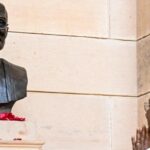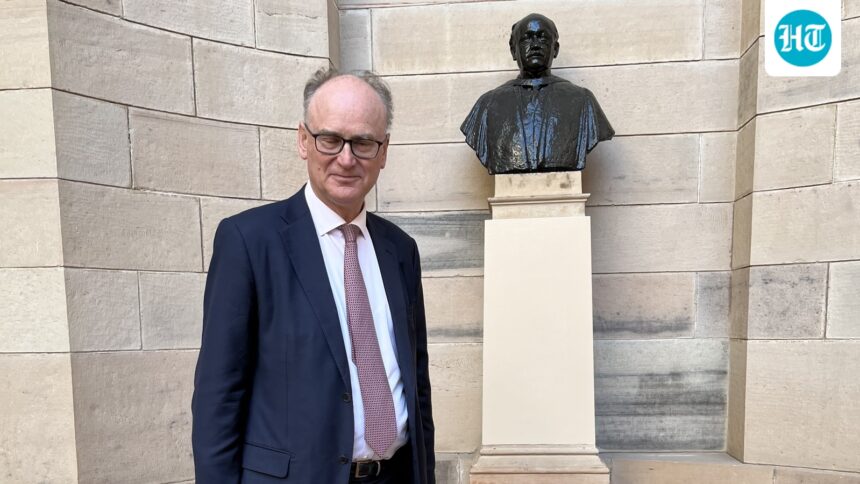
The great grandson of Edwin Lutyens, the architect of Rashtrapati Bhavan whose statue in the Rashtrapati Palace was replaced by a bust of Chakravarti Rajagopalachari, expressed his grief over the development, sharing a throwback picture with the now-vanished structure.

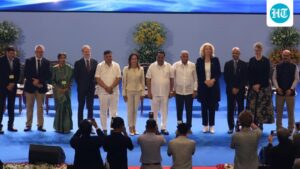
His remarks come as President Draupadi Murmu on Monday unveiled a bust of Chakravarti Rajagopalachari, the first and only Indian Governor-General of independent India, at Rashtrapati Bhavan.
Read also | Lutyens’ statue gone: Why the British architect ended up in New Delhi on Modi’s anti-colonial purge list
The bust of Chakravarti Rajagopalachari, located in the Grand Open Staircase near Ashok Mandap, replaced the bust of Edwin Lutyens.
Matt Ridley, a grandson of Edwin Lutyens, said in a post on X: “Sad to read that the bust of Lutyens (my great-grandfather) will be removed from the presidential palace he designed in Delhi. And here I was with him last year. I wondered at the time why his name was removed from the pedestal.”
According to the President’s official handling of
Prime Minister Narendra Modi on Sunday announced that the ‘Rajaji Festival’ will be celebrated at Rashtrapati Bhavan on Monday with the unveiling of the statue of Chakravarti Rajagopalachari.
During the 131st episode of Mann Ki Baat, Prime Minister Modi said the nation is leaving what he described as symbols of slavery behind and starting to connect with Indian culture.
“During the Azadi Ka Amrit Mahotsav, I spoke about the ‘Paanch Pran’ of the Red Fort. One of them is freedom from the mentality of slavery. Today, the country is leaving behind the symbols of slavery and has started appreciating the symbols related to Indian culture,” he said, as quoted by news agency ANI.
A lawyer and thinker among many other things, C Rajaopalachari was born on 10 December 1878 in the Madras Presidency. He is considered an early political companion of Mahatma Gandhi, who left his law practice to join the Indian National Congress and later participated in various protests against the British Crown.
Most famously, Rajagopalachari revolted against the Rowlatt Act, Non-Cooperation, and Civil Disobedience Movement.
He was elected to the Constituent Assembly from Madras on a Congress ticket. He was part of the Sub-Committee on Minorities and was conferred the post of Bharat Ratna in 1954.
(with ANI inputs)