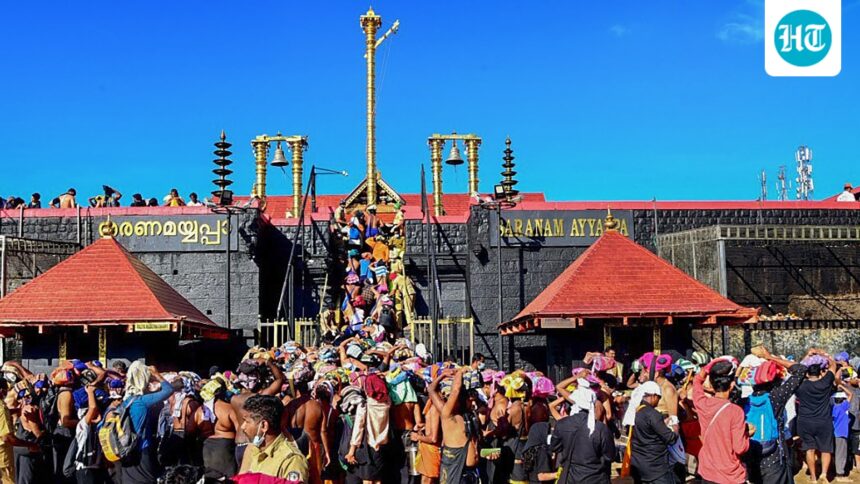
The Supreme Court continues to hear the dispute over the ban on women inside the Sabarimala temple in Kerala. As the hearing continues, the matter is being heard by a nine-judge bench led by Chief Justice of India Surya Kant.

The bench also includes Justices B V Nagarathna, M M Sundresh, Ahsanuddin Amanullah, Arvind Kumar, A G Masih, R Mahadevan, Prasanna P Varali and Joymalia Bagchi.
On the third day of the hearing, the Supreme Court said that excluding a particular caste from access to temples and ‘mathematics’ would have a negative and negative impact on Hinduism.
Justice Nagarathna said: “Everyone should have access to every temple and gymnasium. Put aside the controversy over the Sabarimala judgment. But if I say it is a practice and it is a religious matter, then I will exclude others and my caste only, and my caste and no one else will attend the temple. This is not good for Hinduism. Let the religion not be adversely affected. It will be counterproductive to the caste.”
Additionally, Justice Kumar stated that such exclusion would further divide society.
Where the issue stands
On the third day of the session, the Center supported restricting the entry of women of menstruating age into the historic temple by submitting statements of temples that do not allow men to enter.
Solicitor General Tushar Mehta, who appeared for the Centre, told the CJI-led Constitution Bench that he had submitted a written request and given instances where men would not be allowed to enter temples.
“It is a Devi Bhagwati temple, and there are some religions and beliefs associated with it. I read it, there is one temple in Kerala, where men dress up as women. They go to a beauty salon and female family members help them wear sarees,” Mehta said, according to PTI.
“So it is not about male- or female-centric religious beliefs. In the present case, the case is women-centric,” Mehta told the court.
This comes after the Supreme Court backed down from the Centre’s argument that courts cannot adjudicate on religious practices.
The Supreme Court’s observation came after it highlighted that while the court may restrict matters relating to faith and religion, it cannot ignore a practice found to violate the constitutional freedoms guaranteed to Indians, which include the right to religious freedom.
General Secretary Mehta also added that the federation’s position is that the 2018 Sabarimala ruling, which allowed all women’s sections to enter the temple, was wrongly taken on the assumption that men are superior and women are on a lower pedestal.
The constitutional hearing comes after a 2018 Supreme Court ruling lifted restrictions on women and girls aged 10 to 50, deeming their exclusion illegal and unconstitutional.