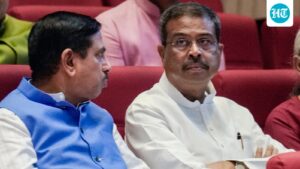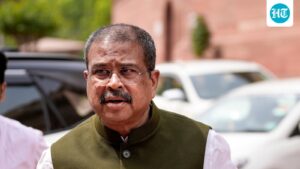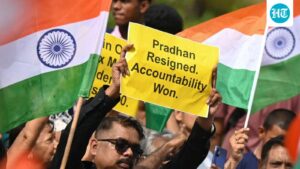
Union Education Minister Dharmendra Pradhan resigned on Saturday after weeks of protests led by students and youth over leaked NEET-UG papers, becoming one of only two ministers in Narendra Modi-led governments to step down over the controversy.
The protests, led by the satirical Cockroach Janta Party, have attracted sit-ins across the country since June.
CJP ends protest: Live updates
Resigning on moral grounds is uncommon in Indian politics, but it is not unheard of. Ministers have resigned over rail and air disasters, financial scandals and corruption charges, wartime failures and terrorist attacks, sexual harassment allegations – and, in one case, over the price of onions.
Cases included a political leader accepting responsibility for a disaster, controversy, or failure in governance, whether or not he was personally involved:
Railroad disaster: 1956
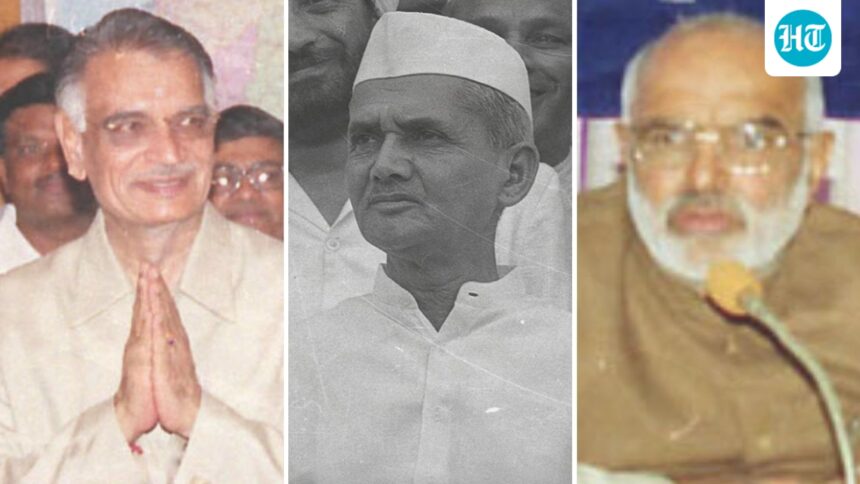
Lal Bahadur Shastri, the then Railway Minister in Jawaharlal Nehru’s government, resigned in November 1956 after the Ariyalur train disaster in Tamil Nadu, in which a passenger train fell into the river after a bridge collapsed. More than 140 people were killed. Shastri had offered to resign months earlier, after the Mahbubnagar train accident in then Hyderabad state, but Nehru convinced him to stay.
His resignation is widely cited as the foundational standard for ministerial accountability in India.
Financial fraud: 1958
Finance Minister T. T. Krishnamachari resigned in February 1958 after the Chagla Commission, headed by former Chief Justice of Bombay M. C. Chagla, reported on the Mundra Scandal – the first major financial fraud in independent India.
It bought the public sector life insurance company $1.24 lakh crore shares in six companies controlled by Kolkata businessman Haridas Mundra, bypassing its investment committee.
Feroz Gandhi, Congress MP from Rae Bareli and husband of Indira Gandhi, unveiled the deal in Parliament. Krishnamachari was not personally accused of corruption, but resigned due to administrative failure.
Read also: Tougher prison sentences, task forces, and faster trials: Paper leak bill would introduce changes and state laws you could join
Defense Lack of Preparedness: 1962
Defense Minister VK Krishna Menon resigned during the Sino-Indian War after facing criticism over the Indian Army’s alleged lack of preparedness. Nehru had initially stripped him of the defense portfolio and left him in charge of defense production. Menon insisted on resigning altogether. His resignation was accepted in November 1962.
Election financing: 1963
Keshav Dev Malviya, Minister of Mines and Fuel, resigned in June 1963 after a special investigation by a Supreme Court judge found that he had asked a private company to contribute money to the election campaign of a Congress candidate.
According to one historian’s account, the amount was small, and Nehru believed that the company did not benefit from the assistance, but the issue could not be disavowed. It is believed that Nehru accepted the resignation reluctantly.
Stock buyout controversy: 1992
Minister of State for Commerce P Chidambaram resigned in July 1992 after it emerged that he and his wife had bought 15,000 shares from promoters’ stakes in Fairgrowth Financial Services, a company tainted in the securities scam of that year.
Prime Minister BV Narasimha Rao accepted the resignation.
Onion prices: 1998
Sahib Singh Verma, the BJP chief minister of Delhi, resigned in October 1998 as onion prices rose to $40-50 kilograms and public anger escalated due to the shortage. He was replaced by Sushma Swaraj weeks before the state Assembly elections, which the BJP lost to the Congress under the leadership of Sheila Dikshit.
Verma, known for his strict manner, reportedly returned home in a DTC bus after signing his resignation. Although he headed a state government and was not a member of the federal cabinet, his exit remains one of the most evocative examples of political accountability in India.
Railway disaster: 1999
Railway Minister Nitish Kumar resigned in August 1999 after the Jaisal train disaster in West Bengal, in which the Awadh-Assam Express and the Brahmaputra Express collided head-on, killing an estimated 290 people. Kumar cited moral responsibility and tendered his resignation to Prime Minister Atal Bihari Vajpayee. He returned as Minister of Railways in 2001.
Mumbai terrorist attacks: 2008
Home Minister Shivraj Patel resigned days after the November 26, 2008 terrorist attacks in Mumbai, which killed more than 160 people in coordinated attacks on hotels, a railway station and a Jewish centre. His resignation came amid public anger over the failure to coordinate intelligence, coastal security, and crisis response.
Maharashtra Chief Minister Vilasrao Deshmukh also resigned over the attacks soon after.
Read also: After 5 years of farm laws, Modi government bows down to street protest: Why the RJD succeeded, and why Shaheen Bagh did not
2G spectrum scam: 2010
Minister of Communications A. resigned. Raja in November 2010 after the Comptroller and Auditor General (CAG) reported that the allocation of 2G mobile spectrum for 2008, at 2001 prices on a first-come, first-served basis, had cost the Treasury up to $1.76 million crores. DMK’s Raja denied any wrongdoing. A special court affiliated with the Central Bank of Iraq later acquitted him and all the co-accused.
Aircel Maxis deal: 2011
Textiles Minister Dayanidhi Maran resigned in July 2011 after the CBI told the Supreme Court that there was prima facie material indicating that – during his previous stint as telecom minister – he had coerced Aircel owner C Sivasankaran into selling his stake to Malaysia’s Maxis group. A special court in the Central Bank of Iraq also released the Maran brothers from the case.
Corruption charges: 2012
Union Minister for Small and Medium Enterprises Virbhadra Singh resigned in June 2012, a day after a Shimla court brought charges of corruption and criminal conspiracy against him and his wife, Pratibha Singh, in a case dating back to his tenure as Himachal Pradesh chief minister in 1989. Singh described the resignation as his “moral duty.” A special judge acquitted him in December of that year.
Colgate: 2013
Union Law Minister Ashwani Kumar resigned in May 2013 after the Supreme Court criticized the Congress-led United Progressive Alliance government’s handling of the coal block allocation probe. Kumar was accused of reviewing the CBI’s status report and making changes to it before submitting it to the court. His resignation was framed as a political impeachment rather than any admission of legal wrongdoing.
Sexual harassment allegations: 2018
Minister of State for External Affairs MJ Akbar resigned in October 2018 after female journalists leveled sexual harassment allegations against him during the #MeToo movement in India. Akbar said he resigned to face the charges “before a court in my personal capacity” and “to challenge the false accusations.” His resignation, before that of Dharmendra Pradhan, was the only case in which a minister in a Modi-led government resigned over a controversy.