Protests broke out in parts of Jammu and Kashmir after Iran confirmed the death of Supreme Leader Ali Khamenei. Iranian state media reported that the Ayatollah died in the early hours of Saturday during joint military strikes carried out by Israel and the United States.

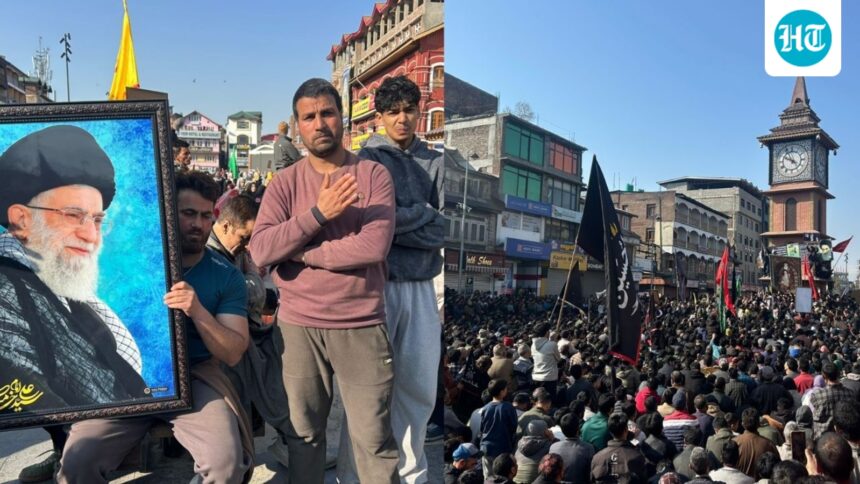
Demonstrations were reported in Srinagar, Sonawari and Bandipora. The demonstrators raised slogans and expressed their anger over the reported attack. Hundreds of Kashmiri Shiite Muslims took to the streets carrying pictures of Khamenei and pro-Iran banners. Follow live updates on the US-Iran conflict here
Black flags, pictures of the Ayatollah and traditional mourning chants (nuha) were seen on the streets of Srinagar.
One protester told news agency ANI: “We received news from Iran that the revolutionary Supreme Leader Ali Khamenei is no longer there. He was brutally killed by the US and Israel… We are all saddened by this incident…” For the Shia Muslim community in Srinagar, Ayatollah Ali Khamenei was more than just a foreign political leader; It was a reference of imitation (a source of emulation).
Iran’s Supreme Leader Ayatollah Ali Khamenei, a cleric who consolidated theocratic power for more than three decades and led the Islamic Republic into confrontation with Israel and the United States, has died at the age of 86, Iranian state media reported early Sunday.
Mehbooba Mufti criticizes the US-Israeli attack on Iran
On Sunday, the head of the Peoples’ Democratic Party, Mehbooba Mufti, strongly criticized Israel and the United States in the wake of reports of the killing of Iranian Supreme Leader Ali Khamenei.
In a statement, the Mufti described this development as “a very tragic and shameful point in history.” It accused Israel and the United States of “bringing about the killing of beloved Iranian leader Ayatollah Ali Khanani.”
The head of the People’s Democratic Party also expressed her disappointment at what she described as the silence and support of many Islamic countries.
She added: “What is most shameful and shocking is the explicit and implicit support provided by Islamic countries that have preferred convenience and expediency over conscience.”
Mufti added that history will judge who sided with Iran and who, in its view, sided with the oppressors.
She said: “History will bear witness to those who fought for justice and those who helped the oppressors.”
Khamenei was killed in US-Israeli raids: what we know
Iranian Supreme Leader Ayatollah Ali Khamenei was killed in US-Israeli raids.
Israeli and American forces launched large-scale strikes on Saturday against military and nuclear sites across the country.
Khamenei’s death comes at a moment of extraordinary escalation, after months of escalating tensions and days of direct exchanges between Iran, Israel, and the United States.
From Khomeini’s successor to the longest-serving ruler of the Islamic Republic
Khamenei took power in 1989 after the death of Ayatollah Ruhollah Khomeini, the architect of the 1979 Islamic Revolution that toppled Shah Mohammad Reza Pahlavi and installed clerical rule. Whereas Khomeini was a charismatic ideologue, Khamenei – then a relatively low-ranking cleric – was seen as a quieter, more bureaucratic figure charged with converting revolutionary fervor into a lasting state.
He ended up ruling for longer than Khomeini. Over the course of 35 years, Khamenei expanded the clerical establishment and turned the Islamic Revolutionary Guard Corps into the backbone of his power. The Revolutionary Guards have evolved into Iran’s most elite military force, controlling an arsenal of ballistic missiles and a vast business empire spanning energy, construction, communications, and finance.
Through a network of appointed bodies that can veto or override elected institutions, Khamenei has become the ultimate arbiter of political life. Hardliners described him as second only to God in authority.