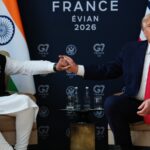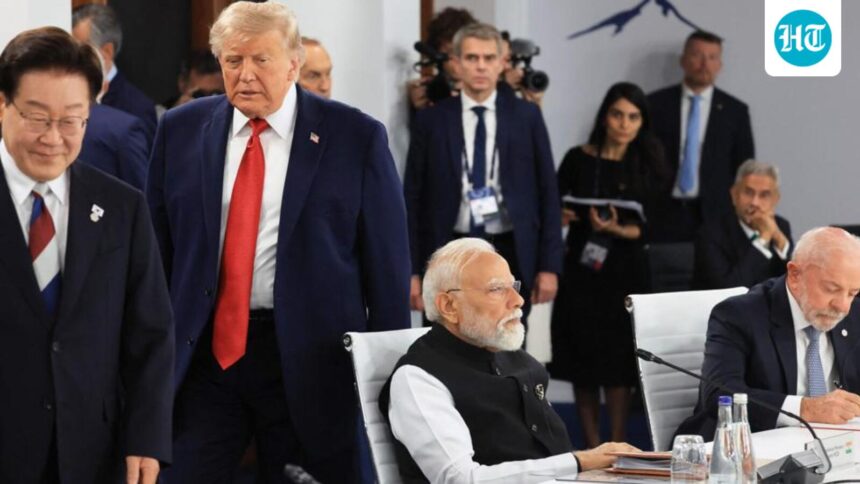
Global financial institutions must create support mechanisms to help countries of the Global South absorb shocks such as the impact of conflict in West Asia on fuel, fertilizer and food supply chains, Prime Minister Narendra Modi said at an outreach session of the G7 summit in France on Wednesday.

Modi, who was speaking at the session on “Reviving Balanced, Shared and Sustainable Economic Growth for All”, called for combining G7 capital with the talents of India and countries of the Global South for connectivity projects in Africa, Latin America and the Pacific Islands focused on trade, technology and energy.
India, Brazil, Egypt, Kenya and South Korea are the partner countries invited to attend the awareness sessions of the summit held in the French resort of Evian. Modi said on social media that his speech focused on common development based on India’s experiences. “The reality today is that when it comes to growth, the question should not be about GDP or trade numbers. The real question is – growth for whom, with whom and in what direction?” He said.
“The impact of the West Asia crisis on fuel, fertilizer and food supply chains will have long-term consequences for the Global South,” he said during his speech, stressing that the most vulnerable countries should not bear the burden of crises alone.
“Our international financial institutions must create support mechanisms that help developing countries absorb these shocks and maintain their economic resilience,” he said.
Referring to the India-Middle East-Europe Economic Corridor (IMEC), Modi proposed new connectivity projects in Africa, Latin America and the Pacific Islands. “By bringing together the capital of the G7, India’s talent and the ownership of the Global South, we can consider creating the International Mobilization Partnership to Accelerate Connectivity and Trade (IMPACT),” he said.
“Today, there is a need to accelerate the pace of initiatives that have local ownership, transparent financing and a clear vision for long-term sustainability,” he added.
Modi also proposed creating a global skills partnership that would allow developed countries with aging societies to benefit from India and other countries in the Global South with the potential of young talent, enterprise and skills. “With this, we can work together to increase skills mapping and reliable skills mobility,” he said.
India’s belief in shared global prosperity is reflected in the actions taken by the country, including concluding trade agreements with many countries. “This shows that India believes in integration not fragmentation; partnership not protectionism; shared prosperity not uncertainty. India will continue to work with all of you to enhance shared economic resilience and build a more stable, reliable and prosperous global economy,” Modi said.