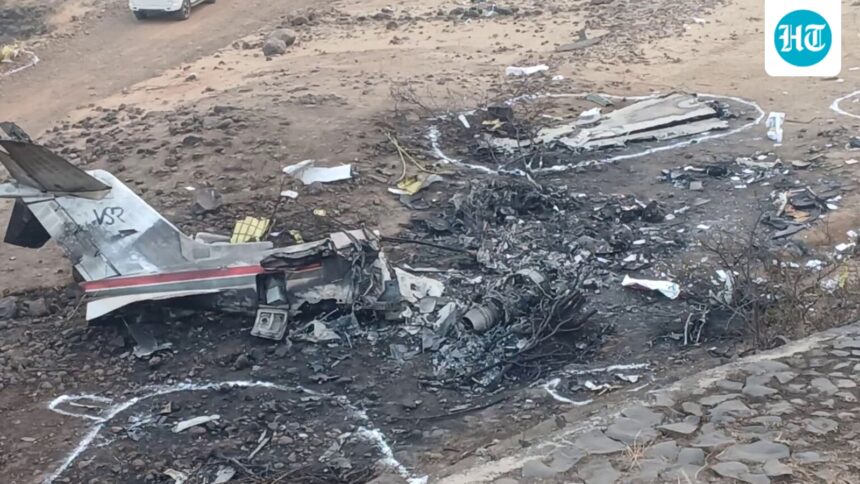
The preliminary investigation report indicated that the plane chartered by VSR Aviation carrying Maharashtra Deputy Chief Minister Ajit Pawar, crashed when the crew attempted to land at an altitude of 3,000 metres, against the legal minimum of 5,000 meters for approaches to such airports.

All five people on board the Learjet 45XR — including two pilots, a flight attendant and two passengers — were killed when the plane plunged to the left of Runway 11 at Baramati Airport, struck trees and burst into flames.
The Aircraft Accident Investigation Bureau’s initial report found that visibility at the time of landing was 3,000 meters and this was conveyed to the pilots. Visual flight rules (VFR) require a minimum of 5,000 metres. VFR refers to visual flight rules that apply when landing at airports without landing navigation instruments.
The report also mentioned what it said were systemic flaws. The number itself has not been officially measured. Baramati does not have a meteorological facility. Visibility was estimated by a ground trainer guarding one of the airport’s two temporary towers, who determined the distance by referring to a hand-drawn chart that locates the permanent structures — water tanks, police headquarters, and toll gate — at various distances around the airport.
This estimate was passed on to the VT-SSK crew as they descended towards Baramati. The crew continued the approach.
On their first attempt, the pilots reported that they were “sight of the terrain” but unable to see the airfield itself, and they executed a go-around—a procedure in which the crew abandons the approach and climbs away to try again. They were back in the ring and made a second approach, this time on Runway 11, one end of which was a tabletop with the ground falling sharply below the threshold.
At 8:43 a.m., the crew reported sighting the field. Sixteen seconds later, the tower allowed them to land, and reported that the winds had calmed. Fourteen seconds later, the crew transmitted “Oh Saint… Oh Saint…” The plane impacted trees and terrain beyond the edge of the runway.
Satellite images from INSAT-3DR taken between 8:45 and 9:12 am showed “very shallow fog in patches” over Baramati. At nearby Pune Airport, 81 km away, official weather reports recorded a drop in visibility of up to 2,000 meters with fog during the same period. Mumbai, where the flight began, recorded visibility at an altitude of 2,500 meters with smoke and fog.
The report notes that the tower gave landing clearance without any recorded challenge to the crew about the minimum conditions.
In interim safety recommendations, the AAIB called on India’s aviation regulator, the Directorate General of Civil Aviation, to direct all operators flying to uncontrolled airports – those without a permanent air traffic control facility – to strictly follow standard operating procedures, and ensure that airport operators only allow flights when the weather reaches regulatory limits.
The investigation is ongoing. The flight data recorder information has been downloaded and is being analysed. Data from the cockpit voice recorder, which captures crew communications and cockpit sounds, suffered thermal damage in a post-crash fire and is being sent to the United States for specialized recovery by the National Transportation Safety Board.