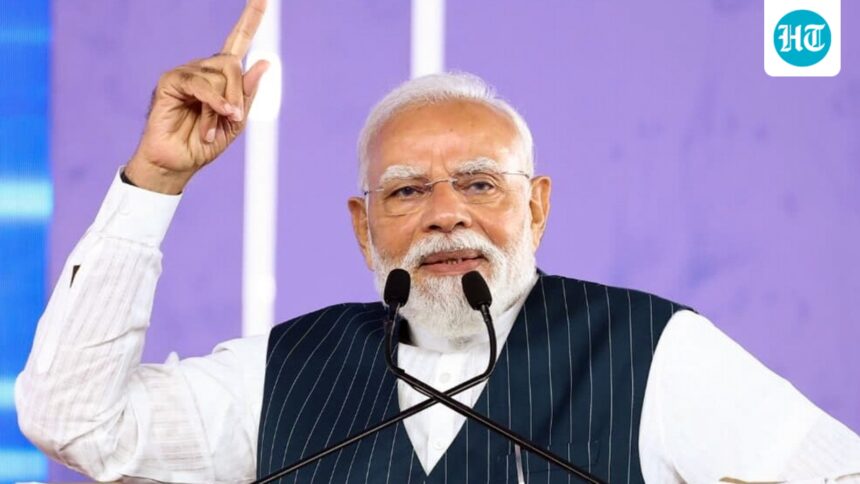
India is building a complete electronics value chain that will serve as a roadmap for Viksit Bharat and the next phase of Make in India, Prime Minister Narendra Modi said on Saturday while inaugurating an offshore semiconductor assembly and testing (OSAT) facility in Sanand, Gujarat.

Speaking at the event, the Prime Minister recalled his attempt to set up a semiconductor plant more than two decades ago when he was chief minister of Gujarat, stating that the project was stalled because the then Union government failed to push through the proposal.
“Twenty years ago, perhaps more than that, I made all the plans to set up a semiconductor plant in Gujarat, finalized 350 acres of land near Gandhinagar and Prantj, and even held talks with some companies,” he said, adding that the efforts stalled despite initial interest from the industry.
“The Government of India was making big statements at that time, so some companies came forward for discussions. But somehow, I don’t know what happened to the Government of India at that time. Their feet were shackled, and the matter did not move forward. Today, when I look at that 20-22-year-old dream… it could not have happened then… but today, when it happens, I feel very happy inside,” he added.
He added that the factory has moved to commercial production capable of producing 20 crore units annually, with the aim of increasing production to 500 crore units annually. “I congratulate the entire team, the state government and the entire country for building this step by step, brick by brick, chip by chip.”
Sanand emerging as a semiconductor group
Modi praised Sanand as an emerging industrial hub rather than an isolated facility, and compared its growth trajectory to specific global clusters such as Silicon Valley in the United States, Hsinchu Science Park in Taiwan, and Tsukuba Science City in Japan.
“In just a few months, Micron, Kainz and CJ Semi started production here. This means the birth of a semiconductor cluster in the country. Today chip packaging is happening here. Tomorrow, specialized companies will come here, chemicals will be produced, new testing laboratories will be built, industries providing machinery service will arrive, design centers will open, and then new startups will also emerge from here,” he said.
CG Semi Pvt Ltd, a subsidiary of CG Power and Industrial Solutions Limited, has incorporated a company $The Rs 7,600-crore facility is in a joint venture with Japan’s Renesas Electronics and Thailand’s Stars Microelectronics.
Describing the economic impact of such clusters, he said: “One industry generates hundreds of industries. Hundreds of industries create thousands of jobs, and these thousands of jobs transform the economy of the entire region.”
He said that this is not limited to Sanand alone, and that similar semiconductor clusters have emerged in several other states across the country.
From mobile phone manufacturing to chip production
Modi said India’s push into semiconductors was the result of a decade of expansion in electronics manufacturing and not an isolated development. “This is the next step in the electronics revolution that has come to India over the past decade,” he said.
Talking about the country’s electronics manufacturing journey, Modi said India has moved from importing mobile phones to becoming a global manufacturing hub. “There was a time when India used to import most of its smartphones from abroad. Mobile phone production in India has increased by 33% compared to what it was before… Today, India is the second largest mobile phone manufacturer in the world and the second largest exporter of mobile phones,” he said.
He said electronics production has increased seven times since 2014, and electronics exports have increased by about 11 times.
He said that the government’s efforts were not limited to self-reliance in the final product but also extended to component manufacturing, and that India’s next step was to move towards manufacturing chips that power the entire electronics world, rather than mobile phones or electronics alone. “We will not only make cell phones, we will not only make electronics, we will make the chips that run the entire electronics world,” he said.
Explaining the government’s strategy, he said: “First products, then components, and now semiconductors, which means the entire value chain of electronics will be in India. This is the Vixit Bharat roadmap. This is the next phase of ‘Make in India’.”
He said the next phase would focus on achieving self-reliance in critical minerals and high-tech materials needed for semiconductor manufacturing, and that the government’s goal was to build a complete semiconductor ecosystem in the country, from chip design to manufacturing and packaging.
The Prime Minister concluded his speech by saying that the semiconductor and artificial intelligence sectors will reflect the historic boom in information technology in generating high-value jobs for India’s youth. He specifically highlighted the presence of young women from local tribal communities at the Sanand plant, who received technical training in Malaysia before joining the ‘Make in India’ chip manufacturing workforce.