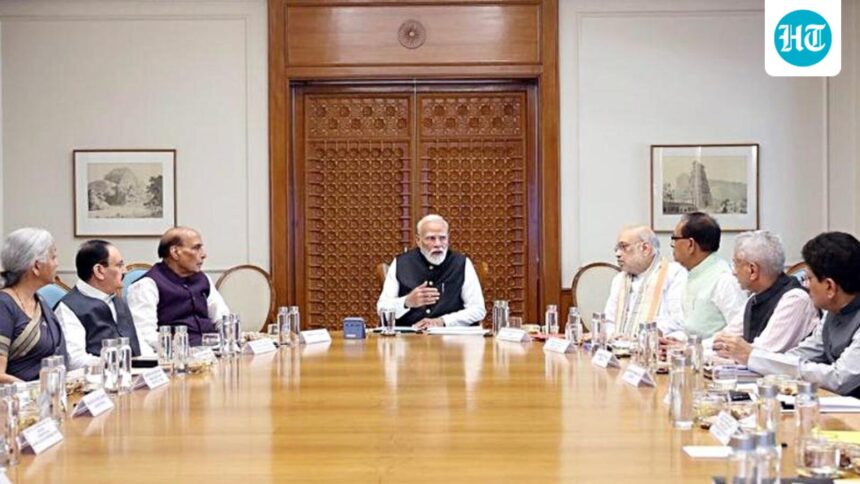
The government decided to take a raft of measures on Sunday to ensure security of food, fuel and fertilizers amid turmoil caused by conflict in West Asia, as a meeting chaired by Prime Minister Narendra Modi unveiled immediate and long-term steps to ensure availability of fuel and diversify imports of fertilizers and other basic needs.

Modi held a meeting of the Cabinet Committee on Security (CCS) as the conflict sparked by Israel and US attacks on Iran enters its fourth week, with oil prices rising above $100 a barrel, concerns growing over gas supply shortages, and countries across the world bracing for rising costs of living.
Modi said on social media that the meeting reviewed “mitigation measures” in the wake of the conflict in West Asia. “We have had extensive discussions on short, medium and long-term measures, including ensuring continued availability of fertilizers to farmers, diversifying import sources for key sectors, promoting exports to new destinations and more,” he said.
The meeting focused on the expected impact of the conflict on sectors such as agriculture, fertilizers, food security, oil, energy, SMEs, exporters, shipping, trade, finance and supply chains, and the measures being taken to address the repercussions, an official statement said. Cabinet Secretary T V Somanathan made a presentation on the global situation and mitigation measures initiated by all ministries and departments.
With the conflict in West Asia expected to have “significant” impacts on the global economy in the short, medium and long term, the meeting took stock of its impact on India and discussed immediate and long-term countermeasures, as well as the overall macroeconomic scenario in the country.
The meeting also conducted a detailed assessment of the availability of the people’s vital needs, including food security, energy and fuel. “Short-term, medium-term and long-term measures to ensure the continued availability of basic needs were discussed in detail,” the reading read.
In addition to assessing the impact on farmers and their fertilizer needs for the fall season, the meeting discussed alternative sources to ensure their continued availability. “Measures taken in the past few years to maintain adequate stocks of fertilizers will ensure their timely availability and food security,” the statement said.
Nearly half of global imports of urea and sulfur, a crucial ingredient for fertilizers, come from West Asian countries, and the closure of the Strait of Hormuz has already disrupted supplies of critical raw materials for the fertilizer sector, such as ammonia, liquefied natural gas, diammonium phosphate, and potash.
The meeting decided to maintain sufficient coal stocks at all power plants to “ensure no shortage of electricity” across the country. The meeting also discussed measures to diversify sources of imports needed by the chemical, pharmaceutical, petrochemical and other industrial sectors. “Similarly, new export destinations will be developed to promote Indian goods in the near future,” the reading said.
The reading said that several measures proposed by various ministries will be prepared and implemented in the coming days after consultation with all stakeholders, without giving details.
Modi ordered the formation of a group of ministers and secretaries “to work dedicatedly in a whole-of-government approach” and instructed the sectoral groups to work in consultation with all stakeholders.
The Prime Minister said that the conflict is “an evolving situation and the whole world is affected in some way.” In such a situation, every effort must be made to protect citizens from the impact of this conflict. He instructed that “all machinery of government should work together to ensure least inconvenience to citizens” and sought proper coordination with state governments to prevent black marketing and monopoly of essential commodities.
“We are committed to protecting our citizens from the impact of conflict,” Modi said in a social media post.
Earlier in the day, a government update on key sectors amid the conflict in West Asia said that LPG supplies “remain a matter of concern in light of [the] “The prevailing geopolitical situation”, despite the presence of “sufficient crude oil stocks” with all refineries operating at high capacity. The country maintains sufficient stocks of gasoline and diesel, and priority sectors of natural gas supply have been protected.
India has criticized all attacks on critical infrastructure, including energy facilities, in West Asia in recent days. Modi condemned attacks on critical infrastructure in West Asia that have disrupted supply chains and stressed the need to keep shipping lanes open during a phone conversation with Iranian President Masoud Pezeshkian on Saturday.
The Indian side focused on New Delhi’s key concerns – the closure of the Strait of Hormuz disrupting commercial shipping, attacks on energy infrastructure affecting supplies, and the safety of 10 million Indians in West Asia – during its outreach to the leadership of GCC members and Iran.