Prime Minister Modi on Sunday advised citizens to adopt a set of austerity measures, including carpooling, using public transport, and working from home.

Prime Minister Narendra Modi’s recent appeal to cut fuel consumption and adopt restraint has sparked discussions among citizens about daily responsibility and the biggest challenge that lies ahead in the energy space. But even as the message traveled through the drawing rooms and public debates, some in his party appeared to have missed the memo, arriving entirely in gaudy, fuel-guzzling convoys.

Prime Minister Modi on Sunday advised citizens to adopt a host of austerity measures, including carpooling, using public transport, working from home, buying less gold and limiting foreign travel among other measures.
A shareable image titled ‘Modi 7 Appeals’ with key points was circulated across the government and corresponding social media.
His appeal came amid global economic turmoil caused by many factors, primarily the conflict in West Asia sparked by US-Israeli strikes on Iran and the recent retaliation that led to a full-scale war that has kept the Strait of Hormuz – a key waterway through which a fifth of the world’s energy needs pass – virtually closed.
Describing austerity as a national duty amid the ongoing US-Iranian conflict in West Asia, he said rising crude oil prices and disruption of global supply chains are putting severe pressure on India’s foreign exchange reserves.
In line with his own call, Prime Minister Narendra Modi has directed the Special Protection Group (SPG) to reduce the size of its convoy by at least 50 per cent as part of the government’s austerity measures aimed at cutting fuel consumption while addressing rising global energy prices caused by the ongoing crisis in the Middle East.
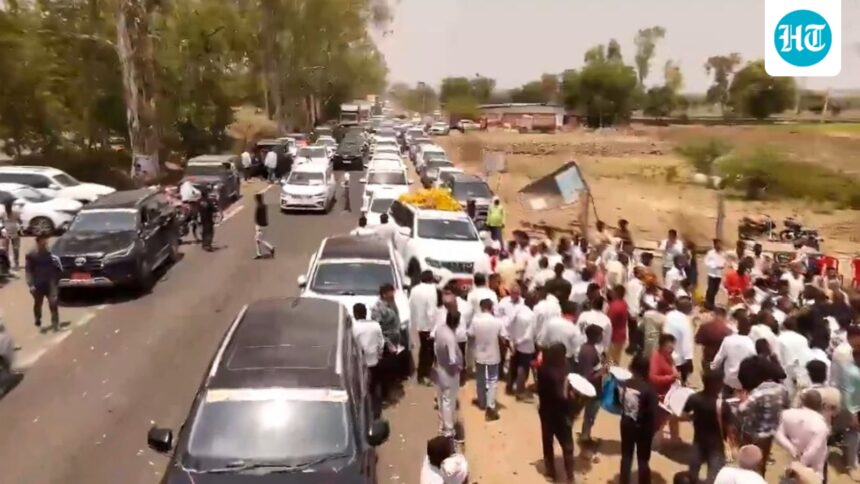
The BJP leader’s huge convoy has gone viral
While the general public discussed the possible reasons behind Prime Minister Modi’s appeals and the way forward, the BJP leader seemed to ignore the same, turning his first day in office into a renewed contradiction to the call for austerity.
Subhagya Singh Thakur, who has been appointed president of Madhya Pradesh Textbook Trust, arrived in Bhopal from Ujjain on Monday with his supporters to take charge of the post. Video clips of his convoy, consisting of dozens of vehicles, spread and sparked reactions.
Thakur later visited Chief Minister Mohan Yadav’s residence along with his supporters to thank the latter for the appointment.
“BJP leader Subhagya Singh Thakur has been appointed president of Madhya Pradesh Textbook Trust. What’s next… In a show of strength, Subhagya Singh took a long convoy of vehicles from Ujjain to Bhopal,” the Congress said in a post on X.
On the one hand, Narendra Modi is “lecturing the country on using less petrol and diesel, while on the other hand, leaders from his own party are tearing his call to pieces,” the Congress said.
“This shows that Narendra Modi expects all the sacrifices from the people alone. The rest – those in power – can enjoy themselves… and he cannot care much about this,” the party said.
Likewise, Rakesh Singh Jadon, who has been appointed as vice-chairman of Khadi Village Industries Board, also arrived with a large convoy from Vidisha, PTI reported.
The Prime Minister’s austerity call was taken seriously by Delhi, Maha, UP CMs
Within hours of PM Modi’s speech on Sunday, social media was filled with videos of PM Modi leading a roadshow in Gujarat’s Jamnagar in an armored SUV surrounded by a convoy of dozens of vehicles.
Many citizens shared photos on social media of the large number of vehicles in his convoy, which seemed to indicate the contradiction.
However, Prime Minister Modi and several other senior leaders and ministers at the Center as well as states seem to have taken notice in no time and issued similar austerity measures, including the PM’s bold directive to SPG to reduce its fleet.
Amit Shah even reduced the size of his convoy.
Uttar Pradesh Chief Minister Yogi Adityanath also issued a similar order to reduce the fleet of vehicles in his convoy, along with those of his ministers and senior bureaucrats. The Prime Minister also instructed his public representatives to use public transportation at least once a week.
Delhi Chief Minister Rekha Gupta on Tuesday appealed to residents to use more public transport and carpool services, and reduce reliance on private vehicles.
In Maharashtra too, Chief Minister Devendra Fadnavis directed ministers not to use government aircraft, except for urgent works, requiring him to personally sign such requests.

Nayanika is a Senior Content Producer at Hindustan Times, based in New Delhi, with over six years of experience in the digital media industry. It specializes in providing clear, in-depth coverage across public, national and international events, with a strong focus on breaking news and in-depth explainers. Known for her ability to decipher complex developments, she enjoys deconstructing multi-layered political and policy issues into accessible, reader-friendly narratives that deliver information without distraction. She previously worked in India’s leading newsrooms, including India Today, News18 and Outlook, where she has been tracking news, covering major events for the last six years and leading teams. Nayanika holds a Master’s degree in Political Science and has a keen interest in international relations and world affairs. Her academic foundations shape her analytical approach to stories, enabling her to connect the dots between local events and broader geopolitical currents. She is particularly drawn to stories that require context, nuance, and clarity—turning complex topics into compelling reads. Outside the newsroom, Nayanika is a passionate gourmet who loves to cook and share meals with her loved ones. When she’s not writing or keeping up with the latest headlines, you can often find her exploring local markets for the freshest ingredients, looking for inspiration for her next culinary experiment.Read more