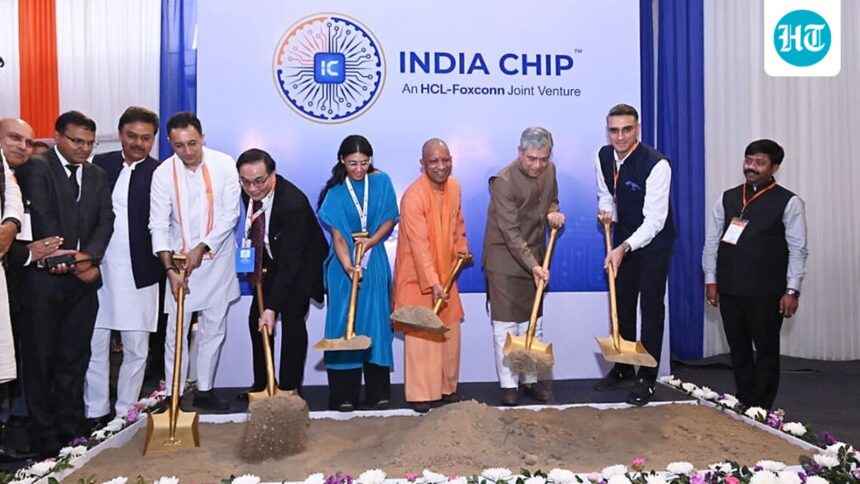
Greater Noida: Prime Minister Narendra Modi and Chief Minister Yogi Adityanath on Saturday led the foundation stone laying ceremony for the city. $A Rs 3,700-crore semiconductor facility in Sector 28, YEEDA, near Noida Airport, marking a crucial step in India’s push towards self-reliance in the global technology supply chain.

The venture, India Chip Pvt Ltd, is a 60:40 joint venture between HCL Group and Taiwanese company Foxconn. Billed as the first project of its kind in Uttar Pradesh, the 48-acre Outsourced Semiconductor Assembly and Testing (OSAT) facility — a factory that packages and tests silicon wafers and turns them into finished chips — is located near Noida Airport along the Yamuna Expressway.
Modi joined the event virtually at 5.05 pm, addressing a gathering of around 1,000 BJP workers and HCL employees. Adityanath attended the ceremony in person, along with Union IT and Electronics Minister Ashwini Vaishnao, Minister of State for Commerce and Industry Jitin Prasada and Uttar Pradesh Industry Minister Nand Gopal Gupta.
Read also | PM Modi holds bilateral meetings with OpenAI and Qualcomm CEOs
Expected to be operational by 2028, the advanced facility will manufacture Display Driver Integrated Circuits (DDICs), which are chips used to control electronic display panels. The factory has a planned capacity to process 20,000 wafers per month and is expected to generate at least 3,500 direct and indirect jobs while stimulating local supply chains.
Addressing the gathering, Modi said the project depicts India’s commitment to building a self-reliant semiconductor ecosystem. “Today’s action reflects our vision of building a self-reliant semiconductor ecosystem in India. A developed India can only be achieved when India becomes self-reliant. This is why it is extremely important that chips are manufactured in India,” Modi said. “Be it digital India, AI, 5G, 6G, electric vehicles or defense equipment – semiconductors are essential components of all of them.”
He noted that while global power was dictated by oil in the 20th century, “in the 21st century, that same power lies in small chips.”
Referring to the global supply chain disruptions during the Covid-19 pandemic, he said: “We have seen how fragile the global chip supply chain is. When disruptions happened, factories around the world came to a standstill. India learned from that crisis and turned it into an opportunity. We are determined to make India self-reliant in manufacturing chips.”
Adityanath described the project as a milestone for the state’s industrial transformation, contrasting the current investment climate with the region’s past. “Earlier, Jewar district was plagued by kidnappings and shootings. People would not leave their homes in the evening,” Adityanath said. “Now, this region has become an electronics hub. Uttar Pradesh is now known for dream investments.”
HCL Chairman Roshni Nadar Malhotra and Foxconn Chairman Yong Liu were present at the site.
“This project builds on our strong engineering heritage and deepens our commitment to Uttar Pradesh,” Malhotra said.
Liu stated that the joint venture reflects the company’s localization strategy in India. “This joint venture is a great example of how to build, operate and localize in India,” he said.
This development is in line with the Indian Semiconductor Mission (ISM), which seeks to position the country as a major player in the global semiconductor value chain and reduce import dependence.