Pakistani security forces opened fire on protesters in Pakistan-occupied Kashmir this week, killing several people and wounding dozens in a crackdown that sources in Kashmir described as among the most violent in the region in recent memory — a crackdown that stands in sharp contrast to Pakistani army chief Field Marshal Asim Munir’s position as a self-proclaimed champion of Kashmir.

The immediate reason behind this was the ban of the Joint Awami Action Committee (JAAC) on June 6 under the Anti-Terrorism Act. Sources in Kashmir said that this move amounts to criminalization of the civil rights movement.
Demand and then ban charter
Founded in September 2023, JAAC is an alliance of traders, carriers, lawyers and student groups that has become the most credible grassroots platform in PoK.
It had called for a region-wide lockdown and a long march on June 9 to press a 38-point charter of demands. Chief among them is the abolition of 12 seats in the PKK assembly reserved for so-called “refugees from Indian Kashmir” – seats that Islamabad has long used to install a captive bloc in the PKK assembly, regardless of which way the PKK party votes.
Sources in the region said that of the 53 Assembly seats, these 12 seats are being filled and manipulated from Islamabad, even though few of these migrants live in the region.
The violence is relentless
On the night of June 6, hours after the ban, a merchant was allegedly shot dead in a confrontation with police, sparking protests that would turn deadly.
The worst violence occurred on June 8 in Rawalakot when Pakistani security forces confronted JAAC supporters gathered at the hospital morgue and attending funerals of those killed earlier.
“The state has started a massacre of our people in Rawalakot,” Shaukat Nawaz Mir, central leader of JAAC, said in a video message, vowing to press ahead despite the ban.
The sources said that at least 23 civilians were killed and more than 32 others injured in Rawalakot alone by that morning. The total death toll achieved by the JAAC during the unrest is 27.
Pakistani officials acknowledged that at least 11 people, seven civilians and four law enforcement personnel, were killed. Some outlets put the number at “more than 30.” More than 70 people were officially counted as wounded, including 23 policemen. About 30 people were arrested during the night of June 8.
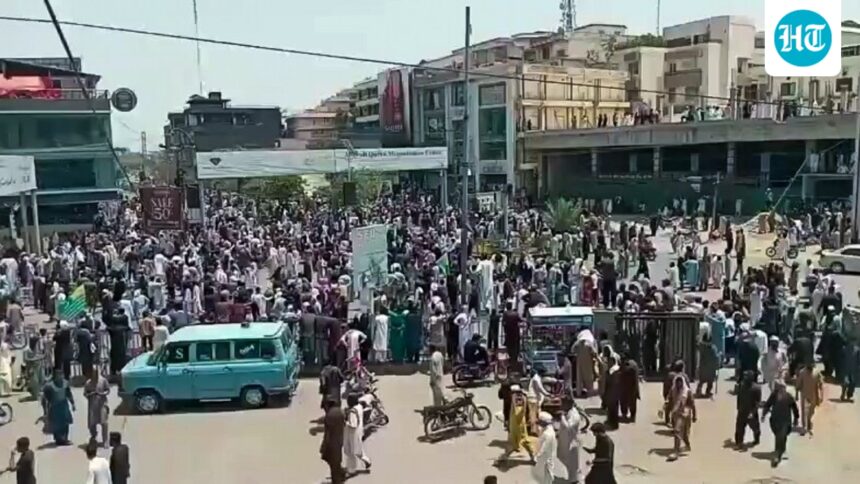
The violence spread quickly, with strikes and lockouts reported in Muzaffarabad, Mirpur, Pember, Kotli, Tata Pani and Balandari.
Authorities suspended mobile data and internet services via PoK, closed the JAAC central office, banned public gatherings and advised tourists to leave by June 20.
Assembly elections are scheduled to be held on July 27.
India condemns
“There are reports of severe police brutality in Pakistan-occupied Kashmir, in which many protesters were killed and many injured. We hope that the international community will hold Pakistan accountable for its misdeeds and violations,” India said.
Foreign Ministry spokesman Randhir Jaiswal on Tuesday accused Islamabad of spreading “a pattern of fake news and videos” as a “desperate attempt to cover up its failures and divert attention from its human rights violations.”
This was not an isolated episode, but rather the third major cycle in two years, following deadly crackdowns in May 2024 – stemming from protests over flour and electricity prices – and in September and October 2025 in Muzaffarabad, which left at least nine dead and more than 100 injured. Officials familiar with the matter said that each session follows the same scenario: popular complaint, lethal force, internet outage, breach of the agreement, renewed protest.
A deadly pattern observed globally
The deeper stream has exceeded the breadth and power requirements. The JAAC and its allied groups have pushed for true autonomy and an end to the direct rule of Islamabad and its military.
The scenes drew attention abroad. The United Kingdom, Australia and Canada issued travel warnings due to the deteriorating security situation, and the US Embassy in Islamabad alerted its citizens to avoid the June 9 protests. These warnings contradict Islamabad’s long-standing claim to normalcy in the region.
For Asim Munir, who has based his public position partly on portraying Pakistan as the aggrieved party in the Kashmir dispute and has used the issue to mobilize audiences at home and abroad, the events represent a stark contrast.