The “old draft law” refers to the 2023 law, which already stipulates a 33% quota for women in legislative councils. He was already notified this week. The demarcation is a warning.

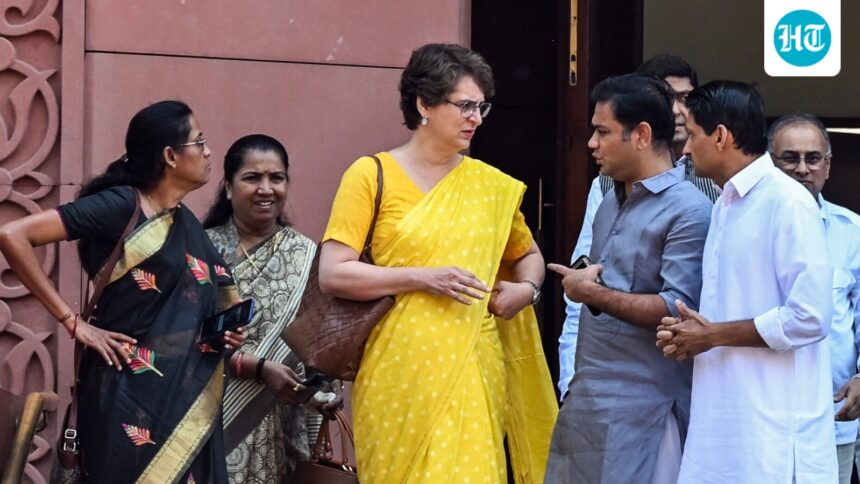
A day after the Narendra Modi government’s Constitution (131st Amendment) Bill fell in the Lok Sabha – the first defeat for a government bill in 12 years – the Opposition on Saturday tried to wrest control of the narrative, with Congress MP Priyanka Gandhi Vadra issuing a public challenge directed at the government.

“They should introduce the old women’s bill – passed by all parties in 2023 – immediately on Monday. Convene Parliament on Monday, bring the bill and let’s see who is anti-women. We will all vote and support you,” she told news agency ANI.
She accused the BJP-led NDA of trying to mislead voters in West Bengal and Tamil Nadu, two states that will vote later this month, by calling the opposition parties “anti-women”. Tamil Nadu’s ruling DMK even introduced a bill to grant the quota within the existing Lok Sabha strength of 543. Bengal’s ruling Trinamool Congress said it supports even a 50% quota if it is not linked to delimitation based on the 2011 census.
The “old bill” that Priyanka Gandhi referred to is the Nari Shakti Vandhan Adhinyam or Constitution (106th Amendment) Act, 2023, which already provides for 33% reservation for women in the House and state assemblies. He was already notified this week.
The reason it cannot be implemented is because the BJP-led government introduced a condition requiring a fresh census and demarcation of boundaries before it can come into effect – a condition the opposition says it did not want until then.
What Priyanka, Rahul said
At a press conference in New Delhi on Saturday, Priyanka Gandhi urged the government to act without delay: “If you want to do something concrete, bring back the bill that was passed unanimously in 2023, with cross-party support. If you need to make some small amendments to it, so that it can be implemented now, do it. Give women their rights, now.”
She also described the failure of the new bills as a “black day” for the government, retracting a term used by the BJP against the Congress-led opposition: “…because they felt shocked for the first time, which they deserve. Women’s problems today are increasing exponentially. Women are not fools. They see everything. PR and media hype will not work anymore.”
Priyanka Gandhi reiterated that the opposition’s position was not against women’s reservation, but rather against linking it to delimitation and census.
“They thought that if it is passed, they will win. If it is not passed, they will become ‘saviors of women’ by calling other parties ‘anti-women’… We know that becoming a savior of women is not easy,” the Wayanad (Kerala) MP said.
Her brother, opposition leader Rahul Gandhi, was at an election rally meanwhile in Puneri in Tamil Nadu state, where he said: “The Modi government has introduced a new bill, claiming it is a women (quotas) bill, even though it has already passed the same bill in 2023. Hidden inside.” [the new bill] The demarcation issue was aimed at reducing Tamil Nadu’s representation and weakening the southern, smaller and north-eastern states. “We defeated that.”
Message to Prime Minister Modi
The Congress-led India Caucus, which includes non-NDA parties, also announced that it would formally write to Prime Minister Narendra Modi to demand implementation of the original 2023 law, without demarcation.
Tamil Nadu’s ruling DMK party even sought to introduce a new bill for this purpose, calling for an immediate quota within the current Lok Sabha strength of 543, for example. But Parliament was adjourned indefinitely on the third day of a special session held specifically on the issue of women’s quotas.
Party leaders from across the alliance held a meeting in which Sonia Gandhi, president of the Congress Parliamentary Party, expressed her gratitude to all allies for sticking together.
Several India Bloc parties held simultaneous press conferences to announce their support for women’s reservation, but not under the guise of a delimitation exercise which they believe is aimed at redrawing India’s electoral map in favor of the BJP.
DMK’s big move, dig Tharoor
A challenge was also made in legislative form by the Dravida Munnetra Kazhagam (DMK) where the party’s MP from Tamil Nadu introduced the Private Member’s Constitution Amendment Bill in the Rajya Sabha, proposing 33% reservation for women from the upcoming elections to the current 543-seat Lok Sabha – without any census, without any demarcation or expansion of the House.
Unlike the Government Bill, 2023, the DMK Bill called for reservation to be made permanent and not limited to 15 years.
Congress MP Shashi Tharoor, who spoke out against the warning on women’s quota in the Lok Sabha on Friday, criticized the government in his own style, online, on Saturday.
He posted on X a photo, among others, with Parliamentary Affairs Minister Kiren Rijiju, whom he described as “charming”. He said Rijiju explained why he and his BJP called the opposition ‘Mahila Virudi’ (anti-women).
“He was told that no one could call me an anti-woman! And he conceded the point,” Tharoor wrote.
He added: “Let’s face it, women are by far the better half of the human race. They are the improved models: Humans 2.0. They deserve representation in Parliament and in every institution. Just don’t tie their progress to a harmful and potentially dangerous demarcation that could destroy our democracy.”
Government position
The BJP’s messaging after it failed to get the approval of a two-thirds majority in Parliament was well-coordinated. Home Minister Amit Shah accused the Congress, TMC, DMK and Samajwadi Party of obstructing the historic reform.
“The opposition will have to face women’s anger not just in the 2029 Lok Sabha elections, but at every level, in every election… This insult to Nari Shakti will not stop here, it will spread far and wide,” he said.
So far, the government has not explained why the 2023 Act cannot be amended simply to remove the census delimitation requirement, and instead make it effective for existing seats.
Amit Shah argued in Parliament that expanding seats by a fixed 50% would mean no state would lose its proportionate share. This was a major concern in the southern states where population control measures were better implemented than in northern India, where the BJP has its main base.
Amit Shah said the expansion would give Tamil Nadu 59 seats, with 20 seats reserved for women, instead of 13 seats out of the current 39. The BJP argues that this would protect the positions of existing leaders, while giving more space to women.
Congress MP KC Venugopal pointed out an apparent contradiction in the Lok Sabha. He said: “We only stipulated that a population census would be conducted, followed by border demarcation, and then reservation would happen. We never said that. We said, only at that time, that we need reservation for women by the 2024 elections.”
Sonia Gandhi had made the same point in a newspaper article dated April 13, three days before the start of the special session: “Leader of the Opposition in the Rajya Sabha, Mallikarjun Kharge, has strongly demanded implementation of the reservation clause from the 2024 Lok Sabha elections itself. For reasons best known to her, the government has not agreed. Why did it take the Prime Minister 30 months to back down?”
A question that never goes away
But there is one issue that remains prominent, which is that the passage of the 2023 bill did not… It solves it too.
The Nari Shakti Vandan Adhiniyam provides for reservation within the existing SC and ST quota: one-third of the seats already reserved for Scheduled Castes and Scheduled Tribes will go to women from those communities.
What it does not offer, is the equivalent for women from other backward classes. OBCs do not have any political reservations in Parliament or state assemblies. The Constitution reserves SC and ST seats under Articles 330 and 332. There is no equivalent provision for OBCs.
An OBC sub-quota within women’s reservation is constitutionally impossible without first creating a political reservation for OBC – which itself would require a separate constitutional amendment.
This is why parties like the Samajwadi Party and the RJD voted in favor of the 2023 bill, while simultaneously opposing it.
Akhilesh Yadav raised the demand in Parliament this week as well, “What if they don’t count OBCs and Muslims in the half of the population that are women? We want Muslim women and OBCs to get reservation – that is our demand.”
The 2026 caste census – the first nationwide caste census since 1931 – should generate the data needed to make this demand actionable. Government surveys in Bihar and Telangana have already shown that backward castes constitute about 60% of the population. A national figure on this scale would create almost irresistible political pressure for OBC political conservatism.
The government was allegedly trying to sidestep this question by seeking to draw boundaries based on the 2011 census before that caste data was available. “Beginning with demarcation first can be seen as a way to secure structural advantages before new data reshapes expectations, alliances and claims to political power across states and social groups,” Manoj Kumar Jha, an RJD member in the Rajya Sabha, explained earlier this week.
The question of border demarcation itself remained unresolved for 50 years. It was last implemented in the 1970s, then postponed for 25 years twice. Now this is anyway scheduled to happen after 2026. Besides the OBC quota demand, there are other fundamental questions that remain unresolved. Southern states fear losing their relative share in the long term if population is used only as a basis for border demarcation.
Amit Shah said the fixed 50% increase would not change the state’s share, and at the last minute promised to write it into law.
By then, it seemed too late. Regarding border demarcation, the parties want further discussions. The Congress, TMC and DMK said the women’s quota could be implemented earlier for now.

Arish Chhabra is an associate editor on the Hindustan Times online team, where he writes news reports and explanatory features, as well as overseeing the site’s coverage. His career spans nearly two decades across India’s most respected newsrooms in print, digital and broadcast. He has reported, written, and edited across formats—from breaking news and live election coverage, to analytical long-reads and cultural commentary—building a body of work that reflects editorial rigor and a deep curiosity about the community for which he writes. Areesh studied English Literature, Sociology and History along with Journalism at Punjab University in Chandigarh, and began his career in that city, eventually moving to Delhi. He is also the author of Little Big City: What Life is Like from Chandigarh, a collection of critical essays originally published as a weekly column in the Hindustan Times, which examines the culture and politics of a city that is much more than just its famous architecture – and in doing so, holds up a mirror to modern India. During his stints at BBC, The Indian Express, NDTV and Jagran New Media, he has worked across formats and languages; Mainly English, as well as Hindi and Punjabi. He was part of the crack team for the BBC Explainer project which was replicated around the world by the broadcaster. At Jagran, he developed editorial guides and trained journalists on integrity and quality content. He has also worked at the intersection of journalism and education. At the Indian School of Business (ISB) in Hyderabad, he developed a website to streamline academic research in management. At Bennett University’s Times School of Media in Noida, he teaches students the craft of digital journalism: from newsgathering and writing to social media strategy and video storytelling. Having moved from small town to larger town to megalopolis for education and work, his intellectual passions lie at the intersection of society, politics, and popular culture—a perspective that guides his writing and worldview. When he’s not working, he’s constantly reading long-form journalism or watching cerebral content, sometimes both at the same time.Read more