The aim of the Transgender Persons (Protection of Rights) Amendment Bill, 2026 is to provide protection to such people, the government said on Tuesday, as the opposition criticized the proposed legislation to take away the right to identity self-determination and demanded it be sent to a standing committee for proper consultations.

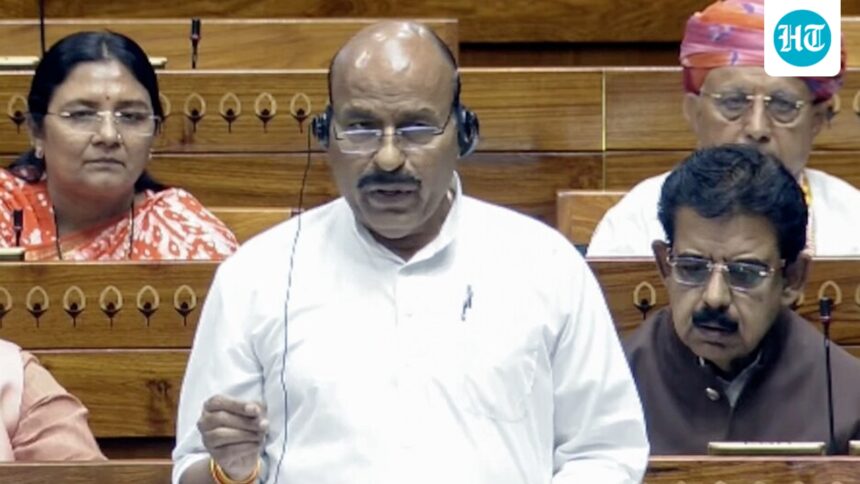
Moving the bill for consideration and passage in Lok Sabha, Social Justice and Empowerment Minister Virendra Kumar said its aim is to provide safety and benefits to the society.
“To ensure that transgender people can avail the benefits of this law, it was necessary to provide them with an accurate definition; this bill was introduced to address this very need,” the minister said.
He said that the draft law includes a provision for the establishment of a medical committee.
He said district judges would issue identity cards to transgender people.
Congress MP Jyothimani, who participated in the discussion, said the bill was brought without consultations from transgender people and shows the government’s “callous” stance.
Read also: ‘Very reactionary proposal’: Shashi Tharoor strongly criticizes new transgender bill
She said Opposition Leader Rahul Gandhi and Congress MP Priyanka Gandhi listened to transgender people and deeply understood what they felt.
Jyothimani stressed that this bill is not a reform.
The Supreme Court ruling recognized that gender identity is a matter of self-determination.
“It was emphasized that dignity, bodily autonomy and identity are protected under Articles 14, 15, 19 and 21 of the Constitution,” she said.
The congressman criticized the requirement to bring a medical board for identification and claimed that the bill narrows the definition of transgender people.
“This is not democracy, it is a monologue of power which is the trademark of the Modi government,” Jyothimani claimed.
She stressed the need to refer the draft law to a permanent committee to conduct comprehensive consultations with transgender people.
Opposing the legislation, Anand Bhadauria of the Samajwadi Party said that the government claims that the bill is aimed at taking care of transgenders, but if this is true, then why are they opposing this bill on the streets.
Read also: Opposition lawmakers and activists oppose the transgender identification bill
He pointed out that it was the SP who created the ‘Samajwadi kinnar sabha’ within its organizational ambit.
“The BJP wants to make people stand in queues. Now it wants to make transgender people stand in queue for their identity,” he said, adding that the bill gives a limited definition to transgender people.
“It is unfair exclusion and not based on constitutional principles,” he said.
DMK’s T Sumathi also criticized the government for allegedly interfering in the right to identity self-determination.
“This government is treating the transgender community as people to be corrected which is highly condemnable… The DMK rejects the bill. The government should withdraw the bill and at least send it to the Standing Committee of Parliament,” she said, calling the bill “draconian.”
The bill seeks to provide a precise definition of the term “transgender” and exclude “different sexual orientations and self-perceived gender identities” from the ambit of the proposed law that was introduced in the Lok Sabha earlier this month.
The draft law stipulates graduated penalties that reflect the seriousness of the harm caused to these people.
It emphasizes that a transgender person “may not, and will never, include people with different sexual orientations and self-perceived gender identities.”
“The intent, object and purpose of the Act is to protect a specific category of persons known socially and culturally as transgender persons who face societal discrimination of an extreme and oppressive nature.
“It was, but is not, the purpose of protecting every category of persons with diverse gender identities, self-perceived gender/sexual identities, or sexual orientations,” the bill says.
The draft law indicates that it is necessary to give a precise definition for the correct and final identification and protection of transgender persons, to whom the benefits of the current law should reach.
The protection and benefits afforded under the current Act 2019 are broad in nature and, therefore, care must be taken that “this definition cannot be expanded based on any obtainable characteristics, personal choice or purported self-identity of the individual”.
The draft law also includes provisions for an “appointed authority” who will have the option to seek “expert advice” if necessary.
A new provision defines ‘authority’ as a medical council headed by the Chief Medical Officer or Deputy Chief Medical Officer appointed by the Central Government, State Government or Union Territory Administration.
The bill notes that over time, during the implementation of the Transgender Protection Act, “certain doubts and difficulties have arisen and are likely to arise” regarding “widening the definition” of transgender.
Inserts a new sub-clause to define a transgender person as a person with socio-cultural identities such as ‘relative’, ‘hijra’, ‘aravani’, ‘jogta’ or eunuch, a person with gender differences or a person who, at birth, has a congenital difference in one or more sex characteristics compared to male or female.
The draft law proposes to create specific crimes with graduated penalties that reflect the seriousness of the harm, the irreversibility of the harm, and the particular vulnerability of child victims.