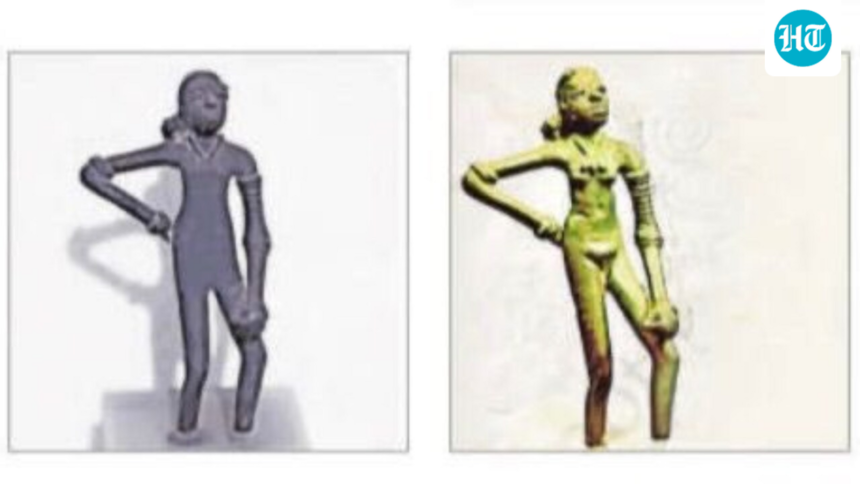
A doctored image of the famous bronze statue known as the ‘Dancing Girl’ of Mohenjo-Daro has appeared in NCERT’s new Class 9 textbook, raising concerns about how one of India’s most iconic artefacts will be presented to students.

The bronze statue, one of the most iconic relics of the Indus Valley Civilisation, is shown with its bare torso obscured in Madhurima, NCERT’s new art education textbook for Class IX. Shading has been added across the upper body, making it noticeably different from photos of the original statue.
The Dancing Girl was discovered at Mohenjo-Daro, and remains among the most famous artifacts from the Indus Valley Civilization.
This change has also drawn attention because the same artifact appears unchanged in the NCERT Class 6 Social Science textbook.
The image has been deemed “age inappropriate”
Historian Michel Danino, who chaired the committee that developed the new NCERT social science textbooks for grade six, said he had previously been told that the “dancing girl” image had been rated as inappropriate for younger students.
“This refers to a social science textbook for class 6. The reason I was given was that the picture of the dancing girl was not age appropriate,” Danino told news agency PTI.
Read also | Rahul Gandhi calls on youth to join Kota protest against exam paper leaks on June 17: ‘Need to raise your voice louder’
According to him, the textbook team did not agree with this assessment. He said: “Our team did not agree; we even contacted the sixth-grade teachers, and they told us that there was no problem at all with the dancing girl.”
Danino questioned the reasons behind these concerns, saying: “The idea that nudity is indecent is, in my opinion, an outdated Victorian view. And yet we are talking about decolonizing Indian education.”
“If a dancing girl cannot appear as she is, with the right proportions, in a class on Indian art, we have a serious problem,” he said.
The agency quoted the historian as saying: “The modification distorts the original artifact just as the church’s addition of a fig leaf to Michelangelo’s medieval statue of David misrepresented this beautiful work of art.”
Danino also criticized the edits made to photos of historical objects, saying they risk distorting the record.
The textbook asks students to analyze the statue’s pose
The chapter titled History of Art identifies the dancing girl as a bronze statue from Mohenjo-Daro dating from about 2600 B.C. He describes the statue as an example of the lost-wax casting technique, a method still practiced textbook notes in parts of West Bengal, Jharkhand and Chhattisgarh.
“This statue depicts a posture of one knee bent, one hand on the waist, and the chin slightly raised,” the textbook says.
Students are also asked to interpret what the pose might represent and engage in an activity that involves recreating and drawing the pose.
NCERT is yet to explain why the statue is depicted differently in the Class 9 Art book and the Class 6 Social Science book.
(with PTI inputs)