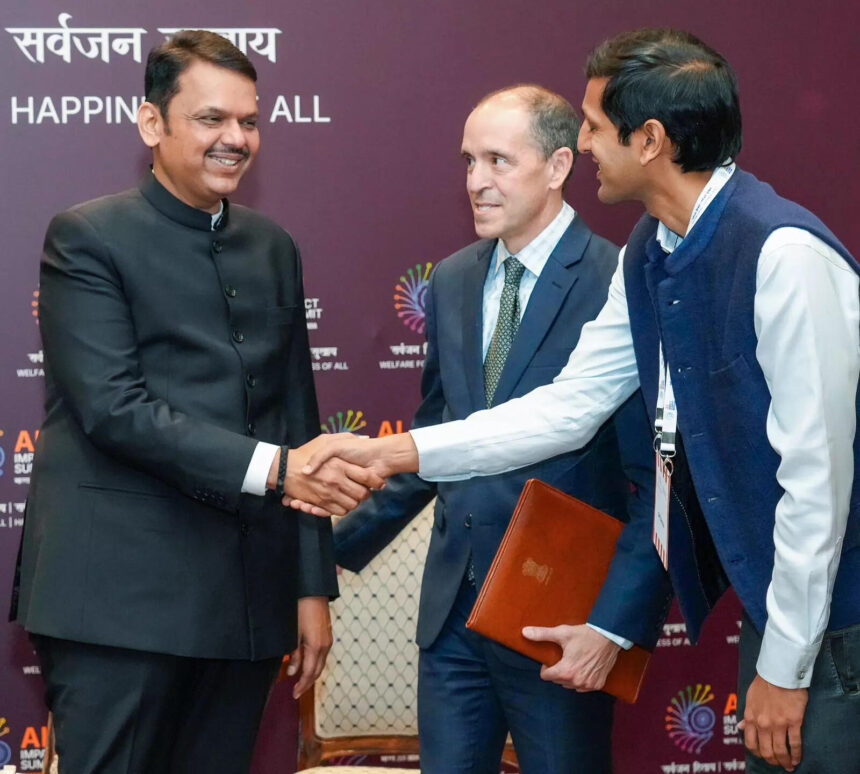

New Delhi, February 20 (ANI): Maharashtra Chief Minister Devendra Fadnavis along with Head of Public Policy, OpenAI Chris Lehane and Rocket Learning Co-Founder Aziz Gupta launched Shiksha Sathi at the India AI Impact Summit 2026, in New Delhi on Friday. (@CMOMaharashtra
NEW DELHI: The future of artificial intelligence will be shaped by the contest between “democratic AI” and “authoritarian AI,” Chris Lehane, chief global affairs officer at OpenAI, said on Friday, arguing that the way states govern technology will determine whether it empowers individuals or entrenches state control.Lehane told TOI that the divide is evident in the growing strategic competition between the US and China, and that large democracies, especially India, will play a crucial role. He described “democratic artificial intelligence” as systems that are “open, transparent, follow the rule of law” and act as “a tool for the individual to expand his capabilities, to learn, think, build, create, and produce.” In contrast, AI developed in “authoritarian regimes” is “designed to reinforce central authority and authoritarian government,” rather than to empower individuals.He pointed out that governance is essential in racing. Citing Russian President Vladimir Putin’s observation that whoever leads with AI will “win the world,” Lehane said the values embedded in AI systems will shape the world order that emerges.Regarding oversight, he said new rules are inevitable for general-purpose technology. AI safety institutes are emerging in the US and UK, with India exploring a similar approach.
Asked whether OpenAI would support audits of its advanced systems, Lehane said the company is subject to transparency requirements under safety frameworks in the United States such as California and New York and works with safety institutes in the United States and the United Kingdom. He distinguished between transparency and disclosure of proprietary information, noting concerns about intellectual property protection. He said basic safety standards can be developed collectively, but countries must retain the capacity to deploy AI in accordance with societal contexts. For India, the risks are high.