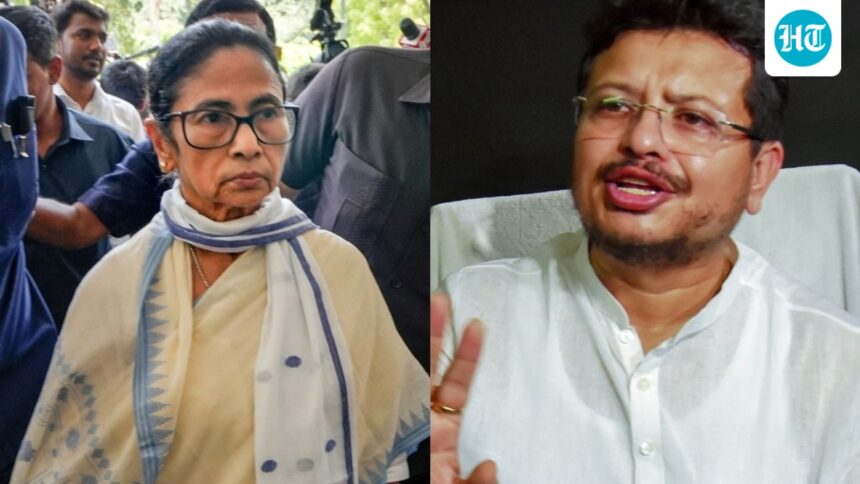
Two factions of the Trinamool Congress, each insisting it is the real party, submitted competing lists of office bearers to the Election Commission of India (EC) on Tuesday, in a procedural move that opened a formal battle over the party’s name, origins and symbol.

The split has divided the West Bengal party after the Bharatiya Janata Party (BJP) overwhelmingly won 207 seats against TMC’s 80 in the Assembly elections in April.
Former chief minister Mamata Banerjee’s camp has since lost 62 of its 80 party members, the leader of the opposition in the assembly, and the mayor of the Kolkata Municipal Corporation.
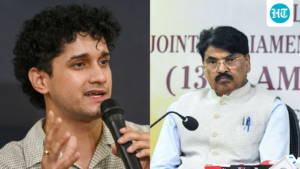
On Monday, the rebel faction led by Ritabrata Banerjee voted to remove Mamata Banerjee as party president and appoint MLA Arup Roy in her place. Mamata’s camp responded with its own list, retaining her as chair, even as it described the submission as an “original but minority” list.
The dispute is now expected to move to the electoral commission’s dual test, which has been used to determine which faction has the right to claim the party’s identity and resources.
Testing
Under paragraph 15 of the Electoral Symbols (Reservation and Allotment) Order 1968, the EC has the power to determine which group represents the real political party once a recognized party has split and its name and symbol are claimed by rival factions.
Both factions of the TMC have already launched this process – the rebel group through a letter to West Bengal’s Chief Electoral Officer (CEO) demanding recognition of the TMC’s twin flower symbol, and the Mamata camp through its revised and dated list of office bearers.
The poll will examine competing claims on the strength of support in two arenas: elected legislators (“legislative wing”) and the party’s formal organizational structure (“organizational wing”). Together this is known as the wings test.
Hizb ut-Tahrir reported that the rebel faction controls 81% of lawmakers in the Transitional Military Council.
The process may take some time. Normally, the European Commission would issue notices to both factions, set a deadline for submissions and evidence of regulatory control, and conduct detailed hearings.
In case the Shiv Sena and NCP split in the last few years, it took months before the EC came to a final decision.
Read also: The crisis-hit Transitional Military Council is reshaping the party’s organization and reducing the role of advisors
SC ranking behind the test
The dual test goes back to the Congress split in 1969, when the party split into factions after a dispute over its presidential candidate – the ‘J’ Congress led by Jagjivan Ram, and the ‘O’ Congress led by S. Negalingaba. Each of them claimed the right to the party’s symbol, “Eruption with a Yoke.”
The European Commission had to decide which group was, formally, the Indian National Congress.
The committee first checked whether either faction rejected the party’s stated aims and objectives. Neither did, making this test redundant.
The EC then turned to numerical strength in the two wings that gave the test its name: the ‘J’ Congress retained a majority of MPs and MLAs who returned to Congress tickets at the national level, although the ‘O’ Congress gained ground in states like Gujarat and Mysore. The J Congress also controlled a majority in the All India Congress Committee, the party’s organizing body.
The Committee later recognized the ‘J’ Congress as the Indian National Congress on 11 January 1971.
But Congress Secretary General Sadiq Ali appealed the poll committee’s decision.
The Supreme Court bench led by Justice H.R. Khanna dismissed the appeal on 11 November 1971, holding that the majority and numerical strength test was a “relevant and valuable test” that had been properly applied by the Commission, that paragraph 15 fell within the powers of the EC, and that the election symbol was not the property of the party using it.
The 1971 ruling, Sadiq Ali v. Election Commission of India, remains the precedent against which party divisions are measured.
Read also: Why can winner-take-all politics weaken democracy?
Before TMC
More recent applications of the two-wing test came with the breakup of the Shiv Sena and NCP in Maharashtra.
Eknath Shinde rebelled in 2022, walked out with the bulk of Shiv Sena legislators and brought down the Uddhav Thackeray-led Maha Vikas Aghadi (MVA) coalition government in the state.
In February 2023, the EC said it found the regulatory wing test inconclusive in the Shiv Sena case, so it backed down from the legislative wing test, which gave majority to the Shinde faction.
Shinde retained the name Shiv Sena and the ‘bow and arrow’ symbol, while the Thackeray faction was registered as the Shiv Sena (Uddhav Balasaheb Thackeray) with the ‘flaming torch’ symbol.
A split in the National Congress Party followed the following year. Ajit Pawar left with a majority of party legislators in July 2023 to join Shinde’s government as Deputy Prime Minister. The EC decided in his favor over Sharad Pawar’s faction in February 2024.
Implications for TMC
The contest reaching the legislative wing could favor the rebel faction in the Trinamool Congress case. The faction, in its report to the EC, cited the TMC’s constitution and said the three-year term of office of the party’s National Working Committee had expired and was, therefore, invalid.
Any faction recognized by the EC is likely to inherit the Trinamool Congress name, the double flower symbol, its registered voter base and its official status as a regional party.
With a final decision awaited, both factions may have to start considering interim measures before Kolkata’s municipal elections scheduled for this year.
Until there is a ruling from the European Commission, civil suits over TMC’s assets cannot begin either. the $An amount of Rs 676 crore held in the party’s primary bank accounts has already been frozen and is likely to remain so till then.
Either way, control of the Trinamool Congress brand could be settled in Delhi, not Kolkata.