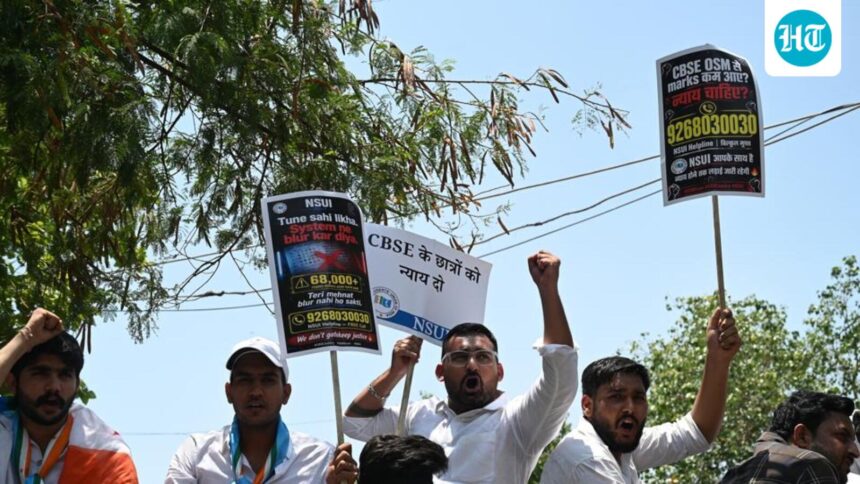
The National Students Union of India (NSUI) has approached the Delhi High Court seeking an independent probe into alleged widespread irregularities, technical deficiencies and grievance redressal failures linked to the Central Board of Secondary Education’s (OSM) on-screen marking system affecting Class 12 students, contending that the repeated public clarifications from the CBSE reflect serious doubts among students and the public regarding the integrity of the digital assessment system.

CBSE’s OSM system is a digital assessment mechanism where examiners evaluate students’ scanned online answer sheets instead of physically checking them. The contract for the system was awarded to Coempt Edu Tech on December 5, just 74 days before board exams began on February 17.
However, after the Class 12 results were announced on May 13, the OSM system came under scrutiny amid allegations of technical glitches, unclear checks, discrepancies in assessment and concerns about data security and transparency.
The Union Education Ministry on Monday sought a detailed report from the CBSE on the OSM procurement process as scrutiny intensifies around the platform’s launch and alleged irregularities in the board’s bidding process, coupled with cybersecurity concerns linked to its digital assessment framework.
Meanwhile, after facing repeated delays, CBSE on Tuesday opened the online portal to check marks and re-evaluate results of Class 12 board exams.
NSUI, in its petition filed through President Vinod Jhakar on behalf of students appearing for CBSE Class
The petition, championed by advocates Rishav Ranjan and Esha Bakshi, also sought extension of the verification and re-evaluation portal for an additional month to enable aggrieved students to pursue redress, along with compensatory marks for students whose answer scripts are allegedly missing, unclear or incorrectly assessed.
The CBSE has itself admitted, through public communications, that the portal for getting scanned copies of answer books witnessed a technical glitch, the NSUI petition said.
It also said that nearly 1,27,146 applications relating to 3,87,399 scanned answer books were submitted within a short period, reflecting an extraordinary level of anxiety and mistrust among students regarding the assessment process.
The petition stated that such a large volume of applications submitted immediately after the announcement of the results could not be dismissed as a routine procedure after the result.
CBSE has repeatedly extended deadlines for obtaining scanned copies of answer sheets and issued multiple public clarifications acknowledging students’ concerns and technical issues, the petition said.
It also said that the CBSE had issued a clarification on the allegations surrounding the OSM portal, asserting that the impugned URL was merely an exam website containing sample data.
The need for successive public clarifications in itself indicates the emergence of serious doubts in the public mind regarding the integrity of the digital assessment system.
“Students whose answer sheets have been properly scanned and evaluated stand in a different position from those whose answer sheets have been affected by scanning defects, mismatch errors or other technical malfunctions. Such unequal treatment, caused by the respondent system, is arbitrary and violates Article 14 of the Constitution of India. Students cannot be made to suffer because of the deficiencies in the system introduced by the authorities themselves,” the petition said.