New Delhi
In December 2019, a young veterinarian was raped and murdered along a dark stretch of road in Hyderabad. Days later, women across the city launched an online campaign called “Light Up Hyderabad,” demanding that dark stretches, broken street lights and blind spots be mapped and fixed.
The campaign went viral, with the lack of proper street lights becoming a hot topic of discussion in many cities.
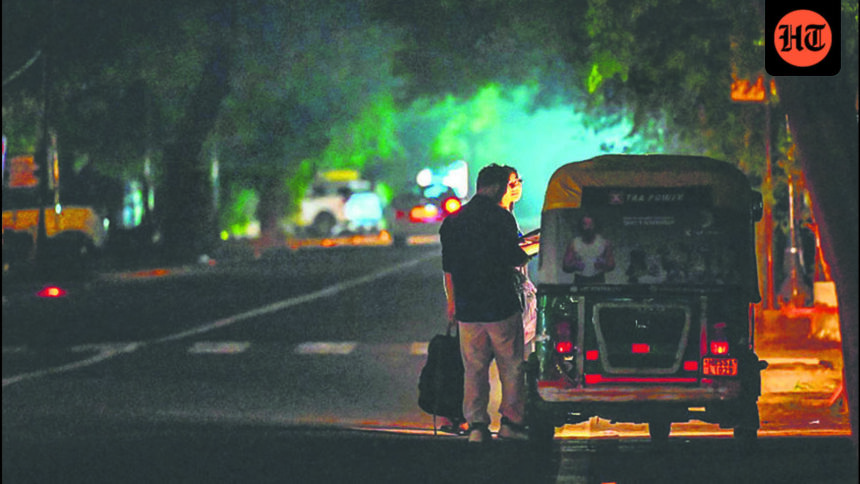
But six years later, not much has changed. Municipal surveys and corporate audits over the past year paint a bleak picture: many roads and public spaces are plunged into darkness in India’s largest cities.
Hyderabad Municipal Corporation recently announced A $1,340-crore overhaul after recognizing that more than 70% of the 760,000 street lights were nearing the end of their operational life, with 20-30% either non-functional or providing insufficient lighting. Spot checks by this newspaper in Gurugram in May and June found many major roads plunged into darkness, while a night-time audit by the Bengaluru Outer Ring Road Corporations Association found that nearly 70% of the lights along the city’s technology corridor were not working. In Delhi, a lack of improvements and regular maintenance has left several spaces dark or dimly lit.
The consequences are costly, if not always visible: whether street lighting determines whether a woman feels safe walking after dark, or whether a street stays alive after 8pm or empties.
“The real problem in India is that street lighting is still considered an electrical service and not a city-building tool,” says Hitesh Vaidya, an urban expert and former director of the National Institute of Urban Affairs. “It’s about making people feel safe, supporting markets, encouraging walking and activating public spaces.”
Architect Dikshu Kokria agrees: “We have invested heavily in roads, bridges and buildings, but we rarely ask what makes a street usable after sunset. Good lighting is often the invisible layer of urban infrastructure, only noticeable when it fails. Without it, cities literally give up half their public life every day.”
Not just a bulb on a pole
Vaidya says conversations about street lighting in India often boil down to numbers — installing poles, replacing LEDs, saving electricity — rather than focusing on how lighting can be integrated into larger city planning.
Architect Shimul Javeri Qadri points out that Indian cities never had to think much about street lighting because the lighting from homes, shops and vendors kept the streets lit on their own — a byproduct of mixed-use neighborhoods rather than single-use zoning.
Today’s planning tends to do the opposite: “Cities are increasingly designed around single-use areas; at BKC or Nariman Point in Mumbai, the lights go out by 7pm once the offices close. With no vendors, no residents, no eyes on the left street, safety drops dramatically,” Qadri says.
Urban designer Akash Hingorani says the solution lies in the kind of mixed-use planning called for by the UN’s New Urban Agenda — compact neighborhoods that remain active and well-lit into the evening. But not every extension can be so versatile. “If the land use along the street is institutional—a college campus, a park, or tall block walls—those are negative edges that need more subtle pedestrian lighting.”
So, the solution is not just more columns. It’s understanding where people are actually going.
Which cities abroad have got it right
Some cities treat street lighting as part of their street design. The New York Department of Transportation (NYCDOT) manages more than 400,000 streetlights across 10,000 kilometers of roads and 19,000 kilometers of sidewalks, treating the entire right of way—the road, sidewalks, and bike paths—as one system. “Sidewalks have to maintain 10 to 20 lux of illumination, which can come from a range of sources,” says Parul Agarwala, former country program director for India at the United Nations Human Settlements Program (UN-Habitat) and a former planner in the New York City Department of Planning. She says New York’s focus on reducing glare and skyglow, and providing relief for people with sensory conditions, is a model worth studying. “Overall lighting is as important as adequate lighting.”
NYCDOT follows the Street Design Guide, which regulates the type and location of streetlights permitted. “Every city should have a guide that says what kind of lighting each street needs—not just lux levels and color temperature, but whether the light makes the space look inviting or leaves it cooler than it actually is,” Kadri says.
She adds that for women, proper lighting is a matter of getting to the city. “A woman’s freedom to move through her city at any hour is one of the truest measures of how equal that city is, and light is one of the first things that gives or takes away that freedom. But light alone cannot create safety; it works best where there are already people in the street. A bright light over an empty, dead street is far less reassuring than a softly lit light with life around it.”
Lighting is always among the strongest factors in whether women feel comfortable using public spaces after dark, says Kalpana Vishwanath, co-founder of Safetipin, which has conducted safety audits across Indian cities for years. The solution, she says, is human-sized lighting designed for pedestrians, not tall median poles meant for cars. “Many cities are now working on our safety audits. We recently submitted a detailed report to Gurugram, which is a report that badly needs improvement.”
Prachi Gupta, a teacher in Gurugram, agrees. “Sometimes, I have to use my phone’s flashlight to navigate in dark places,” she says. “It is men who decide on street lighting for men. Public lighting must be gender-sensitive.”
Qadri, who also serves on the Gender Advisory Committee of the Greater Mumbai Municipal Corporation, describes lighting as “gender work” – and says women should be in the room when these decisions are made, at the design stage. When asked what the committee actually recommended for Mumbai, she answered frankly: “Neither I nor the advisory committee were consulted on this matter.”
But she says her own suggestion would be to prioritize routes frequented by women: the corridor between the station and home, the bus stop, and the approach to public toilets, “rather than lighting up the main road and thinking it’s over.”
Who keeps the lights on
Milind Maske, CEO of the Praja Foundation, says street lighting is a low management priority despite adequate budgets – and this shows in how contracts are managed. Many cities have outsourced installation and maintenance work to private companies or public sector agencies, yet service outages continue, due to poor oversight, or contracts lapsing or being terminated either due to poor performance or late payment.
Lucknow is an example of this. After the expiration of its contract with EESL (Energy Efficiency Services Limited), the municipal corporation brought work back in-house, but staff shortages led to frequent power outages, with residents… Upscale areas like Hazratganj and Gomti Nagar frequently report poorly lit streets.
Manoj Prabhat, chief engineer at the Lucknow Municipal Corporation, says it was maintaining about 250,000 street lights with about 450 employees until recently. “We have recently hired an additional 30 employees,” he says. “We will adopt LoRa-based systems in new areas to ensure faster response when the lights go out.”
Many cities have recently announced much larger reforms to public lighting. People with disabilities in delhi have $Rs 473-crore smart city lighting project, with central monitoring and ‘no performance, no payment’ clause for contractors; Ahmedabad and Mumbai have major modernization programs of their own.
Tata Projects, which runs smart lighting systems in Pune, Nashik, Noida and Ludhiana under performance-based contracts, says digital monitoring has reduced energy usage by 56-62% while improving uptime.
“Many cities have relied on fragmented maintenance practices, which means high rates of non-functional lights, delayed repairs, wasted energy and limited visibility into asset performance,” says Rajendra Inani, Vice President (Water and Smart Cities), Tata Projects. The solution, he says, was an all-digital model. Bugs are automatically flagged, remediation teams are deployed faster, and payments are tied to performance.
Kokria sees a bigger opportunity once lighting is connected digitally: poles that also serve as hosts for sensors, electric vehicle charging, Wi-Fi, surveillance cameras and air quality monitoring — the backbone of the city’s smart infrastructure. “The challenge is to keep these projects based on design and not just technology,” he says.
Light as memory
Lighting also creates memory and gives the city its special character, say urban designers.
Mumbai’s Marine Drive earned its nickname – the Queen’s Necklace – because of the warm glow that paints the coastline every evening. When cool white LEDs briefly replaced them, public reaction was swift, and BMC restored the warmer tone.
Some cities take their lighting heritage seriously. Los Angeles, for example, has an office dedicated to street lighting, and even a street lighting museum that traces the history of lighting in the city.
But Kadri says Lyon, France’s second-largest city, is a better example. Developed in 1989 and most recently revised in 2023, the city-wide lighting plan treats light as a tool for urban transformation. “The goal of the plan is to highlight the city’s heritage through light, protect energy use and nocturnal wildlife, and give citizens a real say in how their neighborhoods are lit,” she says. `
Between 2000 and 2021, lighting points in Lyon rose by more than a quarter, yet electricity consumption fell by half, and light pollution decreased. It also holds the Festival of Lights, which lasts for several days and attracts tourists and revenue.
Kadri also cites Kyoto’s outdoor advertising law, which divides the city into eight landscape control zones; The historic core allows almost no commercial signage. “The city treats the day-and-night visual character of its historic core as something worthy of protection under the law,” she says.
Cities are remembered as much for their nighttime character as they are for their daytime skyline, Kokria says. “The emotional connection between people and place is often shaped by light – the warmth of the street, the silhouette of the monument, the glow off the waterfront,” he says. He adds that when streets remain active into the evening, cities gain economically through longer working hours, culturally through increased use of public space, and socially through stronger community ties. “It tells residents that public spaces belong to everyone, not just during the day, but at night as well.”