The government said on Sunday that fuel and LPG supplies remained normal across the country, with oil marketing companies supplying around 5.5 million cylinders on Saturday, and petrol and diesel retail outlets operating without interruption.

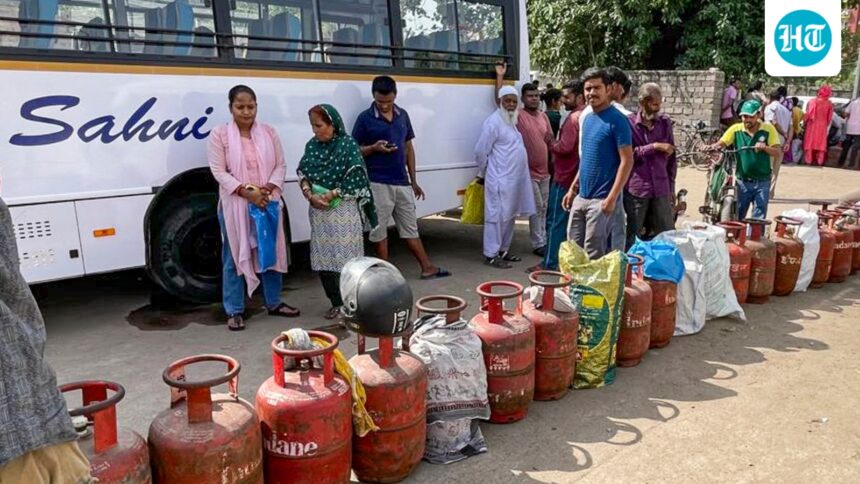
In its daily update on energy supply and fuel availability, the Ministry of Petroleum and Natural Gas said panic buying has been reported in some areas due to rumours. “Some rumors have led to unusually high sales and severe crowding at retail outlets in a few states,” the ministry said.
Although LPG supplies are affected by the prevailing geopolitical situation, no “dryness in LPG distributors” has been reported, the ministry said. Online LPG bookings rose to 94% on an industry basis, compared to 84% before March 15. To prevent diversion at the distributor level, deliveries based on the Delivery Authentication Code (DAC) increased from 53% in February to 84% on Saturday.
Read also | Where does the gas come through the pipelines? Why Papua New Guinea is holding out while LPG struggles amid the Iran war
“Yesterday, more than 55,000 LPG canisters were delivered,” the statement said, stressing that the supply of domestic LPG cylinders remains normal. On Saturday, about 64,000 cylinders of free commercial liquefied petroleum gas weighing 5 kg were sold.
“In light of the ongoing closure of the Strait of Hormuz, proactive measures are being taken to maintain the uninterrupted availability of petroleum products and liquefied petroleum gas throughout the country,” the ministry said in a statement.
The increase in demand comes amid escalating tensions in West Asia, which has pushed global crude oil prices to rise sharply. Benchmark Brent crude has risen nearly 58% over the past month to $112.57 per barrel as of March 27.
The government recently reduced customs duties on gasoline and diesel by a percentage $10 per liter to provide relief to refiners facing recovery shortfall, as fuel prices are linked to international standards. To ensure adequate domestic supplies, the government also imposed export duties worth $100 million $21.5 per liter on diesel and $29.5 per liter of aviation turbine fuel (ATF).
The government is also encouraging the switch from LPG to natural gas. Consumers have been prioritized for 100% supply of domestic PNG gas and CNG transportation, while supply to grid-connected industrial and commercial consumers is approximately 80% of average consumption.
“Gas distribution entities in the city have been advised to prioritize PNG connections to commercial establishments such as restaurants, hotels and canteens to address concerns regarding availability of commercial LPG. Supply of operational urea plants is steady at around 70-75% of their average consumption over the last six months,” the ministry said.
Additional cargoes of LNG and regasified LNG (R-LNG) are also being acquired to maintain supplies, it added. “All industrial consumers including fertilizer plants have been advised to supply their additional requirements on an immediate basis until the same is arranged by the gas marketing companies,” she added.
According to the Petroleum Planning and Analysis Cell (PPAC), as of March 1, 2026, the country has a total of 1,02,075 fuel retail outlets, including 92,343 outlets operated by three state-run oil marketing companies and 9,732 outlets in the private sector, including Nayara Energy, Jio-bp, Shell, Mangalore Refinery and Petrochemicals Limited (MRPL), among others.