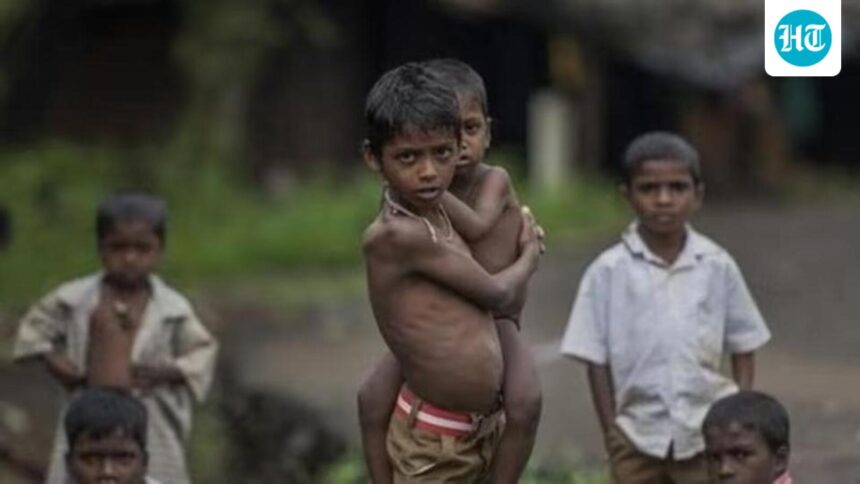
A month ago, four-month-old Priyanshi lost her life due to severe acute malnutrition at Madhya Pradesh’s Majganwa Community Health Center in Satna. A week ago, five-year-old Pawan was found suffering from severe malnutrition in Chitrakoot.

The latest results of the National Family Health Survey (NFHS-6) show that Madhya Pradesh has the highest malnutrition rates of any state in the country. Worse still, malnutrition has risen by about four percentage points in the past five years.
Madhya Pradesh now has the highest proportion of wasting (weight for height) children in India – 23.8%, compared to 18.9% in NFHS-5. In the latest survey, Maharashtra, Gujarat and Bihar were the worst performing states. All three states have improved.
In the underweight category, Madhya Pradesh came second with 39.7%, behind Jharkhand with 41.1%, registering a sharp rise of 6.7% since the last survey. National rates were 19% for wasting and 31.8% for underweight.
To be sure, Madhya Pradesh has historically had high rates of child malnutrition, and several districts were among the worst in the country.
Read also:Early childhood nutrition needs more than budget fixes
However, the state saw improvement as the percentage of children suffering from stunted growth decreased from 31.4% to 24.5%.
The survey also showed that rates of exclusive postpartum breastfeeding declined in Madhya Pradesh, mirroring the trend seen in several other states. It also found that many children aged six to 23 months who did not receive adequate nutrition died.
In 2025-26, the Madhya Pradesh government introduced the Yashoda scheme that promises mobilization of Tetra milk for school children and anganwadis. More than a year later, the scheme has yet to begin.
The Panchayat and Rural Development Department is yet to decide who will supply the milk and at what cost, a senior government official aware of the developments said.
Panchayati Raj Minister Prahlad Patel said milk has to be provided to 8 million children daily and hence, it is taking time to finalize the rollout of the scheme.
Read also:Malnutrition: The recovery rate of girls is lower than boys in the capital of Madhya Pradesh
State spending on nutrition plans remained constant at $1,500 crores in recent years.
Although the funds allocated for the Bhushan scheme decreased $1,300 crore in 2024–25 to $1,150 crore in 2026-27, the state has increased the funding for Poshan Abhiyan from $42 Crores $250 Crores.
A senior officer, who requested anonymity, said: “The budget and plans are not enough to improve the situation. It needs a strict, campaign-like approach.”
Congress MLA Umang Singhar said, “The state government is spending huge amounts on promotion and events, but has no time or money to help malnourished children.”
Women and Child Development Minister Nirmala Boria responded, insisting that the government was serious about tackling the crisis. “We are introducing district-level schemes like Moti Ai, where children are adopted by locals, to improve conditions,” she said.