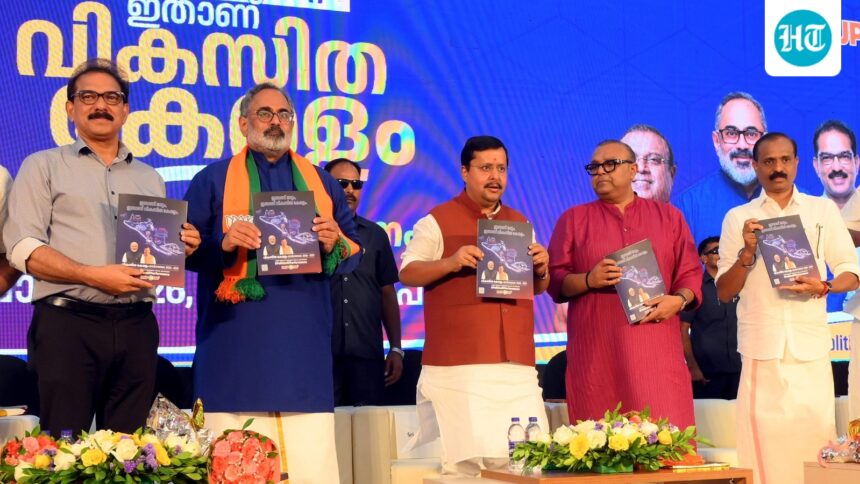
The Kerala BJP on Tuesday released its election manifesto outlining a detailed roadmap for the state’s development, economic growth for specific sectors, and welfare initiatives for women and poor families if voted to power in the upcoming Assembly elections.

The manifesto, unveiled by party national president Nitin Nabeen and party state president Rajeev Chandrasekhar, positions Kerala as a preferred global tourist destination while aiming to develop the state’s cities as niche economic hubs.
The party has promised to promote Thiruvananthapuram as an IT and innovation capital, Kochi as a shipbuilding hub of India, Kozhikode as a hub for healthcare and medical innovation, Thrissur as a cultural tourism capital, Kollam as an internationally competitive blue economic cluster that prioritizes maritime exports, and Kannur as a hub for defense innovation. The party stressed that these sectoral hubs are expected to generate great job opportunities.
On the welfare front, the BJP promised to issue Bhakshya Arogya Suraksha card to needy women, providing monthly recharge. $2,500 for medicines and groceries. The manifesto also proposes setting up an AIIMS system in Kerala, along with a high-speed rail network connecting Thiruvananthapuram to Kannur.
Other pledges include providing two free LPG cylinders annually to poor families, one during Onam and one during Christmas. Each family will also be provided with 20,000 liters of free water per month. The manifesto also addresses the management of major places of worship, including Sabarimala and Guruvayur, and promises protection through revamped Devaswom councils. Regarding the Mullaperiyar Dam, the BJP pledged to ensure water supply to Tamil Nadu while protecting the interests of Kerala.
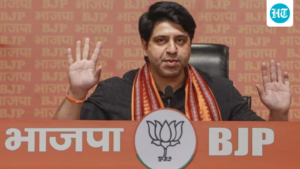
Earlier in the day, Nabin launched a sharp attack on the Left Democratic Front (LDF) and the United Democratic Front (UDF), accusing them of engaging in “game-manipulating” politics by alternately supporting and criticizing each other to stay in power.
Speaking to ANI, Nabin highlighted the growing support for the BJP in Kerala, noting that the party’s vote share had increased from 2% to 20%, reflecting its steady progress. He said that under the leadership of Prime Minister Narendra Modi, the state now aspires to transform from being a mere ‘Kerala’ to an ‘advanced Kerala’.
“This time, the BJP will make the lotus bloom in Kerala. The kind of support we are receiving from the people here – having gone from 2% of votes to 20% – shows the progress we have made. Under Narendra Modi’s leadership, what was once just ‘Kerala’ now aspires to move forward as ‘Advanced Kerala’,” Nabin said.
He further alleged that for over 70 years, Kerala politics had been dominated by a cycle of “fixing the game” between the LDF and the UDF. According to him, the two alliances alternated power by leveling accusations against each other, a pattern that the general public now clearly understands. Nabin asserted that the people of Kerala are ready to reject the “match-fixers” and put an end to this political cycle by voting them out of power.
“For too long – for the last 70 years – the policies of so-called ‘match-fixing’ have continued between the LDF and the United Democratic Front. Now, the people of Kerala will uproot this system. The public has understood these ‘match-fixers’, who alternate between power and the opposition by trading accusations against each other. The people of Kerala will now respond to this and remove the match-fixing forces from power,” Nabin said.
Polling for the 2026 Kerala Legislative Assembly elections will be held on April 9, with the counting of votes on May 4. The Assembly’s current term is scheduled to expire on May 23.
The Congress-led United Democratic Front (UDF) seeks to oust the incumbent Communist Party of India (Marxist)-led Left Democratic Front (LDF) and take control of the 140-member assembly. The LDP-led government has ruled the state for about a decade.
About 2.7 lakh crore people are expected to participate in the elections. After the Special Intensive Review (SIR) of the state’s electoral register, the final electorate list for Kerala was released on February 21. The revised list includes 2,69,53,644 voters – 1,31,26,048 male voters, 1,38,27,319 female voters, and 227 third-gender voters. Among them, 4,24,518 voters belong to the age group of 18-19 years. (that I)