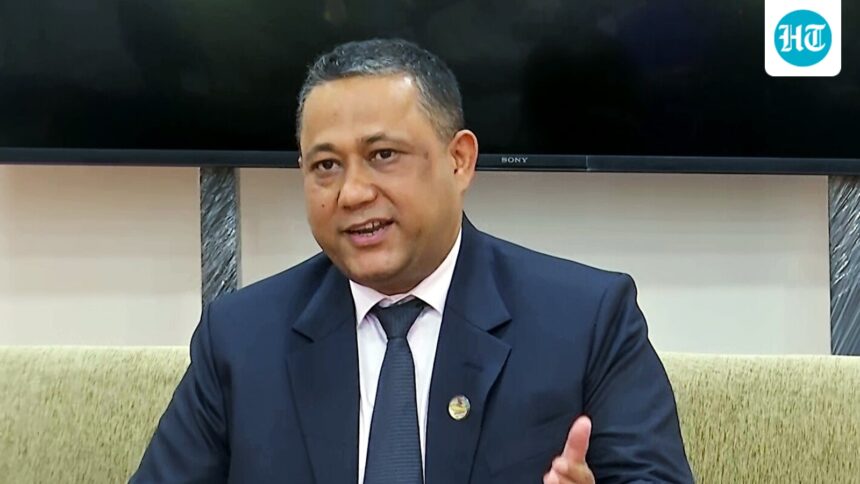
Nepalese Foreign Minister Shishir Khanal on Wednesday clarified that the border dispute between Nepal and India is a bilateral issue and the government has not sought any third party’s intervention in resolving it with India, reported the Nepal News Agency.

Addressing Parliament, Khanal stressed that Nepal remains firmly committed to the bilateral approach.
“What I would like to make clear in this esteemed council is that the Nepal-India border is a bilateral issue and Nepal is always committed to resolving this issue through diplomatic dialogue and negotiations on the basis of treaties, agreements and historical maps in accordance with the spirit and spirit of the close relationship between Nepal and India,” Khanal said.
Read Also: All about Lipulekh: The key corridor that left India and Nepal stuck in a 210-year-old dispute | He explained
This clarification comes after Nepalese Prime Minister Balin Shah sparked a political controversy with his statements in which he said that he was seeking the participation of China and the United Kingdom to address the long-standing issue. His proposals have drawn opposition from both the Indian government and internal opposition in Nepal.
Khanal added that the Prime Minister’s comments were not a call for mediation but meant that any historical reference materials from the Sugauli Treaty era could, if available, be useful as supplementary aids to the ongoing technical process.
“The issue raised by the Prime Minister in Parliament is mainly related to encroachment in Dashgaja area and ‘cross-border occupation,'” Khanal said, adding that border-related mechanisms and technical teams in Nepal and India are actively working on mapping, maintaining border pillars and collecting data on encroachment and occupation along the border. He added: “Maintaining the border posts, and collecting data about the encroachment on the Dashgaga area and the ‘cross-border occupation.’
Khanal explained that the Prime Minister’s concerns focused primarily on the practical challenges of “cross-border occupation” and encroachment within the Dashgaga (restricted zone) areas.
“The work of the technical committee, which was stalled for a long time, is currently active in the border area and joint data collection is underway. The Nepal-India Border Working Group (BWG) and other border related mechanisms are conducting mapping work on the sites of encroachment on no man’s land and cross-border occupation along the Nepal-India border. Detailed details on this will be available later.”
India’s position on the Shah’s statements
This clarification came after External Affairs Minister’s spokesperson Randhir Jaiswal asserted that there is no role for any third party in bilateral affairs between India and Nepal.
“We have seen the statements of the Prime Minister of Nepal on the Indo-Nepal border as well as the subsequent statement issued by the Ministry of Foreign Affairs of Nepal on the issue. All parties concerned should be clear that any bilateral issues between India and Nepal should be resolved between the two countries only, and there is no role for any third party in such matters,” he said.
“Nearly 98 per cent of the India-Nepal border has already been demarcated. However, some issues remain unresolved in certain parts. This situation has arisen due to changes in the course of the Gandak River.”
“In addition, there are cases of cross-border encroachment and encroachment on prohibited lands in some of the demarcated areas, which are currently being jointly mapped,” Jaiswal added.
What did Balin Shah say?
Shah said that apart from discussions with India over the border dispute over Lipulekh Pass, Nepal is in touch with China and Britain as well.
“Since this problem dates back to the time when British India left the region, we feel that England should be involved in this matter,” he said.
“You will be surprised to know a fact that I did not know until after I became prime minister. It was not only India that encroached on Nepalese territory, but Nepal also encroached on Indian territory in many places,” Shah said during his first appearance in the ongoing parliamentary session.
(With ANI inputs).