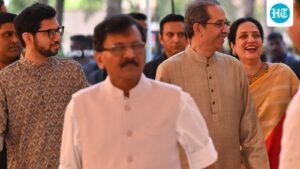
After a protest inside the Houses of Parliament when External Affairs Minister S Jaishankar spoke on Monday, Congress-led opposition lawmakers later gathered outside and raised slogans to seek a full-fledged discussion on the US-Iran conflict expanding into West Asia.
The protesting MPs carried a large banner that read, “Burning the Gulf, Oil Shock. Stranded Indians. India needs leadership – not silence.” Among the protesting MPs were Rahul Gandhi and Mallikarjun Kharge, leaders of the opposition in the Lok Sabha and Rajya Sabha, respectively.
Live updates here: Parliament proceedings today
Many held placards in Hindi and English asking for “Leadership, Not Cowardice” – echoing Congress’ allegations against Prime Minister Narendra Modi’s foreign policy choices, including a visit to Israel just before the conflict erupted when the US and Israel attacked Iran on February 28.
Congress member KC Venugopal said India has been greatly affected by the West Asia crisis, citing rising LPG prices as a direct example.
“We are demanding discussion of the crisis. We are very firm on that. India will be affected very greatly. The energy crisis is happening everywhere. Fuel prices are rising day by day. People are in distress. The government will have to come to the discussion. There are precedents in this council itself when such discussions took place,” Venugopal told reporters outside the council.
Read also | What Jaishankar said in Parliament about the West Asia crisis
Congressman Karti Chidambaram strongly criticized the actions of the United States and Israel. He said: “This unprovoked attack by the United States on a sovereign state is strongly condemnable… More importantly, innocent people are being killed. Whatever the differences, whatever the security concerns, they must be resolved through discussions, not through war.”
Congress MP Jairam Ramesh justified the opposition benches’ walkout, saying: “As expected, the External Affairs Minister made a spontaneous statement on the situation in Rajya Sabha on which no questions could be asked or clarifications sought. The entire Opposition wanted an immediate discussion on the situation in West Asia. This was rejected and hence the Opposition walked out after the protests.”
Earlier, the Lok Sabha proceedings were postponed until 3 pm amid loud protests over the demand for a debate or debate in which questions can be asked, and not a one-sided reading. However, the BJP-led NDA government accused the opposition benches of not following basic ethics of the House during Jaishankar’s speech.
The Foreign Secretary made his statement first in the Rajya Sabha, of which he is a member, and then in the Lok Sabha; He faced protests in both.
In the Lok Sabha, as soon as Jaishankar rose to make his ‘spontaneous statement’ on the topic ‘Situation in West Asia’, opposition members started raising slogans against the government and demanded a full-fledged debate instead of just a speech.
BJP MP Jagdambika Pal – who was presiding over the proceedings as speaker Om Birla chose to stay away pending the no-confidence motion against him – said the questions raised by the opposition on their banners had been “answered in detail” by the government.
He also noted that while the decision on the application against Om Birla was already on the agenda, the Opposition was pressing for a notice adjourning all other proceedings for the West Asia debate to be issued.
He wondered how the opposition wanted to discuss the two issues on the same day. “If you are not satisfied with the statement, please contact the Business Advisory Committee for a discussion on this topic,” Pal said.
After Jaishankar completed his statement, Parliamentary Affairs Minister Kiren Rijiju accused the Opposition of not following the Council’s ethics. Pal then said that the no-confidence resolution would be taken up when the House of Representatives was stable.
As the protesting MPs refused to back down – at one point they moved to the well of the house – Pal postponed the proceedings until 3pm.
Following this, the India Bloc MPs protested at Makkar Dwarar in Parliament.
Congress MP Jairam Ramesh justified the opposition benches’ walkout, saying: “As expected, the External Affairs Minister made a spontaneous statement on the situation in the Rajya Sabha where no questions could be asked or clarifications sought. The entire opposition wanted an immediate discussion on the situation in West Asia. This was rejected and hence the opposition walked out after the protests.”
“Prime Minister (Narendra Mubdi) continues to closely monitor emerging developments, and relevant ministries are coordinating to ensure effective responses,” Jaishankar said in his statement, among other things.
Jaishankar said the government had acted pre-emptively for the sake of its citizens in the region.
He added: “Our government issued a statement on February 20 in which it expressed its deep concern and urged all parties to exercise restraint. We still believe that dialogue and diplomacy should continue to calm tensions.”
Before the statement, Mallikarjun Kharge demanded a short-term debate in Rajya Sabha on India’s energy security amid the conflict in West Asia.
Referring to the rise in cooking gas prices, Karji said the conflict has affected India’s energy security and the country’s image.
“The conflict is not limited to West Asia; it has now affected India’s energy security and the country’s image. The outcome of this conflict will also affect our economic stability,” Karji said.
Ahead of Jaishankar’s scheduled statement, Congress MP Shashi Tharoor also demanded a comprehensive discussion instead.
“Oil has crossed $100 a barrel this morning. Gas has completely stopped coming out of Qatar. Gas is not reaching our plants now from this side. We can get it from the east. So we will try to get some supplies, but we are definitely suffering. Prices are rising. LPG prices rose by Rs 60 the day before yesterday. And of course, the cost of petrol will rise. So, all this will be a real problem for our country. Therefore, we need a very responsible approach and a proactive approach on the part of the government,” he said.
This development comes in the wake of the war that broke out on February 28 after joint US-Israeli strikes targeted Iran, which led to the killing of Supreme Leader Ayatollah Ali Khamenei and several key members of the ruling group. The situation has escalated since then, with new attacks reported over the weekend on oil depots and desalination plants.
Earlier today, some suspended representatives protested in front of Parliament headquarters, carrying a banner that read, “Silencing the opposition equals killing democracy.”