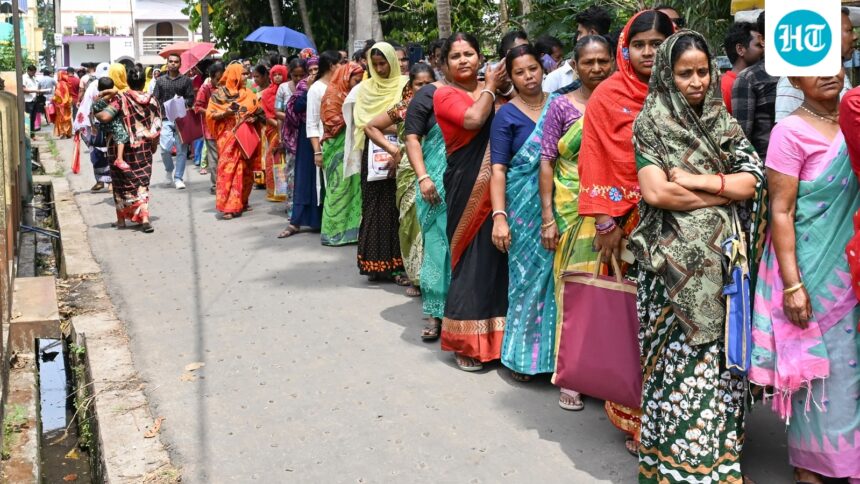
About 45% of the six million voters categorized under the controversial logical inconsistency category are likely to be deleted after adjudication, Manoj Kumar Agarwal, West Bengal’s chief electoral officer, said on Monday, hours before the lists are frozen for the first phase of Assembly elections later this month.

The 19 courts – which were set up to hear appeals from people rejected by judicial officials during the case adjudication process – are not yet fully operational. The Muslim-majority districts of Murshidabad and Malda have the largest number of voters subject to adjudication. The Supreme Court refused to set a final date for the two courts.
“The judicial officers appointed by the Calcutta High Court will dispose of all the six million cases decided by Monday night. About 45% of them are likely to be deleted,” Agarwal said in the evening.
This will delete about 2.7 million or 27 thousand names after separation.
Bengal goes to the polls in two phases – 152 seats on April 23 (as nominations and lists will close on Monday) and 142 seats on April 29 (as nominations and lists will close on April 9).
The electoral roll published on February 28 listed 70.46 million voters after the Special Intensive Review (SIR) that lasted nearly four months. At that point, 6.18 million names had been deleted.
A senior polling official said that the seats in the first phase included 3.2 million out of six million voters “for a logical contradiction.” With the closure of the lists for the first phase, approximately 45% of these 3.2 million people – approximately 1.44 million people – will not be able to vote in the Assembly elections.
This brings the total number of names removed from the rolls during SIR in Bengal to 7.62 million as of Monday.
A further 2.8 million people staying in Phase 2 seats have an extra two days before the lists close on April 9.
Agarwal explained that people who failed to pass judgments and whose appeals were pending before the court would not be able to vote this time.
“Monday was the last day for filing nominations by political party candidates. The electoral list for the first phase of the elections will be frozen at midnight. No other names can be added or deleted. Voters whose names are deleted after the matter is decided can appeal to the courts appointed by the Supreme Court. However, they will not be able to cast their votes this year as the first phase list will be frozen at midnight. If the appellate court clears their names, their names will be deleted. They will have to be registered again,” Agarwal said. Others, and they can vote in the next elections.”
During the past two weeks, the Election Commission published supplementary lists of the names of voters whose cases were decided by judicial officers. As of Monday evening, the poll committee had published 12 names. The European Commission informed the Supreme Court on Monday afternoon that the latest supplementary list would be published at midnight.
“The adjudication process at the first level is largely complete, although technical issues — particularly delays in uploading digitally signed applications — created bottlenecks in the final stages,” the same survey official mentioned above said.
“The electoral register was frozen in accordance with the legal provisions after the last date for nominations. The adjudication process was carried out in accordance with due procedures and only those cases that were decided within the specified timetable can be reflected in the final register for this stage,” the officer added.
The EC constituted 19 appellate courts across West Bengal and appointed retired judges to hear appeals against orders of judicial officials. On Monday, the West Bengal chief executive appointed IAS chief Vibhu Goel as additional chief executive, entrusting him with crucial coordination between the Election Commission of India and the judges of the appellate courts.
“The appellate courts are yet to start functioning. The Supreme Court has asked the Chief Justice of Calcutta High Court to form a team of three senior chief justices or former judges to prescribe the procedure that all the courts will mandatorily follow. A computer program will also have to be developed based on standard operating procedures. The courts are likely to start functioning soon,” another senior EC official said.
The above-mentioned official added that about four to five complaints from voters whose names were deleted after the matter was decided were heard urgently after they were referred by the Supreme Court.
Former Calcutta High Court Chief Justice TS Sivagnanam, who was heading the appellate courts, on Sunday ordered the poll panel to immediately restore the name of Mehtab Sheikh, the Congress candidate from Murshidabad, officials said. His name was removed after the ruling.