Every four years, hundreds of millions around the world gather in front of television screens to watch World Cup soccer matches. Indians are no exception. From Kerala to Nagaland and from Gujarat to West Bengal, families, friends and fans of the game come together to support their teams.
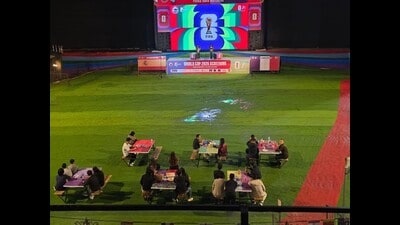
Joining this global celebration is the state of Nagaland, one of the states located in the far east of India, whose cities and towns amidst the wavy hills are decorated with the colors of the flags of the countries participating in the World Cup.
“Here in Nagaland, football is number one,” says Abu Maitha, vice president of the Athletics Federation of India and general secretary of the Nagaland Olympic Association. “Just as cricket dominates the imagination of mainland India, football is here – many miles away. During the FIFA World Cup, it did not remain just a sport…it became a way of life.”
Here, mass midnight parades have been part of the daily routine since mid-June, and heroism has become a celebration despite the stereotype of rebellion associated with the state.
Football is not only celebrated during the FIFA World Cup. It starts with village level tournaments.
“In rural villages, a simple football match between clans can attract a huge amount of support and cheers! Everyone in the village comes to watch the match and the crowd goes roaring with every goal scored. Our passion for football is that high,” says Mikivili Yashu, the state’s first national referee.
Read also: And now, for the final flourish
The Legend of Dr. T. Ao
Nagaland is home to the legendary Dr. Talimerin Ao (also known as Dr. T. Ao), who captained India’s first independent football team at the 1948 London Olympics. The women’s national championship is named after him while the inter-zonal tournament is named after him in Nagaland.
Last year, the 24th edition of the Dr T Ao Trophy Finals recorded a massive attendance of 30,000 spectators at the Indira Gandhi Stadium in the capital Kohima while nearly 200,000 viewers tuned in online, reinforcing the fact that the Naga people’s love for the beautiful game is unparalleled.
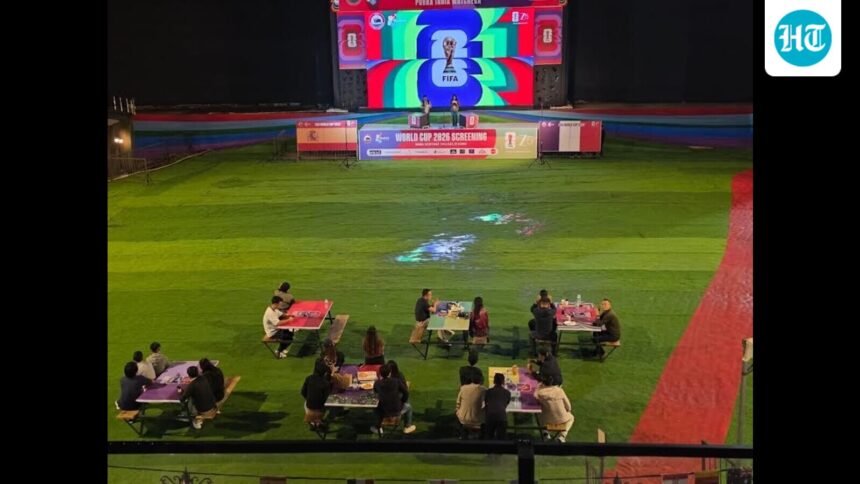
At this World Cup, in Mokokchung – the home of Dr. T. Aw, a group of seven young football enthusiasts built a 15-foot-tall FIFA World Cup replica using bamboo strips on the side of National Highway-2. The same group of young people from Ongma participate in the live broadcast on the big screen in the streets of their area.
Support Argentina
There is an intense passion for Argentina at Ongma, which was fueled by the legacy of Diego Maradona in the 1980s and, more recently, Lionel Messi.
On Thursday morning, when the final whistle blew in Atlanta, USA, for the semi-final match between Argentina and England, even the sound of rain was drowned out by Ongma’s roar of joy.
“We are having the best time,” says Okumer Jamir, an entrepreneur involved in making a 15-foot World Cup replica. “The streets of Aungma are noisy. Age was just a number this morning… Mothers in their 70s, young people, children, everyone took to the streets to celebrate. There was an explosion of fireworks. The celebrations continued for about two hours.”
In Visama, a small village about 10 km from Kohima, the football craze rises to a higher level – boosting the enthusiasm for the FIFA World Cup, the village youth organize their own mini-World Cup every four years immediately after the World Cup. This event started in 1994, when the locals were unable to overcome the final match of the FIFA World Cup between Brazil and Italy.
They decide to settle their never-ending debate by organizing their own final playoff match – by selecting the best players in the village to represent their own version of the Brazil-Italy team. Since then, this event has become a tradition that follows every World Cup.
“The Phesama Mini World Cup includes everyone from the village regardless of clans or clans. We (the youth group) currently have about 800 active members and have ordered more than a thousand T-shirts for our upcoming eighth edition,” Seyievilie Peter Zashümo, one of the organizers, told HT.
Events all over the state
In the state capital Kohima and commercial hub Dimapur, city councilors and commercial establishments also joined the World Cup fever by organizing mass parade parties, attracting huge crowds.
Residents of the Akamine district of Mokokchung have developed a tradition of flying the country’s flags along footpaths and roadsides during major international football tournaments including the FIFA World Cup, the UEFA European Football Championship and the Copa America.
One unique aspect of the initiative is that most of the flags are handmade: residents buy colorful fabric, mothers help sew colorful clothes together, and youth draw patriotic slogans and designs.
Overall, the 2026 FIFA World Cup has not only awakened the passion for football in Nagaland but also enhanced people’s love for the game and the thrill that every match brings to them.
“Victories by Argentina, Portugal and other favorite teams spark spontaneous car processions, celebrations and enough honking to make you think the trophy has arrived in Nagaland itself,” Mitha said.
Mitha added: “This is the magic of football. It unites people across tribes, generations and communities. For a few precious weeks, it provides a pleasant escape from the pressures and realities of everyday life and reminds us that happiness can be so simple. Of course, football also teaches us one of life’s greatest lessons – you win some, you lose others. Every World Cup creates heroes, sadness, unforgettable memories and endless discussions that will last for another four years.”
On a more reality-touching note, Chinunlo Arun Watch of the Nagaland Football Association said the love for the beautiful game among Nagalanders is undoubted, but he feels there is a need to develop a football culture that extends beyond tournaments and hype.
He added: “If our passion for the beautiful game and our connection with the World Cup, the popular teams for which we are willing to lose our sleep, and the European clubs for which we fight tooth and nail, are directed towards building the local football culture and ecosystem, only then can our football grow.”