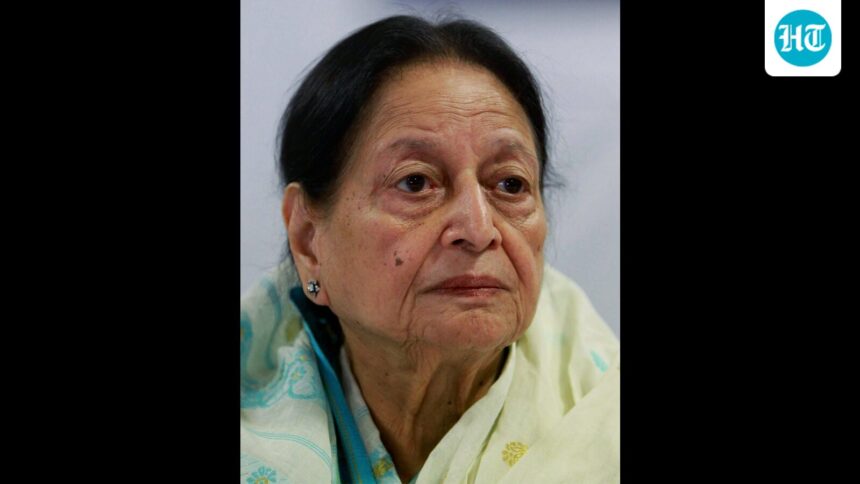
Nine days after Raj Kumar Hirani’s “Lage Raho Munnabhai” hit theaters, the Congress Working Committee met in New Delhi on September 10 to plan the centenary commemoration of Mahatma Gandhi’s “Satyagraha” in South Africa. When it was her turn to speak, Mohsina Kidwai brought up the film — an unusual reference at a CWC meeting — and asked her colleagues to learn from it about how to get Gandhi’s message to a new generation.

Born in 1932 to an aristocratic family in the Banda district of Uttar Pradesh, Kidwai was a staunch loyalist of the Nehru-Gandhi family, especially Indira Gandhi. However, the platform for her entry into politics was laid in 1954 when 22-year-old Mohsina met Jawaharlal Nehru along with her father-in-law Jamilur Rahman Kidwai, one of the most powerful Congress members in UP. Mohsana had mentioned in her autobiography that Nehru asked Jameel: When did you introduce her to politics?
She became the Minister of State for Food in the UP government in 1973. But her biggest impact came five years later, when she won the Azamgarh bypoll in 1978 – a year after defeating the Congress in the Lok Sabha polls. Kidwai’s victory marked a decisive turnaround for the beleaguered Congress in the post-Emergency era. It was also a reminder that the Congress under Indira Gandhi was in decline but not out. Two years later, the feuding faction in the Janata government collapsed, and Gandhi returned to the Southern Bloc as Prime Minister.
The highlights of her election were captured in a photo: Kidwai pushing a hand pump in a village, while Indira, who campaigned for Kidwai for five days, quenched her thirst. For party veterans, the photo also showed the deep relationship between the two leaders.
Her brief biography in the Lok Sabha portal showed an interesting side of Kidwai: her focus on upliftment of Dalits and marginalized communities – a vote bank that later sided with regional outfits in the post-Mandal era and decimated the Congress party’s strongholds in north India. Kidwai was a Harijan and Social Welfare Minister (1974-75), whose social activities were “the upliftment of women and children, including Harijans and the betterment of the downtrodden sections of society”.
In her long political career, she held several ministerial posts in UP and later became a Union Minister in the governments of Indira and Rajiv Gandhi. The three-time Lok Sabha MP held the portfolios of labour, health and rural development. When the United Progressive Alliance came to power in 2004, Kidwai, a Gandhi loyalist, did not find a place in the cabinet as a group of younger leaders stepped forward, signaling a generational shift in the Congress party. Although she was not outright in the opposition, she did support Shashi Tharoor in the 2022 Congress presidential elections, perhaps in silent protest against the organization she had been a part of for decades. With her death, the Congress party and the country lost another leader of the fading generation and an important member of the old school of Indian politics.
Political analyst KV Prasad remembers her as a good orator, exuding old-world charm, grace and dignity. Another senior analyst, Javed Ansari, said: “She has been a voice of reason and reason. She has been unwell for the last two years. Whenever we meet, I see in her an old pro-Congress woman. “I have lived a long life,” she said. “And before I close my eyes, my party must regain its standing.”