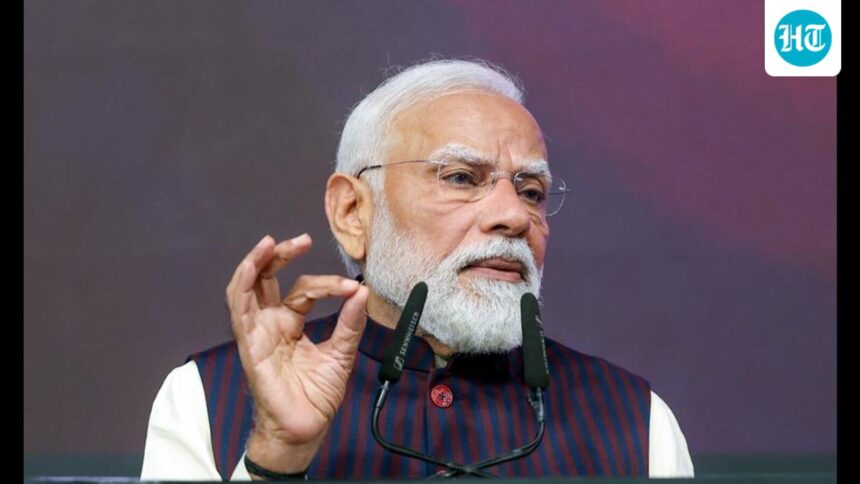
Prime Minister Narendra Modi on Friday inaugurated US company Micron’s semiconductor assembly, testing and packaging (ATMP) facility in Sanand, Gujarat, saying it marked India’s decisive entry into the global semiconductor manufacturing chain.

This development reflects India’s transition from a software-focused economy to one that is consolidating its hardware base, he said. “After the largest and most successful artificial intelligence summit in the world [this month]We are witnessing another historical milestone. While the AI Summit introduced the world to India’s AI prowess, today’s event is a testament to India’s commitment to technological leadership.
Modi referred to semiconductor manufacturing and said the country known for software is now working on strengthening its identity in the hardware space. “At Sanand, we are witnessing the emergence of a new future. The start of commercial production at Micron’s ATMP facility will strengthen India’s role in the global technology value chain,” he said.
Modi said that this century is the century of artificial intelligence, and semiconductor technology is the bridge in this transformation. “There is a microchip that connects the industrial revolution and the artificial intelligence revolution. If oil shaped the last century, microchips will shape this century.”
Modi said the Sanand facility is a testimony to the strong partnership between India and the United States, especially in the field of artificial intelligence and chip technology. He said that the two largest democracies in the world, India and the United States, were working to secure the global supply chain. Modi said the PAX Silica Agreement signed during the AI Summit was a major effort to make the supply chain of critical minerals more reliable.
Modi said that commercial production began at the Sanand facility about three years after laying the foundation stone. “In February 2024, installation of machines began at the pilot facility,” he said. “Those who understand this sector know what this speed means. In developed countries, advanced pricing agreements can take three to five years to complete. India has cleared them in a few months,” he said.
Modi said India announced its semiconductor mission during the Covid pandemic. “Under the Semicon India programme, 10 projects have been approved so far. Apart from Micron, three more projects are expected to start production soon.”
Describing the Sanand facility as India’s first major semiconductor assembly and testing plant, Gaur said the $2.75 billion investment represented much more than just a new factory. “It represents the future of American technology leadership, the strength of the US-India partnership, and our shared commitment to building resilient supply chains that serve our two countries and the world,” he said.
He added that semiconductors are the foundation of modern technology and building resilient supply chains requires reliable semiconductor ecosystems across multiple locations. “Today marks India’s entry into the global semiconductor supply chain as a manufacturing nation,” he said. He noted that 10 semiconductor projects worth $19 billion are being implemented across the country.
Under the leadership of President Donald Trump, the United States was securing its place at the forefront of the global semiconductor industry, Gore said. He pointed to the $100 billion MegaFab project in Clay, New York, which he said was the largest semiconductor manufacturing project in U.S. history and demonstrated a commitment to manufacturing advanced chips at home while building trusted partnerships abroad.
“But American leadership is not about doing this alone,” Gore said. “It is about working with our partners who share common goals and our vision for a secure and prosperous future.”
“Prosperity does not come automatically. It is the result of trust, leadership and friendship. And I can tell everyone in this room that our President has a dear friendship with your Prime Minister. This is something that has continued for many years in the past, and it is something we will continue over the next three years of the Trump administration in Washington.”
Gore referred to the meeting held between Modi and Trump in Washington last February, and said that the two leaders launched the joint agreement between the United States and India (stimulating military partnership opportunities and accelerating trade and technology). He said that the Trust (Transforming the Relationship with Strategic Technology) initiative, which focuses on strategic technologies, is at the heart of this framework.
“Semiconductors are the foundation of modern technology, powering everything from smartphones to defense systems, from artificial intelligence to autonomous vehicles,” he said. “Creating resilient supply chains for these critical components requires building semiconductor ecosystems in multiple, trusted locations.”
ATMP’s facility in Sanand will manufacture integrated circuit packages, modules and solid-state drives for the global market. It will receive advanced DRAM and NAND chips from Micron’s global factories and turn them into finished memory products to support the growing demand for memory and storage solutions in the AI sector.
About 2,000 people work at the site. The project is expected to generate about 5,000 direct jobs once it is fully expanded.
Mehrotra described the project as a milestone for India’s semiconductor ecosystem. “This pioneering facility, the first assembly and testing site of its kind in the country, helps build a resilient ecosystem that supports the global AI economy. We are extremely grateful to the Government of India, the Government of Gujarat, and all partners involved for their unwavering support in making this achievement possible,” he said.
The company said in its statement that it provided the first shipment of made-in-India memory modules to Dell Technologies for made-in-India laptops for the local market on the occasion of the opening of the facility. She added that Micron expects to assemble and test tens of millions of chips in Sanand in 2026, increasing to hundreds of millions in 2027.