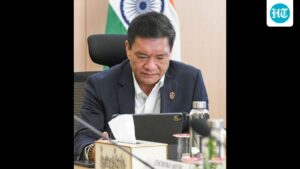
Aizawl, Amid intense debate on social media, Mizoram Chief Minister Laldahoma said the recent amendments to the Mizo Marriage and Property Succession Act were not a unilateral government initiative but built on consensus among key stakeholders.

The Mizo Marriage and Property Inheritance Bill, tabled by Laldouma, who also holds the law portfolio, was approved by the assembly earlier this month.
The new legislation codifies customary law and reinforces the 2014 Master Act, introducing changes relating to polygamy, inter-communal marriage and women’s property rights.
While the bill introduces a historic ban on polygamy and gives women rights to 50 per cent of marital property, it has sparked a heated debate over the interpretation of a provision by the prime minister that potentially strips Mizo women of their Mizo identity and Scheduled Tribe status if they marry non-Mizo men.
Mizoram’s largest women’s organisation, Mizo Hmeichhe Insuihkhawm Pawl, on Friday urged the state government to withdraw the bill, calling it potentially “unsafe” for Mizo women.
Responding to the criticism, Laldhuma said the bill was based on the recommendations of the Mizo Customary Law Review Committee, which includes representatives of 10 organisations, including MHIP, the Central Young Mizo Association, and experts from Mizoram University and the state law college.
Speaking during a debate on a member’s resolution in the Assembly on Friday, the Prime Minister said the previous Mizo Marriage, Divorce and Inheritance Act, 2014, stipulated that if a Mizo woman marries someone from another community, she is considered to have “entered” her husband’s family, effectively separating her from Mizo customary rights.
Thus, in the recently amended law, according to Ladohoma, they usually considered that if a Mizo woman marries a non-tribal man, she immediately loses her tribal status and her children will also not be able to obtain a tribal certificate.
“Our customary law does not clearly explain the status or status of Mizo women who marry outside the community, it simply rejects them. It is worth considering whether the time has come to review these points. Moreover, our customary law is completely silent on the status of their children who are brought up strictly according to Mizo culture and tradition,” the Prime Minister said.
Referring to a May 1977 circular issued by the Ministry of Home Affairs to Chief Secretaries of State on children born out of inter-caste or inter-tribal marriage, Laldhuma said a tribal certificate could be issued if the child was brought up as tribal by the mother and faced similar deprivation as the community before him.
However, he noted that the circular stipulates that such issues should be decided on an objective basis and not treated as a general rule.
He said that in October 2019, the Ministry of Social Justice and Empowerment issued another circular regarding the status of children of divorced women with the same standards as the Ministry of Interior.
The Prime Minister said the Supreme Court’s ruling last November was specific to the individual petitioner and not a blanket ruling applicable to all Scheduled Castes or Scheduled Tribes.
Noting that inter-community marriages are inevitable in today’s “global village”, Laldahoma urged people to move away from the “isolationist mentality”.
He urged the audience to move away from the “isolationist mentality”, noting that he personally knows many Mizo women married to non-Mizo people living abroad or elsewhere in India who are highly respected and continue to support Mizo communities.
Recognizing the complexity of the issue, Lalduhoma also proposed setting up a committee to look deeper into the complex situation of Mizo women who marry outside their community and their children.
This article was generated from an automated news feed without any modifications to the text.