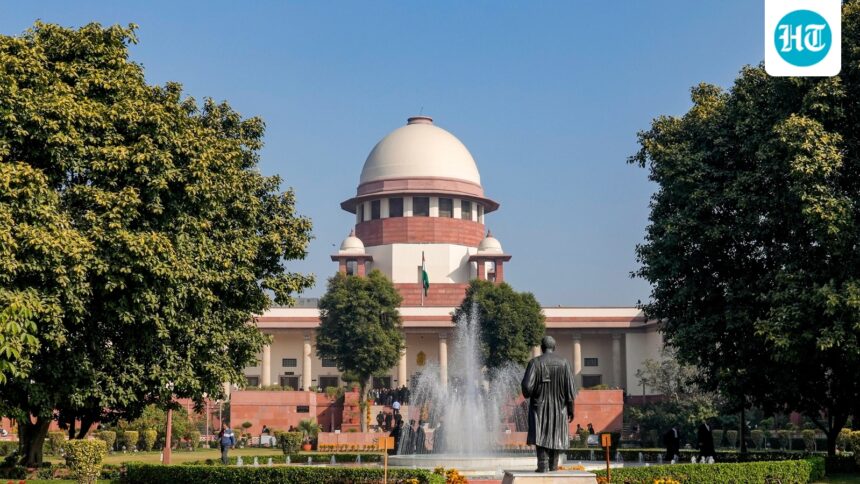
The Supreme Court on Friday said that the law mandating menstrual leave may not be in the best interest of women, leaving the government to debate the issue while refusing to entertain a public interest litigation (PIL) in this regard.

Citing the “practical realities” that women might face in the labor market if the court makes such leave mandatory, a bench headed by Chief Justice of India Surya Kant said: “You don’t know what kind of mentality this could create in the workplace and the labor market. The moment you bring a law, you can’t imagine the long-term problem they might face.”
The court was hearing a PIL filed by advocate Shailendra Mani Tripathi, who said there is no uniform policy across the country on the matter, as some institutions and companies provide menstrual leave as a matter of policy, and others do not.
Senior advocate Mr Shamshad, appearing for the petition, said Odisha and Karnataka have come up with a menstrual leave policy while Kerala allows menstrual leave for students in state universities, allowing them up to 60 days in a year. Odisha and Karnataka each provide 12 paid leaves per year to women working in the government sector, and Karnataka’s policy extends to the private sector as well.
“If it is voluntary, that is good. We agree with you that affirmative action should be recognised. But we have to look at the practical reality in the labor market,” the court, which also includes Justice Joymalia Bagchi, said.
“From a business point of view, would an employer be willing to allow anyone to take leave for two or three days every month? In the judiciary also, they may not be assigned cases that require a long trial,” the court said.
Shamshad said that the petitioner had approached the court on previous occasions as well. In his first petition decided on February 24, 2023, the Supreme Court allowed him to transfer representation to the Union government. He complied with this order and approached the court again a year later, this time seeking a model policy on menstrual leave. The court also decided this on July 8, 2024 with a direction issued to the Union Ministry of Women and Child Development to hold consultations with all stakeholders, both at the Union and State levels, and consider formulating a model policy for all.
The council said it wonders what prevents the government from “coming out with a political framework.” “It is not necessary for the petitioner to approach the court again and again. We have no doubt that the competent authority will seriously consider our orders of February 24, 2023 and July 8, 2024 on formulating a model policy for consideration by all stakeholders,” the bench said, while hearing Tripathi’s petition for the third time.